Choose roof repair when an inspection confirms a limited problem and a serviceable surrounding roof; choose replacement when the roof’s overall condition calls for a new system. For Lincoln and Omaha property owners planning work in 2026, the next step is a documented inspection—not a decision based on the size of a ceiling stain.
- Murray Roofing provides roof repair, replacement, and inspections for homeowners and commercial property owners in Lincoln and Omaha.
- Choose repair for a documented, localized defect when the surrounding roof remains serviceable.
- Choose replacement when an inspection identifies broader deterioration that isolated repairs will not address.
- Compare written scopes, warranty terms, and payment obligations before signing a roofing contract.
Why this matters
A roof leak tells you water entered the building. It does not tell you whether the right answer is a flashing repair, a larger restoration project, or full replacement. That distinction matters because you need work that addresses the cause, not just the visible symptom.
Murray Roofing’s roofing services include residential and commercial repair, replacement, inspections, and maintenance. Start with the condition of your roof, then select the scope of work. A replacement proposal should explain why repair is insufficient; a repair proposal should explain what remains outside its scope.
For your 2026 roofing decision, insist on photographs, plain-language findings, and a written recommendation. Those records give you something concrete to evaluate before committing to construction.
At a glance: repair versus replacement
Neither option wins every project. Repair preserves a serviceable roof by addressing a specific defect, while replacement addresses the roof more broadly and requires a larger construction scope.
| Decision factor | Roof repair | Roof replacement |
|---|---|---|
| Best for | A localized defect with serviceable surrounding roofing | Widespread deterioration or a roof that no longer supports an effective repair |
| Main benefit | Limits work to the identified problem | Addresses the roof as a coordinated system |
| Main limitation | Leaves existing roofing and its remaining limitations in place | Requires broader removal, installation, and site planning |
| Inspection question | Can the cause be isolated and corrected? | What conditions justify replacing the existing roof? |
| Building disruption | Focuses activity on the repair area | Requires planning across the replacement area |
| Warranty review | Confirm coverage for the specific repair | Review material and workmanship coverage separately |
| Payment decision | Evaluate the complete repair scope | Evaluate the complete replacement scope and financing terms |
| Follow-up | Monitor the repaired area and remaining roof | Keep installation records and warranty documents |
Use this table to organize questions, not diagnose your roof from the ground. The inspection must establish which column fits the building.
Repair wins when the problem is genuinely localized
A roof repair is appropriate when the contractor can identify the defect, explain the correction, and confirm that the surrounding roofing can support that work. Examples include problems around roof penetrations, damaged flashing, or a limited area of damaged roofing. The specific remedy depends on the material and observed condition.
Ask the contractor to show you where water enters and how the proposed work addresses that entry point. An interior stain alone does not establish the source because water can travel before becoming visible inside.
A useful repair proposal answers these questions:
- What defect was observed, and where is it located?
- What materials will be removed or repaired?
- How will the repaired area connect with the existing roof?
- What conditions remain outside the repair scope?
- What follow-up is recommended if leaking continues?
Repair has a clear limitation: it does not renew the rest of the roof. If you select a targeted repair, keep the inspection photographs and written explanation so you understand what was corrected and what still needs monitoring.
Replacement wins when isolated repairs leave the main problem intact
Choose replacement when documented roof conditions make a localized repair an incomplete answer. The recommendation should identify the affected areas and explain why keeping the existing roof is unsuitable for the proposed solution.
Replacement deserves consideration when deterioration extends beyond a single defect, previous repairs have not addressed the underlying problem, or inspection findings show that substantial portions of the roof require work. None of those conditions should be assumed from the roof’s age alone.
For a Lincoln or Omaha roof replacement in 2026, ask for a scope that addresses:
- Removal of existing roofing and handling of debris.
- Evaluation of the underlying roof deck after exposure.
- Treatment of flashing, penetrations, and roof edges.
- Ventilation details where applicable to the roof assembly.
- Protection of entrances, landscaping, equipment, and neighboring areas.
- Cleanup, final review, and delivery of warranty documents.
Replacement also has a tradeoff. A broader project requires more decisions about access, materials, payment, and building use. A thorough proposal makes those decisions visible before work begins rather than leaving them for the installation crew to resolve.
Both options need an inspection that explains the cause
A useful inspection separates observations from recommendations. You should be able to tell what the contractor actually saw, what remains concealed, and why the proposed scope follows from those findings.
Murray Roofing offers free inspections for residential and commercial roofing needs. Use the inspection to establish the problem before discussing financing or selecting a replacement system. An inspection is the starting point for a recommendation, not a guarantee that every concealed condition is already known.
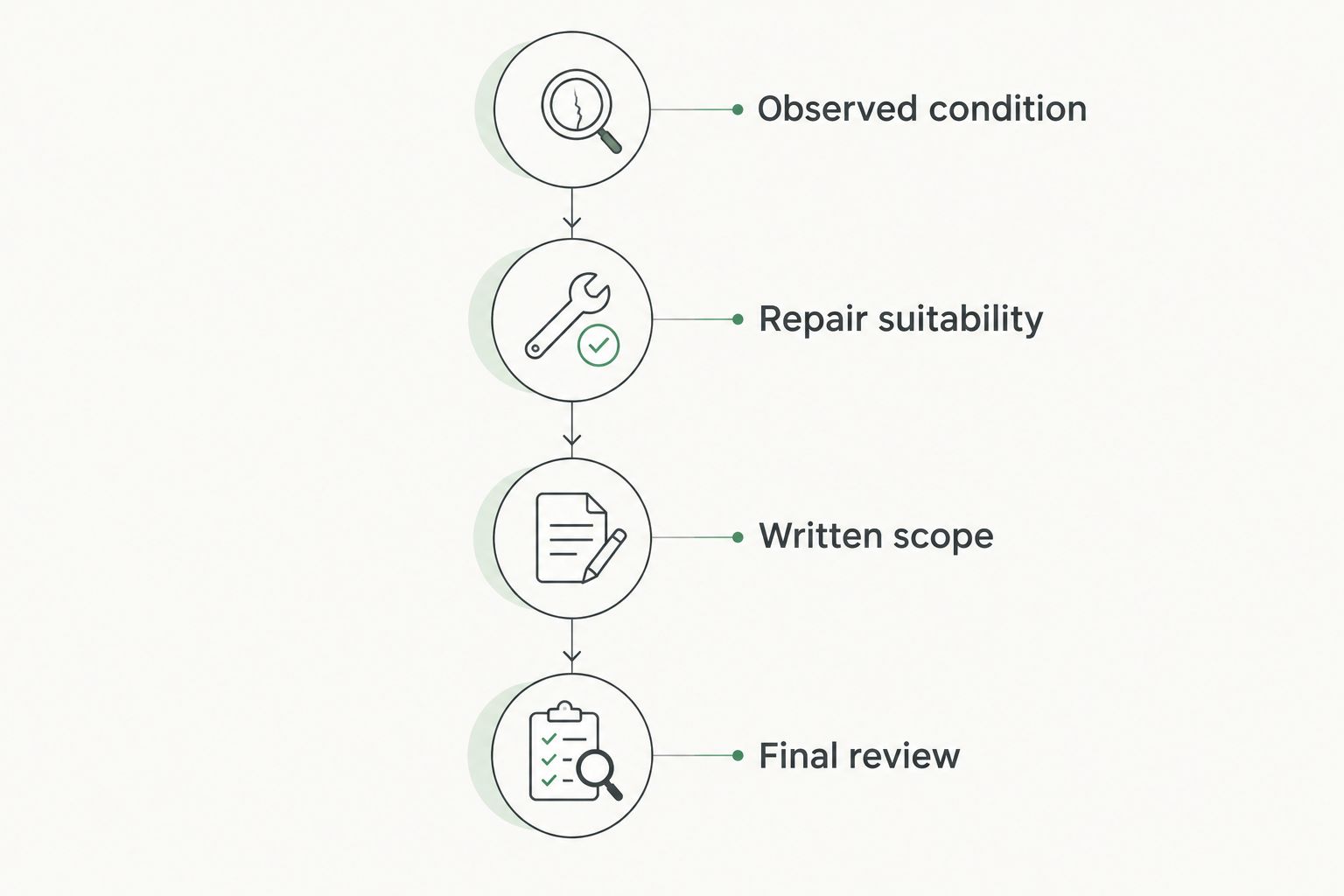
Organize the discussion around these stages:
- Observed condition: Review photographs and the locations of visible defects.
- Repair suitability: Ask whether the surrounding roof can support a lasting correction.
- Written scope: Obtain the recommended work, exclusions, and process for unexpected findings.
- Final review: Confirm what records and warranty documents you receive after completion.
Keep your inspection discussion focused on evidence. If a recommendation is unclear, ask the contractor to identify the relevant photograph and explain the consequence of leaving that condition unaddressed.
Commercial properties need an operating plan, not just a roof scope
Commercial roofing decisions affect more than the roof surface. Your contractor needs to understand how the building operates so the proposed work accounts for access, occupants, deliveries, and equipment.
The same planning standard applies to offices, restaurants, warehouses, retail properties, schools, churches, and multifamily buildings. No property type should receive a less explicit scope because its roof appears straightforward.
Before approving commercial roofing work, identify:
- Building access: Entrances, loading areas, parking, and routes that must remain usable.
- Occupied areas: Spaces where noise, debris, or interior protection needs special planning.
- Roof equipment: Mechanical equipment and penetrations requiring coordination.
- Drainage: Existing drainage conditions that belong in the inspection discussion.
- Decision authority: Who approves scope changes and receives progress updates.
For commercial projects planned in 2026, put these requirements in writing before signing. Do not assume that a proposal includes equipment relocation, interior work, or changes to drainage unless those items appear in its scope.
A repair and a replacement both need this coordination. The difference is the extent of the work—not whether the contractor should account for building operations.
Compare written scopes before comparing payment options
A roofing quote is only useful when you understand what it includes. A shorter document is not necessarily a simpler project, and a larger scope is not automatically the right recommendation.
When finding roof replacement quotes, consistency matters: each contractor needs the same description of the building, observed problems, and requested work. The process of finding roof replacement quotes should leave you comparing defined work rather than trying to reconcile unrelated proposals.
Create a side-by-side worksheet with these headings:
- Included work: Materials, removal, installation, protection, and cleanup.
- Excluded work: Items the contractor has specifically left out.
- Concealed conditions: How additional deck damage or other unexpected findings will be documented and approved.
- Warranty documents: The coverage attached to the proposed work.
- Payment obligations: When payments become due and what triggers each obligation.
Request clarification wherever proposals differ. If one scope includes replacement of a component and another leaves it in place, ask why. That explanation is more useful than assuming the difference represents either unnecessary work or a bargain.
Financing changes how you pay, not what the roof needs
Murray Roofing offers financing for roofing projects. Choose the appropriate repair or replacement scope first, then evaluate the payment arrangement. Financing should support an informed construction decision rather than substitute for one.
Before accepting a financing offer, review the repayment period, interest terms, fees, payment obligations, and any conditions attached to the offer. Confirm who provides the financing and which documents govern the agreement.
For your 2026 project, distinguish between the roofing contract and the financing agreement. Ask how payments relate to project milestones and what happens if the scope changes after concealed conditions become visible.
Do not assume that a monthly payment tells you the full financial commitment. Read the agreement and ask for an explanation of any term you cannot clearly describe in your own words. Approval and applicable terms must be confirmed for your situation.
Warranty terms matter more than the headline duration
Murray Roofing identifies a 50-year Golden Pledge warranty and a 10-year labor warranty among its roofing offerings. Confirm which warranty applies to your proposed project, what it covers, and what requirements govern that coverage.
A warranty duration does not mean every roof problem receives identical treatment throughout that period. Material coverage and workmanship coverage address different responsibilities, and the written documents control the details.
Before signing, ask:
- Which warranty is included in this specific proposal?
- Who is responsible for each type of covered issue?
- What exclusions and maintenance requirements apply?
- Is registration required, and who completes it?
- What documents should the property owner retain?
- What happens to coverage if ownership changes?
A repair warranty also needs a defined scope. Confirm whether it applies only to the repaired area and how a later leak outside that area would be handled. Get the applicable warranty in writing rather than relying on a verbal summary.
Insurance support does not guarantee claim approval
Roof condition, recommended construction work, and insurance coverage are separate questions. A contractor can document observed damage and explain a repair or replacement recommendation; the insurer determines coverage under the policy.
If you suspect storm damage, preserve relevant photographs, inspection findings, and correspondence. Ask your insurer about reporting requirements and the claim process rather than assuming a contractor’s recommendation guarantees payment.
Insurance-claim support is part of the services Murray Roofing provides. That support does not remove your responsibility to understand the policy, deductible, exclusions, or any obligations in the construction contract.
Before authorizing work, clarify which decisions depend on the insurance process and which remain your responsibility. Avoid signing a document you do not understand simply because a storm recently occurred.
FAQ
Should I repair my roof or replace it in Lincoln or Omaha?
Choose repair when an inspection confirms a localized defect and serviceable surrounding roofing; choose replacement when the documented condition requires broader work. Ask for photographs and a written explanation of the recommendation.
Does a small ceiling stain mean I only need a small roof repair?
No, the size of a ceiling stain does not establish the extent or source of a roof problem. Water can travel before it becomes visible, so an inspection should identify the entry point and affected roofing.
Does Murray Roofing offer free roof inspections?
Yes, Murray Roofing offers free inspections. Use the inspection to review observed conditions, discuss repair versus replacement, and request a written scope.
Can I finance a roof replacement?
Financing is available through Murray Roofing, with approval and applicable terms requiring confirmation for your situation. Review the financing agreement separately from the roofing contract.
Does every replacement include the same roof warranty?
Do not assume every replacement carries identical coverage. Confirm the warranty included in your proposal, its requirements, exclusions, and the documents you will receive.
Will insurance pay for a damaged roof?
Your insurer determines coverage under your policy. Inspection findings and contractor documentation support the evaluation, but they do not guarantee claim approval.
What should a commercial property owner ask before roofing work starts?
Ask for a written roof scope and a plan addressing building access, occupants, equipment, drainage, and change approvals. Confirm who coordinates the work and who can authorize additional items.
One last thing
The most revealing question is: “What does this proposal leave unresolved?” A repair can be appropriate while leaving an aging roof in service. A replacement can address the roofing while excluding interior damage or unrelated building work.
Knowing those boundaries helps you approve the right project without mistaking a defined scope for an unlimited promise. For a Lincoln or Omaha roofing project, schedule an inspection and request a written recommendation and project-specific quote.
Related guides
- Is it cheaper to repair a roof or replace it completely?
- From roof inspection to signed contract
- Commercial roof warranty types for property owners