For homeowners and property managers researching buildzoom alternatives in 2026, contacting a roofing contractor directly is a practical next step when you need an inspection rather than more search results. Murray Roofing is a direct roofing-service option for Lincoln and Omaha owners who need roof inspections, repairs, or replacement.
- Researching buildzoom alternatives? Start with a roof inspection and a written scope, not a directory ranking.
- Murray Roofing provides residential and commercial roofing services in Lincoln and Omaha.
- Compare repair and replacement recommendations against documented roof conditions.
- Ask for separate material-warranty, labor-warranty, and financing documents before signing.
Why this matters
Finding a roofer and choosing a roof project are different decisions. A search result helps you identify a company; an inspection and written proposal help you decide what work your building needs.
For Lincoln and Omaha property owners, the useful next step is to connect the roof's condition with a defined repair or replacement scope. Murray Roofing provides residential and commercial inspections, repair, replacement, maintenance, insurance-claim support, and financing.
This 2026 guide focuses on that hiring decision: how to move beyond browsing, compare recommendations fairly, and identify the documents you need before authorizing work. The goal is not to collect the longest contractor list. It is to choose a contractor whose proposed work you understand.
Start with the decision your roof actually needs
Before requesting proposals, describe the problem rather than prescribing the solution. A ceiling stain, missing shingles, recurring leak, or concern about an aging roof gives the contractor a starting point; none establishes the full scope by itself.
For a commercial building, include where the issue appears and which occupied areas it affects. For a home, explain any previous repairs and whether the same problem has returned. Share existing photographs and records without climbing onto the roof yourself.
Roofing choices at a glance
| Option | Best for | Main benefit | Main limitation | What to request |
|---|---|---|---|---|
| Roof inspection | Owners who do not yet know the cause or extent of a problem | Establishes findings before selecting work | Does not itself complete repairs | Photos, findings, and recommended next steps |
| Targeted repair | A defined defect that a contractor determines is repairable | Addresses a specific problem without a full replacement scope | Does not renew the rest of the roof | Repair boundaries, materials, and exclusions |
| Full replacement | A roof whose documented condition supports replacement | Addresses the roof through a coordinated replacement project | Requires broader planning and disruption than a localized repair | Removal, installation, protection, and warranty details |
| Planned maintenance | Owners managing an existing roof over time | Creates a process for identifying and addressing maintenance needs | Is not a substitute for necessary replacement | Inspection tasks, service scope, and reporting |
Choose the work from the findings—not from the name of the service you initially searched for. A useful contractor explains why the recommendation fits your roof and what it leaves unresolved.
Practical ways to find a roofing contractor
You do not need a ranked platform list to build a useful shortlist. Direct contact, referrals, and existing property records each provide a different starting point, but none replaces checking the proposed work.
Contact a roofing contractor directly
Best for: Owners ready to discuss a specific residential or commercial roof.
Direct contact lets you describe the building and ask about the inspection process. Review the contractor's roofing services before requesting work so your inquiry matches the service you need.
- Benefit: You can discuss the project directly with a potential service provider.
- Limitation: One contractor's recommendation is not an independent comparison of every available option.
- Next move: Ask for findings and a written proposal before making a commitment.
Ask for a relevant local referral
Best for: Owners who want a starting point based on a completed project.
Ask a neighbor, colleague, or property contact about roofing work similar to yours. A recommendation about a residential shingle replacement does not answer every question about a commercial low-slope roof.
- Benefit: You can ask about communication, cleanup, and how concerns were handled.
- Limitation: Someone else's project does not establish the right scope for your building.
- Next move: Verify the contractor and evaluate a proposal for your own roof.
Review existing roof records
Best for: Owners with maintenance files, previous invoices, or warranty paperwork.
Existing records can help explain previous work and identify questions for an inspection. Treat those records as background rather than proof that the current roof needs the same solution again.
- Benefit: Prior documents give the next contractor useful project history.
- Limitation: Older paperwork does not describe every current condition.
- Next move: Share the records and request a current assessment.
Use a simple inspection-to-contract process
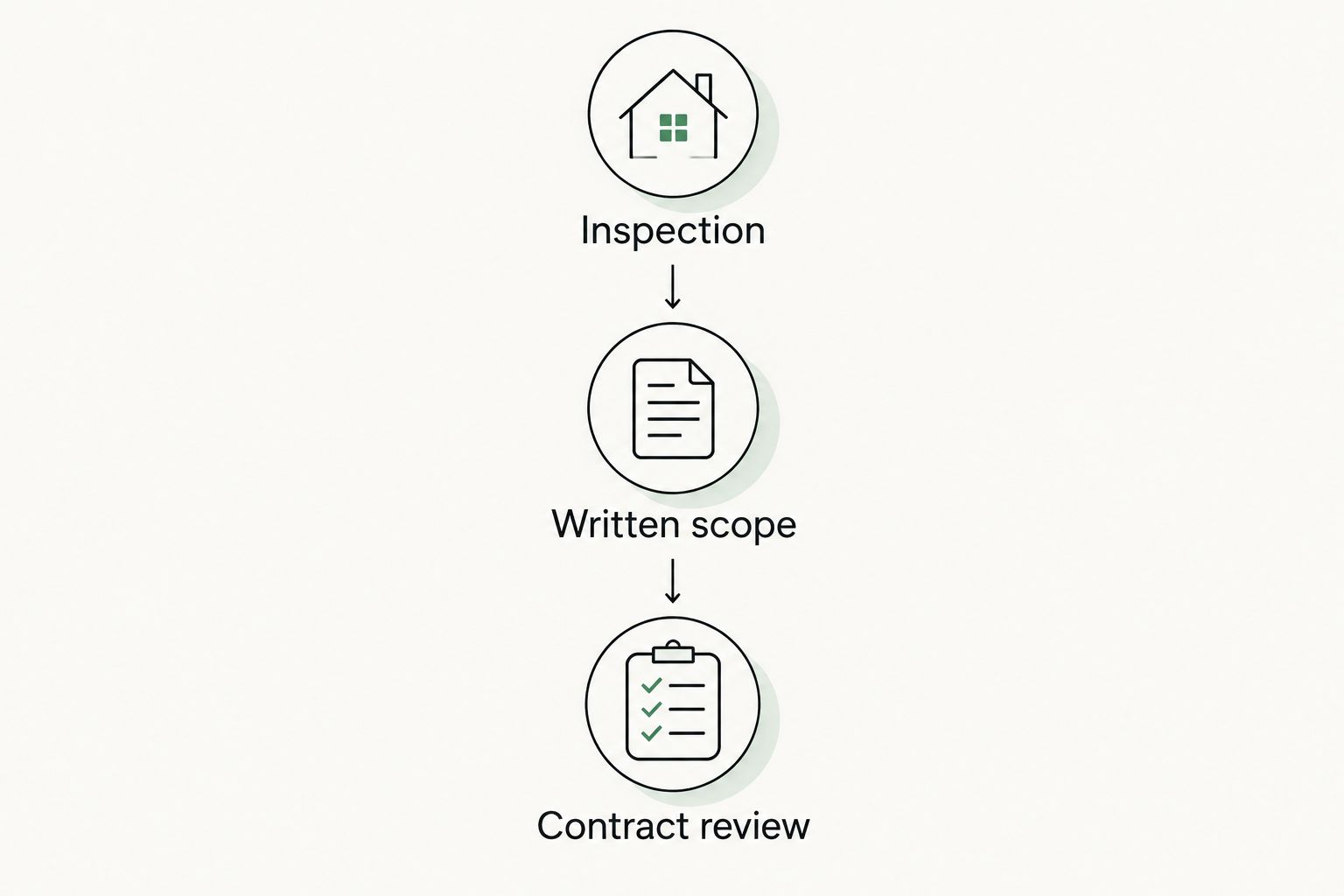
A clear sequence keeps the search from turning into disconnected conversations. For a 2026 roofing project, organize the decision around these stages: Inspection, Written scope, Contract review.
Inspection
Ask the contractor to explain what was observed, where the problem is located, and how the findings support the recommendation. Request photographs where useful, especially when you cannot safely view the area yourself.
For a recurring leak, provide previous repair records and describe when you noticed the problem. Ask whether the proposed work addresses the identified cause or only a visible symptom. Keep that distinction in the written record.
Written scope
The scope should explain what the contractor intends to remove, repair, install, protect, and clean up. It should also identify exclusions and explain how additional work will be proposed if concealed conditions are discovered.
Ask for material descriptions that you can compare across proposals. A short document that says only “replace roof” leaves important questions unanswered about the actual work.
Contract review
Read the final agreement against the proposal you selected. Confirm the contractor's identity, project address, scope, payment terms, warranty documents, and process for approving changes.
Do not rely on a conversation to resolve an omission. Ask for the agreement to reflect the understanding before you sign, particularly when an exclusion could affect the finished project.
Compare written scopes before choosing a proposal
Two roof proposals are only useful side by side when you understand what each includes. Different recommendations deserve an explanation, not an automatic assumption that either contractor is wrong.
Use these 4 questions during your proposal review:
- What problem does this work address? Connect each recommended task to an inspection finding.
- What remains outside the scope? Identify existing components or conditions that will not be addressed.
- What happens if hidden damage is discovered? Ask how the contractor documents it and obtains your approval.
- What protects the property during the project? Discuss access, occupied areas, landscaping, equipment, and cleanup as applicable.
If one contractor recommends a repair and another recommends replacement, ask both to explain the difference. The useful comparison is the condition each observed, the work each proposes, and the limitations each acknowledges.
A proposal is easier to evaluate when the contractor states what the work will not solve. That matters for both a small residential repair and a full commercial replacement.
Separate credentials, warranties, and financing
These subjects answer different questions. Credentials help you evaluate a contractor; warranties describe specific obligations; financing describes how a project is paid for. None replaces an appropriate scope.
Murray Roofing's verified credentials include GAF Master Elite status. The company also identifies a 50-year Golden Pledge warranty and a 10-year labor warranty among its warranty offerings. Ask which written terms apply to your proposed project rather than assuming every service carries identical coverage.
For your 2026 project file, request 3 documents before signing: the written scope, applicable warranty terms, and any financing agreement you intend to use. Keep them together with the final contract.
Read warranty responsibilities separately
Ask what the material warranty covers and what the labor warranty covers. Check exclusions, claim procedures, registration requirements, and any responsibilities assigned to the owner.
Do not treat a warranty duration as a promise that every future roof problem is covered. The written terms define the protection, and the contractor should explain how the proposed installation relates to those terms.
Review financing as a separate decision
Financing is available through Murray Roofing, but a roofing recommendation and a borrowing decision still need separate review. Ask for the applicable terms, payment obligations, and approval requirements in writing.
Compare the financing agreement with your project plan. Do not assume that requesting an inspection or receiving a roof proposal establishes financing approval.
Give commercial roof projects a building-specific brief
Commercial roofing decisions need more than a description of the roof surface. Explain how the property operates so the contractor can address access, occupied spaces, equipment, and work coordination in the proposal.
The same approach applies to offices, apartments, restaurants, warehouses, schools, churches, retail properties, and other commercial buildings. The scope should reflect the building's conditions and use—not a generic assumption about its property type.
Before a commercial inspection, gather:
- Previous leak reports and locations of recurring interior damage.
- Available roof installation, repair, and maintenance records.
- Known rooftop equipment and access arrangements.
- Tenant or staff communication requirements.
- Approval requirements for the owner, board, or property manager.
For a Lincoln or Omaha commercial project in 2026, ask the contractor to distinguish immediate corrective work from longer-term planning. A repair proposal should explain its boundaries; a replacement proposal should explain how the work will be coordinated with building operations.
Keep insurance decisions separate from roof findings
If you suspect storm damage, document what you can observe safely and request a professional inspection. Ask for findings that describe the roof's condition without treating an insurance payment as certain.
Insurance-claim support does not establish coverage or determine the insurer's decision. Your policy and the insurer's assessment govern the claim; the roofing proposal should clearly describe the proposed work.
Before authorizing an insurance-related project, understand your contractual obligations and how changes will be handled. Do not substitute an anticipated claim outcome for a written agreement you understand.
When continuing your search makes sense
Keep researching if you cannot get a clear explanation of the roof findings, the proposed work, or the exclusions. You should also pause when the contract differs from the scope you believed you accepted.
Continuing a search is useful when it answers an unresolved question. Repeating the same inquiry without improving the project brief simply gives the next contractor the same incomplete starting point.
If you already have a qualified contractor, documented findings, and an understandable proposal, another discovery channel is not automatically necessary. The right stopping point is a defensible roofing decision, not a particular number of search results.
FAQ
What’s a practical next step when researching buildzoom alternatives for roofing?
Request a roof inspection and a written scope from a contractor serving your property. For Lincoln and Omaha owners, Murray Roofing provides residential and commercial roofing services directly.
Should I contact a roofer directly or keep searching?
Contact a roofer directly when you have a specific problem or replacement project to assess. Keep researching if you still need to identify a suitable provider or resolve questions about a proposal.
How do I compare roof replacement proposals?
Compare the written scopes, exclusions, materials, property-protection plans, and warranty terms. Ask each contractor to connect the proposed work to documented roof findings.
Does a roof inspection mean I need a replacement?
No, requesting an inspection does not establish that replacement is necessary. Ask the contractor to explain whether the findings support repair, replacement, maintenance, or further assessment.
What should a commercial property manager ask a roofer?
Ask how the proposed work addresses the roof’s condition and the building’s operating needs. Discuss access, occupied areas, rooftop equipment, reporting, and approval requirements.
Does insurance-claim support guarantee my roof claim will be approved?
No, insurance-claim support does not guarantee coverage or approval. The insurer evaluates the claim under the policy, while the roofing contractor documents findings and proposes work.
What warranty paperwork should I request before signing?
Request the material and labor warranty terms that apply to your specific project. Check coverage, exclusions, registration requirements, and the process for reporting a problem.
One last thing
Ask the contractor to identify the most important exclusion in the proposal. That question can reveal more about your remaining responsibility than another list of included services.
For a 2026 roof project, save the answer with the scope and contract. A clear boundary helps you understand exactly what you are authorizing.
Related guides
- Is it cheaper to repair a roof or replace it completely?
- From roof inspection to signed contract
- Roofing for property managers
Ready to make a decision about your Lincoln or Omaha roof? Schedule a free inspection with Murray Roofing and request a written scope and price for the recommended work.
Schedule your roof inspection
Discuss your Lincoln or Omaha roof and request a written scope and price.