
Custom homes for relocating professionals are homes planned around a work-related move, with the aim of matching your new location, daily routines, and long-term living needs. This 2026 guide explains how to coordinate a home build with a career move when your start date, household transition, and design decisions do not follow the same schedule.
- Custom homes for relocating professionals require separate plans for employment dates, housing, and construction milestones.
- Murray Custom Homes suits Lincoln-area buyers seeking in-house design guidance and selected decisions through Semi-Custom Homes.
- Compare Semi-Custom Homes, move-in-ready homes, and Custom Homes by decision load, design flexibility, and relocation timing.
- Confirm the lot, document selections, and review floor plans before committing to features that are difficult to change.
Why custom homebuilding matters for relocating professionals
A relocation creates two different commitments: when you need to live near work and when your new home is ready for occupancy. Treat those as separate plans until your builder confirms how they fit together. A job start date does not establish a construction completion date.
For a Lincoln-area move in 2026, Murray Custom Homes provides a local starting point, with homebuilding within a stated 50-mile radius of Lincoln. Confirm the specific property address before making a lot commitment; a general regional search is not enough.
Your design brief also needs to reflect the new job rather than simply reproduce your current house. A home office, an early departure routine, frequent travel, or a partner's work schedule can change which spaces deserve priority.
The practical goal is a home that supports the move without making every household decision urgent. Start with the responsibilities only you can settle, then decide where you want professional guidance.
How to plan a home around your relocation
Define your priorities
Begin manually with a 1-page relocation brief. Record your employment start date, household moving needs, current housing commitments, and the daily activities your new home must support. Keep confirmed dates separate from preferences and estimates.
Choose 3 nonnegotiable requirements before collecting finishes. These should describe outcomes, such as private calls during the workday or a bedroom arrangement that accommodates visiting family, rather than decorative choices.
For a 2026 move, label every date by its source: employer, lender, household, or builder. That distinction prevents an internal planning assumption from becoming an apparent promise. Share the brief with everyone responsible for approving plans or selections.
- Work requirements: Record office attendance, travel patterns, and home-working needs.
- Household requirements: Identify school, caregiving, pet, and accessibility considerations.
- Timing dependencies: Separate required move dates from preferred occupancy dates.
- Decision ownership: Name who approves layouts, finishes, and scope changes.
Confirm your location
Build a shortlist yourself before falling in love with a floor plan. Visit candidate neighborhoods when you would normally commute, and review the actual route to your workplace rather than relying on straight-line distance. Include recurring destinations such as childcare, groceries, and medical appointments.
A lot is part of the design problem. Ask about access, utilities, drainage, neighborhood requirements, and the proposed home's fit before treating a property as suitable. Have the responsible professionals explain which site conditions require further investigation.
You can bring an existing lot to Murray Custom Homes. Its stated 50-mile homebuilding service radius starts from Lincoln; confirm the address and project fit directly rather than assuming nearby cities or other company divisions establish coverage.
- Commute route: Test the journey at the times you expect to travel.
- Lot suitability: Request review of access, utilities, grading, and home placement.
- Neighborhood rules: Check applicable restrictions before finalizing exterior choices.
- Daily destinations: Compare the location against your household's regular trips.
Choose your approach
“We Create Luxury Living” is Murray Custom Homes' promise. For a relocating household, the practical question is which homebuilding approach delivers the right balance of thoughtful design, personal guidance, and decisions you want to make yourself.
Start by listing the choices you want to control. Semi-Custom Homes let you choose selected features and leave remaining decisions to the builder; that makes them the first option to assess when decision load matters. Custom Homes suit a home shaped more fully around your preferences, while move-in-ready homes are already built and require evaluation of the specific property.
Murray Custom Homes is best for Lincoln-area relocating professionals who want in-house design guidance and selected decisions through Semi-Custom Homes. The limitation is equally important: selected choices are not unlimited customization, and any required feature needs confirmation before you commit.
- Semi-Custom Homes: Prioritize selected personal choices with fewer decisions left to manage yourself.
- Move-in-ready homes: Assess the completed layout against your actual relocation requirements.
- Custom Homes: Choose this route when distinctive layout or feature needs justify more design involvement.
- Written scope: Confirm which decisions belong to you and which remain with the builder.
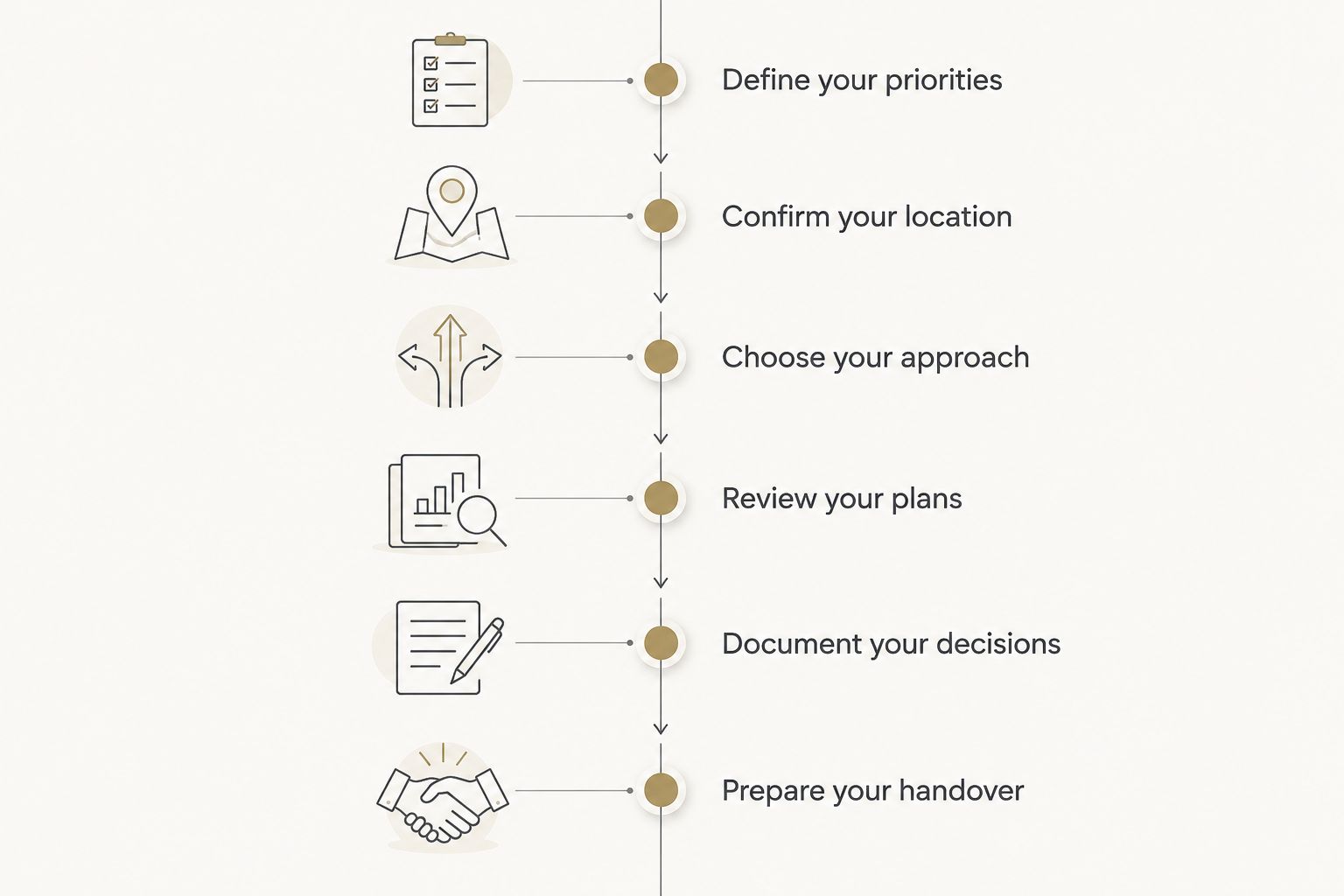
Review your plans
Walk through an ordinary workday on paper before approving a layout. Trace your morning route from bedroom to kitchen to garage, then check where a video call would happen while someone else uses the kitchen. These exercises expose conflicts that a room list misses.
You can mark up a printed plan yourself first. In-house drafting, blueprints, and 3D renderings then provide a way to discuss spatial relationships with the builder's team. Meghan Murray provides in-house design guidance, giving you a named design resource rather than leaving every selection to independent research.
For your 2026 plan review, ask how each drawing relates to the written specifications. A rendering helps you understand an idea; confirm the materials, dimensions, and features included in the agreed documents. For work-from-home priorities, review these home office design ideas for custom homes.
- Call privacy: Check doors, adjacent activities, and the intended office location.
- Arrival storage: Plan a place for work bags, outerwear, and travel items.
- Guest separation: Review how visitors affect household and working routines.
- Furniture fit: Compare actual furniture dimensions with the proposed rooms.
Document your decisions
Start with a shared spreadsheet or document that lists each selection, its status, and the person responsible for approval. Keep a single current version. A long message thread is not a reliable substitute for an agreed record of what the home includes.
Ask the project manager how selections, changes, questions, and approvals will be handled while you are away. The builder provides construction and project management, and its project managers bring more than 20 years of combined experience. That support does not remove the need for your approvals; agree on the communication process before the move gets busy.
Make schedule discussions specific. Ask which milestone depends on a selection or unresolved site question, and request an explanation of the effect of any proposed change. Avoid treating a progress update as confirmation of an occupancy date.
- Selection record: Record the choice, approval status, and relevant specification.
- Communication process: Agree on the contact person and method for routine questions.
- Change documentation: Request written scope and schedule implications before approving changes.
- Travel coordination: Identify reviews that require your presence and discuss alternatives in advance.
Prepare your handover
Plan occupancy as a separate workstream, not the final item on a moving checklist. Ask which approvals, walkthroughs, documents, and practical arrangements must be complete before you can occupy the home. Confirm those requirements with the responsible parties rather than assuming a visually finished house is ready.
Keep your own questions organized by room or system. During the walkthrough, ask how to operate and maintain the features installed in your home, and record the procedure for reporting unresolved items. Do not assume an appliance manual explains the builder's responsibilities or that every concern follows the same reporting process.
Maintain a housing contingency that does not rely on an unconfirmed completion date. The right arrangement depends on your employment commitments and household circumstances, but the principle is consistent: avoid making an irreversible moving decision on an assumption.
- Occupancy confirmation: Establish who confirms readiness and what documentation is required.
- Walkthrough record: Document agreed follow-up items and responsible contacts.
- Home information: Collect operating instructions, maintenance guidance, and service contacts.
- Moving coordination: Confirm access and readiness before finalizing the household move.
Compare home options for a professional relocation
For a 2026 relocation, compare the work each option asks of you—not just its label. Semi-custom is the strongest starting point when you want personal choices without directing every detail. Choose fully custom when your requirements genuinely need that additional design freedom.
| Option | Best for | Main advantage | Key limitation |
|---|---|---|---|
| Semi-Custom Homes | Professionals who want selected personal choices and guided decisions | You choose selected features and entrust remaining decisions to the builder | Not every feature or layout change is part of the agreed scope |
| Move-in-ready homes | Professionals who prefer to evaluate an already-built home | You can assess the completed spaces rather than relying only on plans | The existing layout and features determine the fit |
| Custom Homes | Professionals with distinctive layout, lifestyle, or feature requirements | The home is shaped around the buyer's preferences | More design decisions require your attention and approval |
An already-built home still needs due diligence, and a semi-custom home still needs a clearly documented scope. None of these labels establishes an occupancy date. Request project-specific information before coordinating housing or employment commitments around a home.
Common mistakes relocating professionals make
Treating the job start date as the build deadline
Your employer's schedule and the home's construction schedule have different dependencies. Discuss the relationship early, and keep a separate plan for where your household will live if the dates do not align. Do not schedule your move on an unconfirmed assumption.
Choosing an office by room name alone
A room labeled “office” does not establish privacy or suitability for your work. Check its relationship to shared living areas, the entry, and other bedrooms. Review the actual tasks you perform before deciding whether an open study or enclosed room fits.
Letting distance turn approvals into informal messages
Remote decision-making needs a clear record. Confirm the final selection and its place in the agreed scope rather than assuming a photo, conversation, or preliminary preference counts as approval. Give a designated decision-maker responsibility for resolving conflicting household feedback.
Buying a lot before reviewing the home's requirements
An appealing address does not prove a particular home fits the property. Request site review and confirm applicable requirements before treating the lot and design as a settled combination. Keep the commute assessment separate from the buildability assessment; both matter.
FAQ
What’s the best home option if I’m relocating for work?
Semi-custom is a strong starting point when you want selected personal choices without managing every design decision. Compare it with a completed home if you prefer to assess finished spaces, or fully custom if your layout requirements need greater design freedom.
Can Murray Custom Homes build on a lot I already own?
Murray Custom Homes can build on a client’s existing lot. Confirm the specific address, site conditions, and project fit within its stated 50-mile homebuilding radius of Lincoln.
Can I plan a custom home while living in another state?
You can begin by sharing a written relocation brief, marked-up plans, and documented selections. Before committing, agree with the builder on communication, approvals, and any visits required; do not assume a fully remote process is included.
Are Semi-Custom Homes the same as Custom Homes?
Semi-Custom Homes involve selected buyer choices, with remaining decisions entrusted to the builder. Custom Homes are shaped more fully around the buyer’s preferences, so confirm which layout and feature decisions each approach includes.
How long does building a home take when I’m relocating?
Your occupancy plan needs a project-specific schedule from the builder. Ask about site review, design approvals, selections, construction milestones, and unresolved dependencies rather than relying on a general completion estimate.
What should I put in a relocation homebuilding brief?
Include your work start date, housing commitments, location requirements, and nonnegotiable home features. Identify who approves decisions and separate confirmed dates from preferences so the builder can assess the actual constraints.
What should I check before committing to a move-in-ready home?
Check the specific home’s layout, condition, location, and suitability for your household and work routines. Confirm the property’s current status and occupancy arrangements directly before making moving commitments.
One last thing
Design around your first ordinary workday, not your first gathering. Imagine arriving home tired, setting down a laptop bag, preparing dinner, and taking a private call while the rest of the household carries on. That exercise gives your 2026 design review a concrete test—and helps distinguish a feature you will use from one that only looks appealing on a plan.
Related guides
- Features to prioritize when choosing a semi-custom home
- Floor plan features to include in a custom home
- Move-in-ready home features to look for