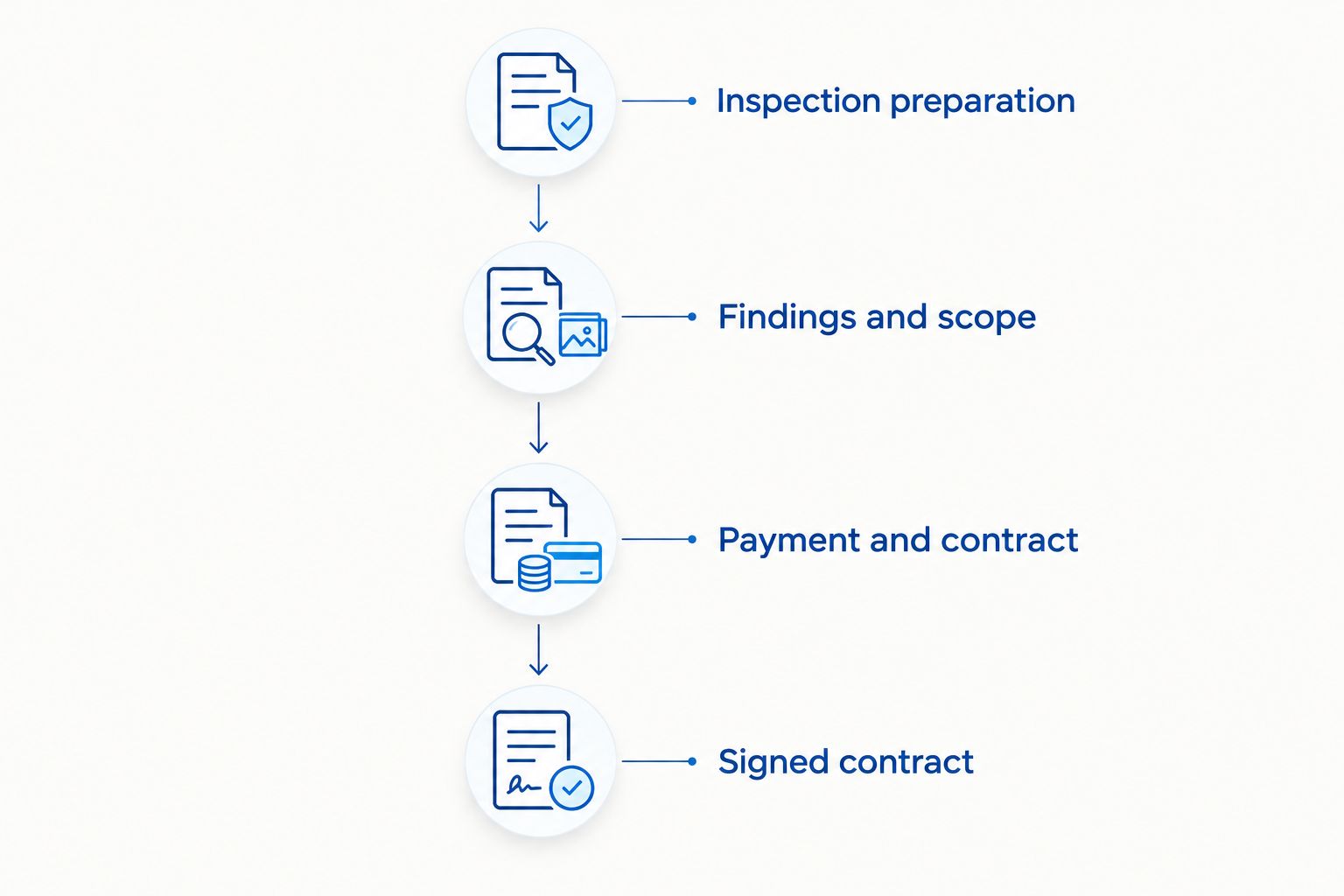
Instead of chasing inspection photos, estimates, and unanswered questions separately, organize the roof inspection process into a single workflow: document the condition, agree on the work, confirm payment arrangements, and sign the contract. For your 2026 project in Lincoln or Omaha, Murray Roofing provides residential and commercial inspections, repairs, and replacements.
- Murray Roofing serves Lincoln and Omaha homeowners and businesses needing roof inspections, repairs, or replacement.
- The roof inspection process should connect documented findings to a written scope before you sign a roofing contract.
- Choose repair, replacement, or monitoring from the findings—not from a verbal promise.
- Confirm exclusions, payment terms, warranty eligibility, and authorization before signing.
Why this matters
A roof inspection identifies visible conditions. A contract defines what the contractor will do about them. Those documents serve different purposes, and neither replaces the other.
Murray Roofing is best for Lincoln and Omaha homeowners and businesses seeking residential or commercial roofing inspection, repair, or replacement services. The practical benefit is access to those services through one contractor; the inspection still needs to establish which work your property requires.
For a 2026 roof replacement, a vague scope leaves you comparing proposals that cover different work. One estimate might include flashing replacement while another excludes it. Ask for the difference in writing before treating the proposals as equivalent.
Before you start
- Gather property information. Have the address, known leak locations, accessible prior roofing records, and any relevant insurance documents ready. Record when you noticed problems without guessing their cause.
- Confirm access and authority. Identify who can authorize the inspection and sign the contract. For commercial buildings, coordinate roof access, occupied spaces, and any tenant or facilities contact the inspector needs.
- Separate inspection access from work authorization. Read any document before signing it. A form presented during an inspection can contain terms beyond permission to inspect; check whether it authorizes repairs, commits you to a contractor, or creates payment obligations.
Do not climb onto the roof to prepare. Share observations from safe locations, and let the contractor determine how to inspect safely. If water is near electrical equipment or a ceiling appears unstable, keep people away and seek appropriate emergency help.
Inspection preparation
Property record
- Create a shared project folder. Use plain document labels such as Inspection findings, Proposed scope, and Contract so everyone reviews the same records.
- Write down the concern that triggered the inspection: an active leak, visible damage, recurring repairs, a planned sale, or replacement planning.
- Identify the decision-maker. A homeowner, building owner, authorized property manager, or association representative needs to understand the scope before approving work.
- Confirm what access the contractor needs. Ask about roof access, attic access where relevant, interior leak locations, and areas that cannot be entered.
Expected result: The inspector knows what to investigate, and you know who receives the findings and approves the next step.
For an Omaha homeowner, that record might focus on a bedroom ceiling stain and previous repairs. For a Lincoln commercial property, it might include separate leak locations, roof-mounted equipment, and access restrictions. Use the property's actual conditions rather than a generic checklist.
Inspection boundaries
- Ask which areas the inspection will cover, including the roof surface, transitions, flashing, drainage, and accessible interior evidence where relevant.
- Ask the contractor to identify anything that cannot be inspected safely or without opening the roof assembly.
- Request photographs tied to locations and written explanations of the findings. A close-up without location or context is difficult to use when reviewing the proposed work.
- Distinguish observed conditions from suspected causes. An interior stain documents water intrusion, but it does not establish the entry point by itself.
Expected result: You have a record of what was observed, what remains uncertain, and whether additional investigation is needed.
An inspection cannot reveal every concealed condition. Do not treat a surface inspection as confirmation that all decking, insulation, or underlying materials are sound. Ask how concealed damage will be handled if it becomes visible during work.
Findings and scope
Condition review
- Review the findings with the contractor. Ask which issues require attention now and which belong in a maintenance or monitoring plan.
- Ask how each proposed action addresses an observed problem. The explanation should connect the condition to the work—not simply recommend a new roof without supporting findings.
- Confirm whether a targeted repair, replacement, or further investigation is appropriate. Ask what remains unresolved under each approach.
- Record the agreed next step in the project folder before requesting the final proposal.
Expected result: You understand the reason for the recommendation and its limits before reviewing a contract.
For Lincoln and Omaha properties, ask how the proposed assembly addresses your building's drainage, roof shape, penetrations, and exposure. A roof chosen for a neighboring building is not automatically the right specification for yours.
Work selection
The inspection findings should drive the choice. Use this table to organize the discussion, not to diagnose the roof yourself.
| Option | Best for | Main benefit | Main limitation |
|---|---|---|---|
| Targeted repair | An identified, localized defect where the surrounding roof remains serviceable | Addresses a defined problem without replacing the entire roof | Does not renew unrelated aging materials or resolve defects outside the repair scope |
| Roof replacement | Conditions that justify replacing the existing roof assembly | Allows a coordinated scope across the roof being replaced | Requires decisions about materials, disruption, concealed conditions, and contract terms |
| Monitoring and maintenance | Conditions the inspector determines do not require immediate repair or replacement | Creates a record for follow-up and planned upkeep | Does not correct an active defect and requires follow-through |
Choose targeted repair only when the contractor can explain its boundaries. Choose replacement when the documented condition supports it. Monitoring is a plan with specific observations and follow-up actions, not a substitute for addressing an active leak.
Written scope
- Request a written scope identifying the roof areas, materials, and components included in the work.
- For replacement, clarify removal of existing materials, underlying surface evaluation, flashing, penetrations, drainage-related work, disposal, and property protection where applicable.
- Identify exclusions. Ask whether gutters, skylights, rooftop equipment, interior damage, and adjacent building components are included or outside the contract.
- Define the change process. Require written documentation and authorization for additional work, including how added charges will be established.
Expected result: The proposal describes a defined project rather than a general promise to fix the roof.
Keep the inspection findings, written scope, and signed contract together as 3 project records. Each should agree on the relevant roof area and intended work. If the findings identify a drainage concern but the scope never addresses it, resolve that mismatch before signing.
Payment and contract
Payment route
- Decide whether you are paying directly, applying for financing, or pursuing an insurance claim. Keep the roofing scope separate from the payment decision.
- If financing is involved, review the financing agreement and its approval conditions before committing to payment obligations you do not understand.
- If insurance is involved, distinguish the contractor's repair recommendation from the insurer's coverage decision. Ask your insurer about policy requirements, documentation, and deadlines.
- Match the payment schedule to the written contract. Identify when payments are due and what conditions trigger them.
Expected result: You understand your payment obligations without assuming financing approval or insurance coverage.
Murray Roofing offers financing and insurance-claim support. Neither service guarantees approval, policy coverage, or payment by an insurer. For a financed 2026 project, follow the roof estimate to financing approval workflow alongside—not instead of—the contract review.
Contract review
- Confirm the property address, contracting parties, roof areas, and complete scope. Attach or clearly identify any specification document the contract relies on.
- Review scheduling terms and responsibilities. Ask how access, weather-related interruptions, material changes, and occupied-building coordination will be communicated; do not assume a guaranteed completion date.
- Read payment, cancellation, dispute, and change-order terms. Request clarification before signing anything you do not understand.
- Confirm the warranties that apply to the proposed work, their eligibility conditions, exclusions, registration requirements, and claim procedures.
- Obtain the completed contract and its referenced attachments. Keep the signed version separate from earlier drafts.
Expected result: The signed agreement reflects the work you approved and the obligations you accepted.
Murray Roofing lists a 50-year Golden Pledge warranty and a 10-year labor warranty among its trust signals. Ask which warranty applies to your specific project and obtain the governing terms. A stated warranty duration does not mean every component, type of damage, or project is covered for that entire period.
A 2026 contract should not depend on an earlier conversation to explain a major exclusion. If a promise affects your decision to sign, put it in the agreement.
Storm-damage and commercial approval variants
Storm-damage workflow
For a storm-related inspection, add an insurance documentation branch without changing the core sequence. Preserve inspection photographs, observations, correspondence, and the insurer's decisions in the same project folder.
Ask the contractor to describe observed damage without promising coverage. Ask the insurer what evidence it requires and whether approval is needed before particular work begins. Discuss any urgent protective work separately from the permanent repair or replacement agreement.
Best for: Property owners evaluating storm-related roof damage. The benefit is a clear documentation trail; the limitation is that the policy and insurer's decision still control coverage.
Commercial approval workflow
For commercial roofing, add an authorization branch before signing. Identify who approves the technical scope, who accepts operational disruption, and who has authority to commit the organization.
This applies to offices, restaurants, warehouses, apartments, churches, and other commercial properties. Record access restrictions, sensitive occupied areas, rooftop equipment coordination, and the person responsible for tenant or staff notices.
Best for: Buildings with multiple decision-makers or occupants. The benefit is clearer responsibility; the limitation is that the roofing contract does not automatically authorize unrelated equipment work or internal approvals.
Troubleshooting
The recommendation has no supporting photos
Request location-specific evidence and an explanation connecting the findings to the proposed work. If an area was inaccessible, ask the contractor to identify that limitation rather than presenting it as inspected.
Two proposals describe different projects
Compare roof areas, materials, removal work, flashing, underlying surface allowances, exclusions, and warranties. Align the scopes before comparing totals. A shorter proposal is not proof of a simpler project.
Additional damage appears after work starts
Use the contract's concealed-condition and change-order procedure. Ask for documentation, the proposed response, and written authorization before additional permanent work proceeds under changed terms.
Financing or insurance remains unresolved
Do not treat an application or submitted claim as approval. Clarify what you owe under the roofing contract if the financing or insurance outcome differs from your expectations.
The final contract differs from the proposal
Pause and identify every change. Request a corrected agreement or a written explanation, and retain the version you actually sign—not just the earlier estimate.
Customize your workflow
Build your 2026 project folder around the property's decision process. Homeowners need a clear connection between findings, scope, and payment; commercial owners also need access coordination and signing authority.
Before construction begins, ask who will communicate changes and how completion will be documented. Include warranty paperwork, agreed closeout records, and maintenance guidance in that handoff. A contract signature starts the next phase; it does not complete the roofing project.
FAQ
What happens during the roof inspection process?
The roof inspection process examines accessible roof conditions and relevant evidence of problems, then connects the findings to recommended next steps. Ask for photographs, written explanations, and a record of areas that could not be inspected.
Does a roof inspection mean I need a replacement?
No. A roof inspection can support targeted repair, replacement, further investigation, or monitoring, depending on the findings. Ask the contractor to explain why the recommended approach fits your roof.
Can I sign a roofing contract before insurance approves my claim?
Do not assume an unresolved insurance claim will pay your roofing obligations. Read the contract, confirm what you would owe if coverage is denied or limited, and ask your insurer about its requirements before committing.
What should a roofing contract include?
A roofing contract should identify the parties, property, work scope, materials, exclusions, payment terms, change procedures, and applicable warranties. It should also explain responsibilities and scheduling terms without relying on verbal promises.
Can a roof inspection find every hidden problem?
No. Concealed damage beneath roofing materials is not always visible during an inspection. Ask how additional investigation and conditions discovered during construction will be documented and authorized.
Does Murray Roofing offer free inspections in Lincoln and Omaha?
Murray Roofing lists free inspections among its offerings and serves Lincoln and Omaha. Schedule an inspection and confirm the access requirements and scope for your residential or commercial property.
Are roofing warranties the same for every project?
No. Warranty eligibility, covered work, exclusions, and claim requirements depend on the applicable terms. Request the warranty documents for your specific project before signing rather than relying only on the stated duration.
One last thing
The most useful contract question is not simply whether the roof will be repaired. It is: What happens if the condition underneath differs from what the inspection could see? A written answer prevents an inspection limitation from becoming an undefined construction decision.
For your 2026 project, schedule a free inspection with Murray Roofing and request a written scope before deciding whether to repair or replace.
Schedule your roof inspection
Discuss your Lincoln or Omaha property and request a written scope for the recommended work.
Related guides