Standing seam metal roofing is the best roof type for Houston humidity and storms in 2026, with algae-resistant architectural asphalt shingles ranking as the strongest lower-cost alternative and TPO membrane holding the top spot for commercial flat roofs. This guide ranks five roof types against Houston's actual weather risks: year-round humidity near 70%, algae and mold growth, hurricane-force wind gusts, and hail events that hit the Gulf Coast corridor most summers.
- Standing seam metal wins on wind and storm resistance for Houston homes and businesses in 2026.
- Algae-resistant architectural asphalt shingles handle humidity at a lower entry point than metal or tile.
- TPO single-ply membrane is the standard pick for commercial flat roofs facing Houston heat and ponding water.
- Concrete and clay tile resist mold and moisture longest but add structural weight to account for.
- Synthetic composite shingles deliver Class 4 impact resistance without the tile weight penalty.
Why this matters
Houston roofs don't fail the same way roofs in drier climates do. Constant humidity feeds algae and moss on shaded slopes, standing water on low-slope sections breaks down membranes early, and named storms push wind loads that most residential shingle warranties were never written to survive.
The roofing companies in Houston that get called out to the most storm damage tend to see the same three failure patterns every hurricane season: shingle blow-off on aging asphalt, ponding on flat commercial roofs with poor drainage, and algae staining that homeowners mistake for structural rot. Picking the right roof type in 2026 means matching the material to which of those three risks actually threatens your building.
What makes the best roof type for Houston weather
- Wind uplift rating — resistance to sustained gusts and the uplift that follows a gust, not just peak wind speed
- Algae and mold resistance — copper or zinc-infused granules, or a naturally non-porous surface
- Moisture and ponding tolerance — critical for flat and low-slope sections common on commercial buildings
- Impact resistance — Class 3 or Class 4 rated materials for hail exposure
- Warranty coverage — specifically written to address Gulf Coast humidity and storm conditions, not generic climate assumptions
- Code compatibility — installation methods that meet Houston's wind-load building requirements
Roof types for Houston at a glance
| Roof type | Best for | Standout feature | Key limitation |
|---|---|---|---|
| Standing seam metal | Wind and storm resistance | Interlocking panels resist uplift in sustained gusts | Higher upfront material cost than shingles |
| Algae-resistant architectural shingles | Humidity control on a budget | Copper/zinc granules slow algae growth | Shorter lifespan than metal or tile in full sun exposure |
| TPO single-ply membrane | Commercial flat roofs | Heat-reflective surface handles Houston summers | Seams need regular inspection for ponding damage |
| Concrete and clay tile | Long-term mold and moisture resistance | Non-porous surface resists staining and rot | Adds significant structural weight |
| Synthetic composite shingles | Hail and impact resistance | Class 4 impact rating without tile weight | Fewer long-track installation records than asphalt |
1. Standing Seam Metal Roofing: best roof type for Houston wind and storm resistance
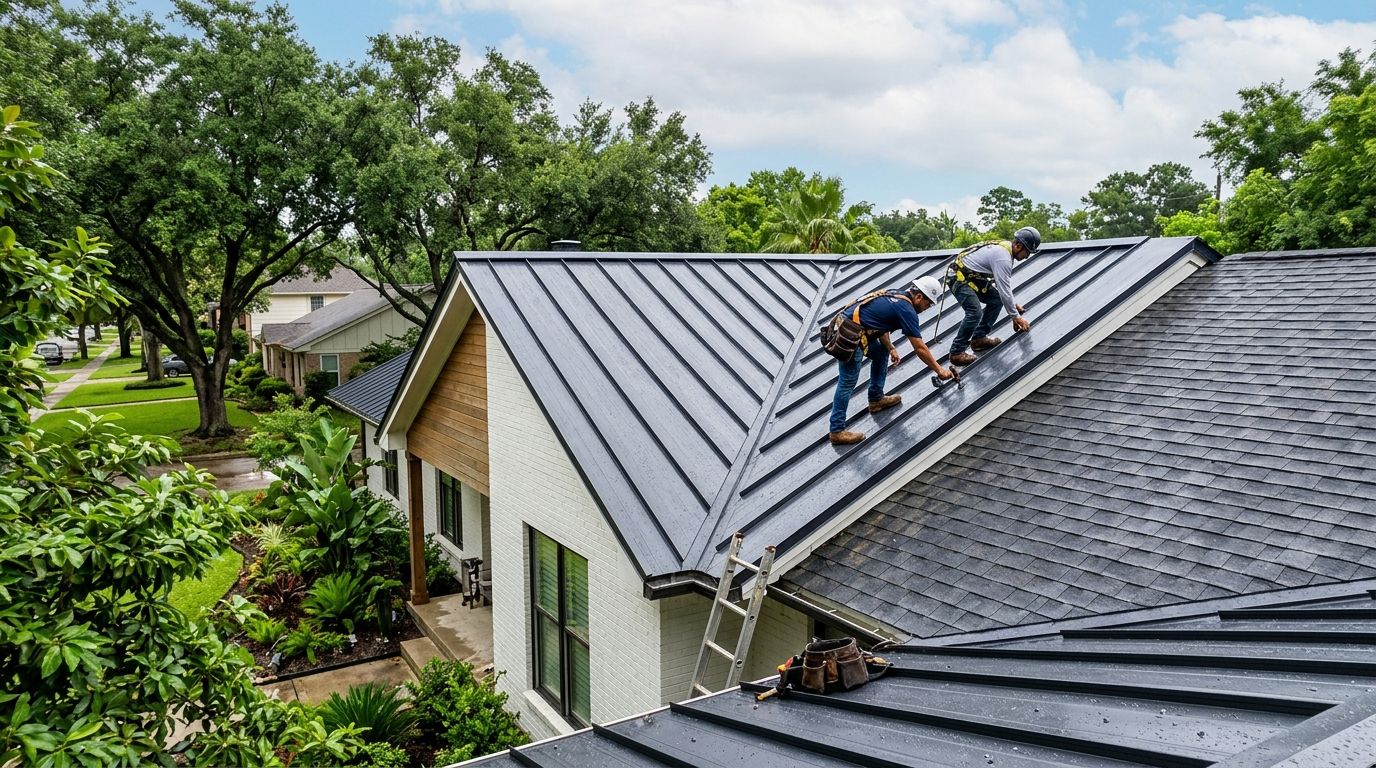
Standing seam metal roofing uses continuous interlocking panels fastened with hidden clips, which lets the whole roof move as one surface instead of individual pieces that can lift and peel. That structural behavior is exactly what matters when a named storm pushes sustained gusts across a Houston roofline.
Murray Roofing installs standing seam systems on both residential and commercial properties across Houston, and it's the material most often recommended for homes near open exposure or in flood-adjacent zones where wind risk compounds with moisture risk.
Standing seam metal pros:
- Panels resist uplift better than individual shingles in sustained wind events
- Non-porous surface doesn't feed algae or mold growth in humid conditions
- Long service life reduces how often the roof faces storm-cycle stress
Standing seam metal cons:
- Upfront material cost runs higher than asphalt shingle systems
- Panel expansion and contraction requires correct fastener spacing at install
- Not every roofing materials supplier stocks every color and gauge locally
Verdict: Buy if wind and storm resistance is the priority and the building's roofline suits panel installation.
2. Algae-Resistant Architectural Asphalt Shingles: best roof type for humidity control at a lower entry point
Standard asphalt shingles stain and streak fast in Houston's humidity. Algae-resistant architectural shingles solve that with copper or zinc granules embedded in the shingle surface, which slows the algae growth that causes the black streaking homeowners see on north-facing slopes.
This is the roof type most Houston homeowners land on when metal or tile isn't in the budget conversation but algae staining is the specific problem they're trying to avoid.
Algae-resistant shingle pros:
- Lower installed weight than tile or metal, no structural reinforcement needed
- Wide range of algae-resistant products backed by manufacturer warranties
- Familiar installation process means faster turnaround from most roofing materials for Texas heat and storms crews
Algae-resistant shingle cons:
- Shorter expected lifespan than metal or tile under constant sun and humidity
- Algae resistance fades over time as granules wear
- Wind ratings vary widely by product line, so the specific shingle matters
Verdict: Buy for homeowners who want humidity control without the metal or tile price jump.
3. TPO Single-Ply Membrane: best roof type for commercial flat roofs in Houston heat and humidity
TPO (thermoplastic polyolefin) membrane dominates commercial low-slope roofing in Houston because it reflects heat, resists UV breakdown, and handles the ponding water that flat roofs inevitably see during heavy rain events. Heat-welded seams give it a tighter moisture seal than older built-up roofing systems.
For commercial property owners weighing flat roof systems for commercial buildings, TPO is the default recommendation unless the building has unusual load or drainage constraints.
TPO membrane pros:
- Reflective surface reduces cooling load in Houston's summer heat
- Heat-welded seams outperform adhesive seams for long-term moisture resistance
- Lighter weight than modified bitumen, easing structural load concerns
TPO membrane cons:
- Seams require periodic inspection, especially near rooftop equipment penetrations
- Ponding water left unaddressed shortens membrane life regardless of material quality
- Not a fit for steep-slope residential applications
Verdict: Buy for commercial flat roofs; this is the category standard for a reason.
4. Concrete and Clay Tile: best roof type for long-term mold and moisture resistance
Concrete and clay tile roofs resist staining, rot, and moisture absorption better than almost any other material because the surface itself is essentially non-porous. In coastal-adjacent Houston neighborhoods where humidity sits high year-round, that resistance matters more than in drier climates.
The tradeoff is weight. Tile roofs run significantly heavier than shingles or metal, and older homes sometimes need structural evaluation before a tile install gets approved.
Concrete and clay tile pros:
- Best-in-class resistance to mold, algae staining, and moisture absorption
- Long service life reduces how often the roof cycles through storm exposure
- Holds up well against sustained UV exposure without surface degradation
Concrete and clay tile cons:
- Structural weight can require reinforcement on older homes
- Individual tiles can crack under large hail impacts, even where the underlying deck holds
- Installation and repair require specialized crews, not every general contractor
Verdict: Hold unless the home's structure already supports the weight or a structural review clears the install.
5. Synthetic Composite Shingles: best roof type for hail and impact resistance
Synthetic composite shingles are engineered products designed to mimic the look of slate or wood shake while carrying Class 4 impact ratings, the highest hail resistance classification available. For Houston properties in hail-prone corridors, that rating matters more than aesthetics.
Composite shingles run lighter than tile, which sidesteps the structural weight conversation while still delivering strong impact performance.
Synthetic composite shingle pros:
- Class 4 impact rating handles hail better than standard asphalt
- Lighter weight than tile, no structural reinforcement typically needed
- Available in profiles that mimic higher-end materials
Synthetic composite shingle cons:
- Fewer decades of installed track record compared to asphalt or metal
- Product quality varies more by manufacturer than with established categories
- Not every crew has deep experience installing composite systems correctly
Verdict: Hold as a strong option for hail-prone areas, worth a direct comparison against metal before committing.
How this ranking works
Each roof type above gets scored against the same six criteria: wind uplift performance, algae and mold resistance, moisture tolerance, impact rating, warranty strength, and code compatibility with Houston's wind-load requirements. Standing seam metal wins because it scores well across all six; the other four types each win a specific tradeoff rather than the full set.
Get a free roof inspection in Houston
See which roof type fits your home or building before storm season.
Which roof type should you choose?
For most Houston homeowners facing wind and storm risk, standing seam metal roofing is the default answer in 2026. If budget is the deciding factor and algae staining is the main concern, algae-resistant architectural shingles get the job done for less. Commercial property owners with flat roofs should default to TPO membrane unless a structural engineer flags a reason not to.
Homeowners weighing tile against composite should get a structural review first — that answer determines which of the two is even on the table. A Houston roof warranty that's written for Gulf Coast conditions matters as much as the material choice itself, and it's worth confirming before signing any contract.
FAQ
What is the best roof type for Houston humidity?
Standing seam metal roofing and algae-resistant architectural shingles both handle Houston humidity well in 2026 because neither surface feeds algae growth the way standard shingles do. Metal wins on longevity; algae-resistant shingles win on upfront cost.
Is metal roofing better than shingles for Houston storms?
Yes, standing seam metal roofing generally outperforms standard asphalt shingles in sustained wind events because its interlocking panels resist uplift better than individual shingle tabs. Algae-resistant architectural shingles narrow that gap for humidity resistance but not for wind performance.
What roof type is best for a Houston commercial building?
TPO single-ply membrane is the standard choice for commercial flat roofs in Houston because it reflects heat and resists the ponding water that flat roofs face during heavy rain. It requires periodic seam inspection to maintain that performance.
Does tile roofing work in Houston’s climate?
Concrete and clay tile resist mold and moisture better than most materials in Houston’s humidity, but the added structural weight means older homes may need a structural review before installation.
How does hail affect roof type choice in Houston?
Hail exposure pushes homeowners toward Class 3 or Class 4 impact-rated materials like synthetic composite shingles or certain metal panel gauges. Standard asphalt shingles without an impact rating are more vulnerable to hail damage.
Does roof type affect insurance claims in Houston?
Impact-rated and wind-rated materials can factor into how an insurance claim is assessed after storm damage, though coverage outcomes depend on the specific policy and adjuster. A documented inspection before and after storm season helps support any claim regardless of roof type.
How long does a metal roof last in Houston weather?
Standing seam metal roofs are built for long service life in humid, storm-prone climates like Houston’s, with warranty coverage such as GAF’s 50-year Golden Pledge backing material performance over decades.
Can I finance a new roof in Houston?
Financing options exist for roof replacement projects in Houston, and reviewing the ways to finance a new roof before choosing a material helps set a realistic budget for metal, tile, or shingle systems alike.
One last thing
The roof type that wins on paper isn't always the one that fits your specific building. A home with heavy tree cover and shaded north slopes has a different algae risk than an open-exposure property facing sustained coastal wind — the same roof type ranking flips depending on which risk actually threatens the structure. A physical inspection settles that question faster than any ranking table, and Murray Roofing's GAF Master Elite certification backs the standing seam and shingle systems installed across Houston with warranty coverage written for exactly these conditions.
Related guides