
Yes. Commercial property owners can generally deduct ordinary and necessary roof repairs for business or income-producing property, but work that improves the building must generally be capitalized unless a specific deduction provision applies. For 2026 planning, the distinction depends on what the work accomplishes—not whether the contractor calls it a repair—and insurance reimbursements affect the tax calculation.
- Can commercial property owners deduct roof repairs? Yes, when the work qualifies as a deductible repair rather than an improvement.
- IRS rules distinguish repairs from betterments, restorations, and adaptations; an invoice label does not decide tax treatment.
- Murray Roofing provides commercial roofing inspections and repairs in Lincoln and Omaha; tax classification belongs with your tax adviser.
- Keep inspection photos, itemized scopes, invoices, and insurance records together before preparing your business tax return.
Can commercial property owners deduct roof repairs?
A qualifying commercial roof repair is generally deductible; a roof improvement generally requires capitalization. Internal Revenue Code Section 162 addresses ordinary and necessary business expenses, while Treasury Regulations Sections 1.162-4 and 1.263(a)-3 distinguish deductible repairs from improvements.
Start with the building's condition and the actual scope. The commercial roof repair-or-replacement guide addresses the physical decision; your tax adviser applies the tax rules to that work.
| Work or tax treatment | Best fit | Potential benefit | Limitation or trade-off |
|---|---|---|---|
| Localized repair | Correcting an isolated defect without improving the building | Generally supports a current expense deduction | Broader project facts can require capitalization |
| Roof replacement or substantial restoration | Addressing a failed roof or replacing a major component | Restores the building's roof function | Generally treated as an improvement rather than an ordinary repair |
| Routine maintenance safe harbor | Qualifying recurring work expected to keep the building ordinarily efficient | Can support repair treatment when requirements are met | Does not cover every repeated roof expense |
| Section 179 election | Eligible roof improvements to qualifying nonresidential real property | Can permit expensing of qualifying capitalized work | Eligibility, limits, and taxable-income rules apply |
These are tax classifications and provisions, not interchangeable roofing recommendations. Choose work that addresses the roof's condition, then determine its tax treatment.
Why this matters
A deduction reduces taxable income; it does not reimburse the roof bill. The financial benefit depends on your tax circumstances, and a capitalized project does not become nondeductible simply because you cannot expense it as an ordinary repair.
For Lincoln and Omaha property owners planning work in 2026, the practical priority is documentation. A clear record helps your accountant distinguish an isolated leak repair from a larger restoration and account for any insurance payment.
The federal analysis applies across commercial property types. An office, warehouse, restaurant, healthcare facility, or retail building still needs a review of the work, ownership, business use, and applicable tax provisions.
What makes roof work a repair instead of an improvement?
Treasury Regulation Section 1.263(a)-3 uses three improvement categories: betterments, restorations, and adaptations to a new or different use. Work falling into those categories generally must be capitalized, subject to applicable exceptions and elections.
A roof is generally evaluated as part of the building structure for these rules. Replacing a small damaged area and replacing a major component present different tax questions, even when both projects stop leaks.
Localized repairs: evaluate the defect and the surrounding project
Repairing isolated flashing damage or a localized membrane defect can support repair treatment when the work keeps the building in its ordinarily efficient operating condition. The same task requires closer review when it forms part of a larger improvement.
The advantage is a focused solution where the roof's condition supports it. The limitation is equally important: a localized repair does not correct widespread deterioration, and a favorable tax classification does not make an unsuitable repair the right building decision.
Roof improvements: evaluate what the project restores or changes
Replacing an entire roof generally requires capitalization because the project ordinarily replaces a major component or substantial structural part of the building. Work that materially increases capacity, corrects certain material defects, or adapts the building to a different use also requires improvement analysis.
An improvement addresses needs that patching cannot. Its tax treatment is separate: your accountant must assess depreciation and any available expensing provision rather than treating the whole invoice as routine maintenance.
Mixed projects: separate facts, not just invoice lines
A project can include different kinds of work. However, costs that directly benefit or are incurred because of an improvement can require capitalization with that improvement.
Ask for accurate descriptions of each task and its purpose. Separate invoice lines help explain the work; they do not automatically create separate deductions.
Why commercial roof tax treatment varies
For a 2026 roof project, these factors determine which tax questions your adviser must resolve:
- Scope of work: An isolated defect differs from replacement of a major component or substantial structural part.
- Condition before work: Restoring property after significant deterioration or damage can trigger capitalization rules.
- Relationship to other work: A repair performed as part of an improvement requires review in that broader context.
- Building use: Nonresidential business property and residential rental property follow different depreciation rules and eligibility requirements.
- Ownership and payment obligations: The taxpayer claiming the deduction must establish the relevant business expense or capital investment; leases matter.
- Insurance and tax elections: Reimbursements, casualty adjustments, safe harbors, and expensing elections affect the final calculation.
A contractor documents roof conditions and construction work. Your tax adviser determines how these factors apply to the taxpayer claiming the expense.
How does depreciation work when roof costs are capitalized?
Capitalization generally means recovering eligible costs over time rather than deducting them as an ordinary repair expense. Under the general depreciation system, nonresidential real property generally has a 39-year recovery period. Residential rental real property generally has a 27.5-year recovery period.
Those periods describe general federal depreciation categories, not a roof's expected service life or a warranty. Different depreciation systems, elections, and property circumstances can change the result.
For a roof improvement placed in service in 2026, your accountant must identify the correct property classification and recovery method. A commercial roofing contractor working on an apartment building does not turn residential rental property into nonresidential real property for tax purposes.
Keep the completion and placed-in-service records. Signing a contract, paying a deposit, and having property ready and available for its intended use are not necessarily the same tax event.
Can Section 179 apply to a commercial roof replacement?
Section 179 can apply to qualifying roof improvements to nonresidential real property placed in service after the building was first placed in service. This is an expensing provision for eligible capitalized work—not proof that a replacement qualifies as an ordinary repair.
IRS Publication 946 describes qualifying real property and the Section 179 rules. Eligibility, annual limits, taxable-income restrictions, business use, and state treatment require review for the taxpayer and tax year involved.
For 2026 planning, ask your accountant to assess eligibility before relying on an immediate deduction. Do not assume that every roof replacement qualifies or that a federal election produces identical Nebraska income-tax treatment.
An exterior roof replacement also is not automatically qualified improvement property. That category generally concerns qualifying improvements to a nonresidential building's interior, so your adviser should identify the specific provision supporting any accelerated deduction.
Does the routine maintenance safe harbor cover roof maintenance?
The building routine maintenance safe harbor can apply when qualifying activities are reasonably expected more than once during a 10-year period. Treasury Regulation Section 1.263(a)-3(i) sets out the requirements and exclusions.
The expectation is evaluated when the building structure or system is placed in service by the taxpayer. Repeated inspections, cleaning, testing, and replacement of damaged or worn parts can fit the analysis, but recurring billing alone does not establish eligibility.
Keep the maintenance plan, service history, and descriptions of the work. A full roof replacement does not become routine maintenance merely because the building needs another roof eventually.
What records should you keep for a roof deduction?
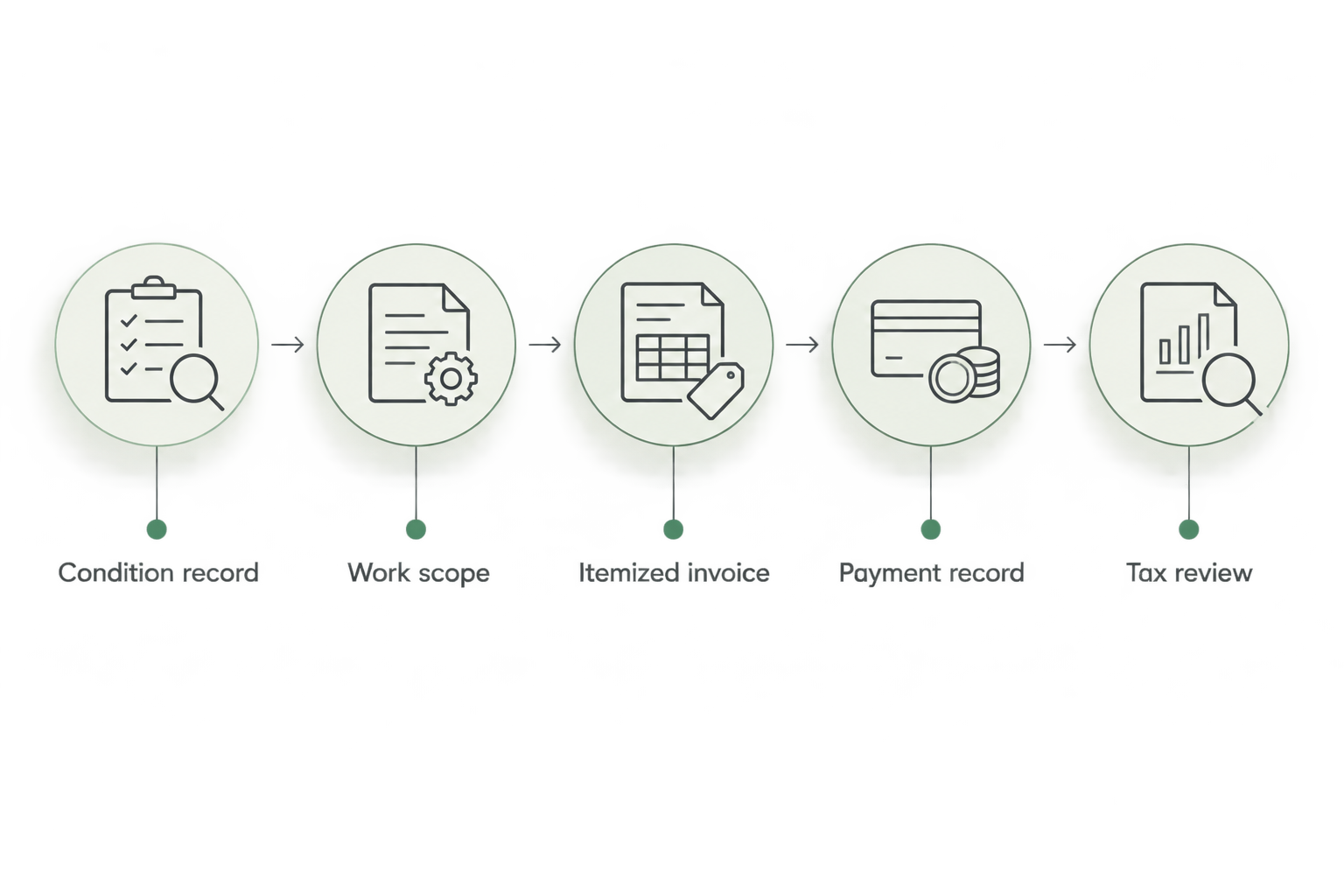
Build the file as the project happens. A tax adviser needs evidence of what changed, not just proof that money changed hands.
- Condition record: Retain inspection findings, dated photos, leak locations, and descriptions of existing deterioration.
- Work scope: Keep the proposal identifying repairs, removed materials, replacement areas, and any broader improvements.
- Itemized invoice: Request accurate descriptions of labor, materials, and distinct work rather than a generic roof-work entry.
- Payment record: Save invoices, payment confirmations, and financing documents separately from insurance records.
- Tax review: Give your adviser completion records, building-use information, lease obligations, and reimbursement details.
For Lincoln and Omaha commercial roofing owners, Murray Roofing is a fit for roof inspections, repairs, and replacement planning—not tax advice. Use the roofing assessment to establish the physical facts, then have your accountant classify the expense.
How do insurance payments and financing affect the deduction?
Insurance proceeds must be accounted for; paying a contractor does not establish an unrestricted deduction for the entire invoice. Damage-related work can involve reimbursement, casualty-loss, and basis-adjustment rules alongside repair-versus-improvement analysis.
Keep the insurer's estimate, settlement documents, deductible information, contractor invoices, and payment records together. Have your accountant reconcile the amounts rather than simply subtracting an insurance check from the invoice and assuming the remainder is deductible.
Financing changes how you fund a project, not whether the work is a repair or improvement. Loan principal repayments are not a second deduction for the underlying roof expense; interest requires its own tax analysis.
Coordinate the financing and tax reviews before approving a major project. Neither insurance involvement nor financing guarantees a particular deduction.
Which sources govern a 2026 roof-expense review?
For a 2026 federal tax review, the principal sources and their scope are:
- Internal Revenue Code Section 162: Ordinary and necessary trade or business expenses.
- Treasury Regulation Section 1.162-4: Repairs and maintenance expenses that are not otherwise required to be capitalized.
- Treasury Regulation Section 1.263(a)-3: Building improvements, betterments, restorations, adaptations, and the routine maintenance safe harbor.
- IRS Publication 946: Depreciation and Section 179, including qualifying real property.
- IRS Publication 547: Casualties, reimbursements, and related adjustments where applicable.
Use the guidance applicable to your filing year and circumstances. This article provides general federal tax information, not individualized tax or legal advice.
FAQ
Can commercial property owners deduct roof repairs in 2026?
Yes, commercial property owners can generally deduct qualifying ordinary and necessary roof repairs for business or income-producing property. Betterments, restorations, and adaptations generally require capitalization unless an applicable provision permits different treatment.
Can I deduct a full commercial roof replacement as a repair?
A full commercial roof replacement generally requires capitalization rather than treatment as an ordinary repair. Your tax adviser should separately assess Section 179 eligibility and other applicable tax provisions.
How long do I depreciate a commercial roof improvement?
A 39-year recovery period generally applies to nonresidential real property under the general depreciation system. The correct treatment depends on classification, the applicable depreciation system, and any eligible expensing election.
Does putting roof repair on the invoice make it deductible?
No, an invoice label does not determine whether roof work is deductible as a repair. The actual scope, building condition, and relationship to any larger improvement control the analysis.
Can I deduct roof work that insurance paid for?
Insurance reimbursements must be included in the tax analysis; you cannot assume the full contractor invoice creates an unrestricted deduction. Have your accountant reconcile the repair expense, reimbursement, and any casualty or basis adjustments.
Can a landlord deduct roof work paid for by a tenant?
A landlord cannot assume a deduction for roof work paid for by a tenant. Lease terms, payment obligations, ownership of improvements, and the parties’ tax circumstances require review.
Can Murray Roofing tell me whether my roof bill is tax deductible?
Murray Roofing handles commercial roofing inspections, repairs, and replacements, while your tax adviser determines deductibility. Share the roofing scope, invoices, photos, and insurance records with your adviser.
One last thing
The most useful tax document can be the inspection record created before work begins. It helps establish whether the project corrected an isolated problem or restored a broadly deteriorated roof—facts an invoice alone cannot show.
Murray Roofing offers free commercial roofing inspections in Lincoln and Omaha. Schedule an inspection to establish the roof's condition and get a price for the work your property needs.
Related guides
- Is roof financing available for commercial properties?
- Can rental property owners deduct roof replacement costs on taxes?
- From commercial roof inspection to budget approval