
Yes, you can negotiate a roof insurance settlement by asking the insurer to review documented errors, omitted damage, or differences in the repair scope. A higher contractor estimate alone does not establish what the insurer owes; your policy terms, deductible, exclusions, and supporting evidence control the claim. This 2026 guide explains how to request that review without confusing a roofing estimate with a coverage decision.
- Can you negotiate a roof insurance settlement? Yes—challenge specific errors with roof damage documentation and policy evidence.
- Compare the insurer’s repair scope with an itemized contractor estimate before requesting a supplement.
- Murray Roofing serves Lincoln and Omaha owners seeking roof inspections and insurance-claim support.
- A revised estimate does not guarantee additional coverage, payment, or a full roof replacement.
Why this matters
The strongest settlement request explains what is wrong, not just why the payment feels low. A missing roof section, an incorrect measurement, and an excluded cause of damage are different problems. Each needs a different response.
For Lincoln and Omaha homeowners and commercial property decision-makers, start with the roof condition and written claim documents. The storm-damage insurance claim workflow explains the broader process; this page focuses on disagreements about the settlement.
Keep coverage questions separate from construction decisions. You still need a safe, appropriate repair even when the insurer and contractor disagree about what the policy will fund.
Can you negotiate a roof insurance settlement?
Yes. You can ask the insurer to reconsider its estimate or coverage position, but the request needs to identify the disputed item and explain the correction you want. Negotiation is a documented claim review, not a promise that the insurer will meet a preferred total.
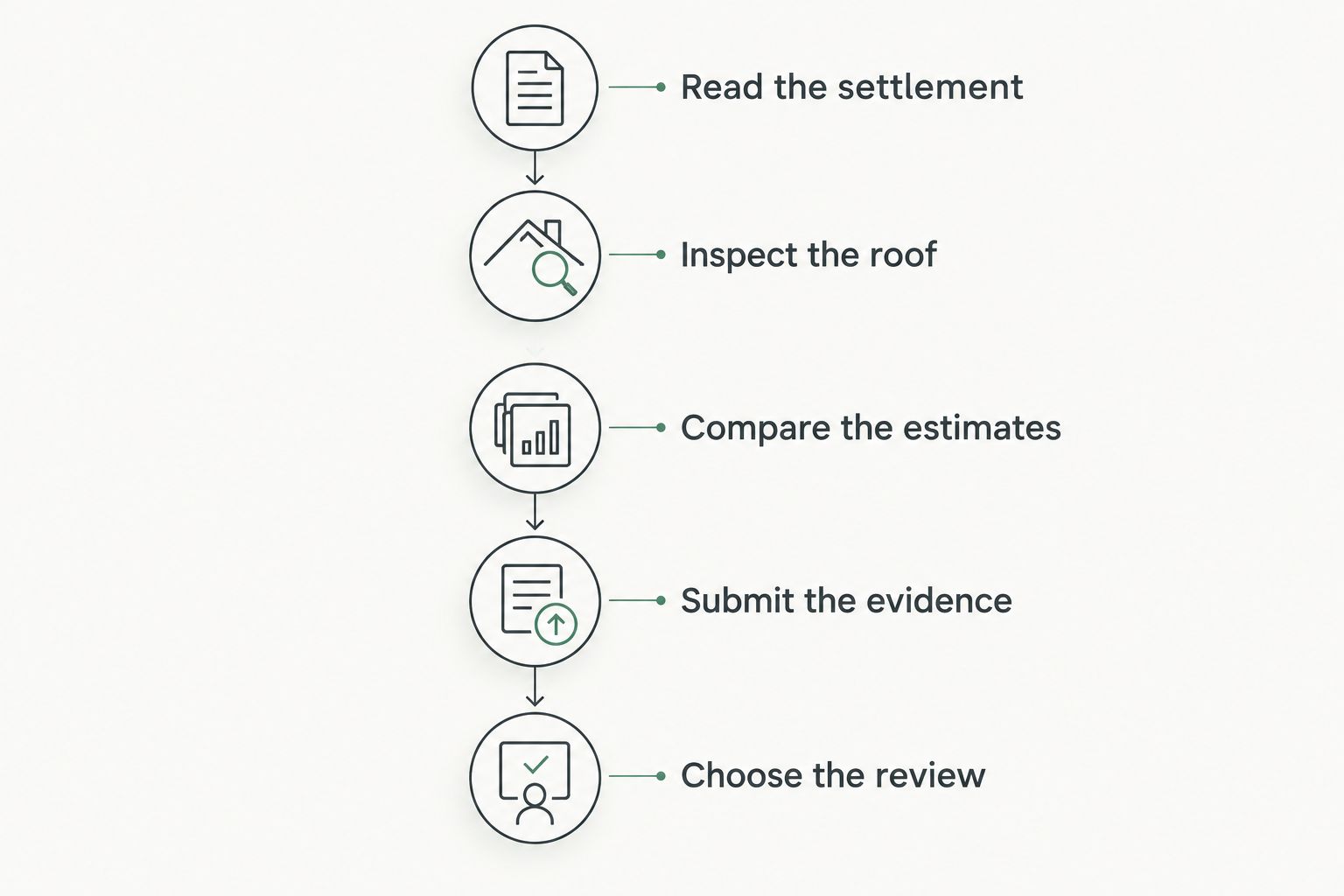
Use these 5 steps to organize a roof settlement review in 2026. Keep correspondence, estimates, photographs, and decisions in 1 claim file so each submission has a clear record.
1. Read the settlement explanation before challenging it
Review the insurer’s estimate, coverage letter, and payment explanation together. Identify whether the disagreement concerns roof damage, the proposed repair, depreciation, the deductible, or an exclusion. These categories affect both your evidence and the available review process.
Ask the adjuster to explain any unfamiliar deduction in writing. A payment that excludes recoverable depreciation is not the same as a denial of that amount, and an estimate total is not necessarily the amount of the initial check.
Also check the policy and correspondence for notice, proof-of-loss, repair, appraisal, and legal-action requirements. Do not assume that ongoing discussions extend a deadline.
2. Get an itemized roof inspection and estimate
Ask a roofing contractor to document the roof’s condition and describe the proposed work. Useful documentation connects photographs to specific roof areas and explains why a repair or replacement is needed. A single total without supporting detail is harder to compare with the insurer’s estimate.
For a Lincoln or Omaha property, ask the contractor to distinguish observed damage from general aging or maintenance issues. Storm exposure alone does not establish that every roof defect resulted from the reported event.
Do not climb onto the roof to collect evidence yourself. Have a qualified professional inspect elevated areas and document conditions safely.
3. Compare the estimates line by line
Match the insurer’s scope against the contractor’s proposed work. Look for differences in measured areas, materials, removal work, flashing, penetrations, disposal, and necessary supporting work. Not every difference is an insurer error; the contractor’s estimate also needs a clear basis.
For each disputed item, record what the insurer included, what the contractor proposes, and what evidence supports the difference. If a building-code requirement is involved, request the applicable requirement rather than relying on a general statement that everything must be upgraded.
A full replacement recommendation needs an explanation of why the proposed repair is insufficient. Preference for a new roof is not evidence of a covered replacement obligation.
4. Submit a focused written request
Send the claim number, disputed line items, relevant photographs, and the contractor’s explanation through the insurer’s accepted submission channel. State whether you are requesting an estimate correction, a supplement for additional work, or another inspection. Ask for a written response addressing the disputed items.
Keep the request specific. Explain the missing work and its purpose rather than accusing the adjuster of deliberately underpaying the claim.
Save the submission and proof of receipt. When new information becomes available, identify what changed instead of repeatedly sending an unchanged estimate.
5. Choose the next review route deliberately
If the adjuster does not resolve the disagreement, ask about supervisory review and the insurer’s formal dispute process. Review any appraisal provision before invoking it. Appraisal generally concerns the amount of loss; it does not automatically resolve a disagreement over policy coverage.
For questions about claim handling, Nebraska property owners can contact the Nebraska Department of Insurance. A regulatory complaint is not a substitute for legal advice or a guarantee of payment.
For a material coverage dispute, disputed release, or approaching legal deadline, consult an attorney licensed in the relevant state. Do not sign away rights simply to end an uncomfortable conversation.
The sequence matters: understand the decision, document the roof, compare the work, submit the evidence, then select an appropriate escalation route.
Which review option fits your disagreement?
Choose the process that matches the problem. A request to correct missing work is different from challenging an exclusion, and neither automatically requires a formal dispute proceeding.
| Review option | Best for | Benefit | Limitation |
|---|---|---|---|
| Estimate supplement | Documented omitted or additional work | Presents specific scope corrections | Requires supporting evidence and insurer review |
| Reinspection | Disputed physical damage or roof conditions | Allows another examination of the property | Does not guarantee a different finding |
| Coverage review | Disagreement about policy wording or exclusions | Focuses attention on the stated coverage decision | Construction evidence alone might not resolve it |
| Policy appraisal | An eligible dispute over the amount of loss | Provides a policy-defined valuation process | Terms, expenses, and scope depend on the policy and applicable law |
Ask what each process requires before choosing it. Confirm who submits the request, which documents are needed, and whether any deadlines continue while the review proceeds.
Why roof insurance settlements vary
Roof settlements differ because policies and losses differ. For a claim reviewed in 2026, focus on these factors rather than comparing your check with a neighbor’s:
- Cause of damage: The insurer evaluates whether the reported loss falls within coverage and whether an exclusion applies.
- Settlement basis: Replacement-cost and actual-cash-value provisions treat depreciation differently. Read the roof-specific endorsements as well as the main policy.
- Deductible: The applicable deductible affects your share of a covered loss. Review whether a separate wind or hail deductible applies.
- Repair scope: Disagreements about damaged areas, repair feasibility, materials, and supporting work affect the estimate.
- Documentation: Photographs, measurements, inspection findings, and records help establish the condition and necessary work.
- Policy limits and endorsements: Limits, roof-payment schedules, matching provisions, and ordinance-or-law coverage can affect payment when included in the policy.
A contractor’s recommendation explains the construction need. The policy determines whether and how that need is covered.
What documents should you send with a settlement review?
Build your initial review around 3 documents: the insurer’s written estimate, an itemized contractor estimate, and a dated inspection report with photographs. Add the policy, coverage correspondence, and supporting records relevant to the disputed issue.
Organize the submission so the reviewer can connect each request to evidence:
- Identify the affected roof area and the disputed estimate item.
- Explain what work is missing or incorrectly described.
- Attach the photograph, measurement, or technical explanation supporting the correction.
- State the response you want, such as a revised estimate or reinspection.
Label photographs by location rather than submitting an unexplained collection. For commercial properties, identify roof sections and penetrations consistently across the report and estimate.
A weather report can support the timing of a reported event, but it does not establish the condition of your particular roof. Pair event information with property-specific findings.
Does replacement-cost coverage mean the first check buys a new roof?
No. Replacement-cost coverage does not necessarily mean the initial payment equals the full replacement estimate. Deductibles, depreciation, policy conditions, and the approved repair scope affect how payment is calculated and released.
Ask the insurer to separate the approved loss amount from the initial payment and any potentially recoverable depreciation. Request the conditions and deadlines for claiming withheld amounts in writing. Do not assume every depreciation deduction is recoverable under your policy.
For your 2026 project budget, separate insurer-approved work, your deductible, and any owner-selected improvements. An upgrade you choose is not automatically part of the covered loss.
Financing addresses how you pay for work; it does not establish what the insurer owes. Keep financing decisions separate from the claim review.
Can your roofer negotiate with the insurance company for you?
A roofer can provide inspection findings, measurements, photographs, and an explanation of the proposed construction work. Representation in an insurance claim and negotiation of coverage are separate activities governed by state law. Do not assume hiring a contractor also appoints a licensed claim representative.
Murray Roofing is a fit for Lincoln and Omaha property owners seeking roof inspections and insurance-claim support. Murray Roofing provides residential and commercial roofing services, but a contractor’s assessment does not determine insurance coverage or guarantee a settlement increase.
Ask anyone assisting with the claim to explain their role, authority, agreement, and any separate compensation. Keep your construction contract distinct from any agreement for claim representation.
What changes for a commercial roof settlement?
Commercial roof claims require close attention to the insured building, roof sections, policy endorsements, and the person authorized to act for the owner. Keep the roof repair scope separate from contents damage, tenant losses, and business-income questions. Each requires its own policy review and documentation.
Whether you manage a warehouse, office, apartment building, school, or another property type, identify affected areas consistently. A report should distinguish observed roof damage from maintenance conditions and explain proposed work around drains, edges, equipment, and penetrations where relevant.
For a commercial claim in 2026, document operational constraints without presenting them as automatic coverage. Access restrictions and occupied areas affect construction planning; the policy controls whether related expenses are insured.
Should you accept the first roof settlement?
Review the first settlement before treating it as complete. Check the scope, deductions, payment conditions, and any document requiring your signature. An initial estimate is not necessarily the insurer’s final position, but a release can affect your ability to pursue additional recovery.
Ask whether accepting or depositing a payment affects disputed portions of the claim. Obtain legal advice when the language is unclear rather than assuming every check has the same effect.
Can you request more money after repairs begin?
You can request review of newly documented damage or necessary work discovered during construction, subject to the policy and applicable requirements. Notify the insurer promptly and ask how to document the condition before it is covered or removed.
Have the contractor preserve photographs and explain why the additional work is needed. Do not delay reasonable protective action while waiting for a response; document emergency measures and retain receipts without assuming reimbursement.
FAQ
Can I negotiate a roof insurance settlement myself?
Yes, you can request a review yourself by identifying disputed items and providing supporting evidence. Ask for written explanations and check your policy’s requirements and deadlines.
What if my roofer’s estimate is higher than the insurance estimate?
Compare the estimates line by line before asking for additional payment. A higher total alone does not establish an underpayment; explain differences in damage, quantities, materials, or necessary work.
Can I ask the insurance company to inspect my roof again?
Yes, you can request a reinspection when you dispute the damage findings or have additional evidence. Explain what needs another review; a reinspection does not guarantee a changed decision.
Does insurance have to replace my entire roof after hail?
Hail does not automatically require an insurer to fund a full roof replacement. The documented damage, repair feasibility, policy terms, and applicable law determine the claim outcome.
Can appraisal resolve a denied roof claim?
Appraisal does not automatically resolve a coverage denial. It generally addresses the amount of loss, and its availability and scope depend on the policy and applicable law.
Can Murray Roofing help document my roof damage?
Murray Roofing provides roof inspections and insurance-claim support for residential and commercial properties, including Lincoln and Omaha. Inspection findings support the construction assessment but do not guarantee coverage or payment.
Is there a deadline to dispute my roof settlement?
Your policy and applicable law determine the relevant deadlines. Review the policy and claim correspondence promptly, and do not assume negotiations pause a deadline.
One last thing
A larger estimate is not always the same as a larger payment. Even an approved scope correction remains subject to the policy’s deductible, depreciation treatment, limits, and payment conditions. Ask the insurer to explain both the revised work and the resulting payment calculation.
Keep every version of the estimate. A clear record of what changed makes the next discussion more useful than starting over with a disputed total.
Related guides
- Can you file an insurance claim for an old roof?
- How long does it take for an insurance company to pay a roof claim?
- Can you negotiate the price of a roof replacement?
For a documented assessment of your Lincoln or Omaha roof, contact Murray Roofing to schedule an inspection or get a price for the proposed work.