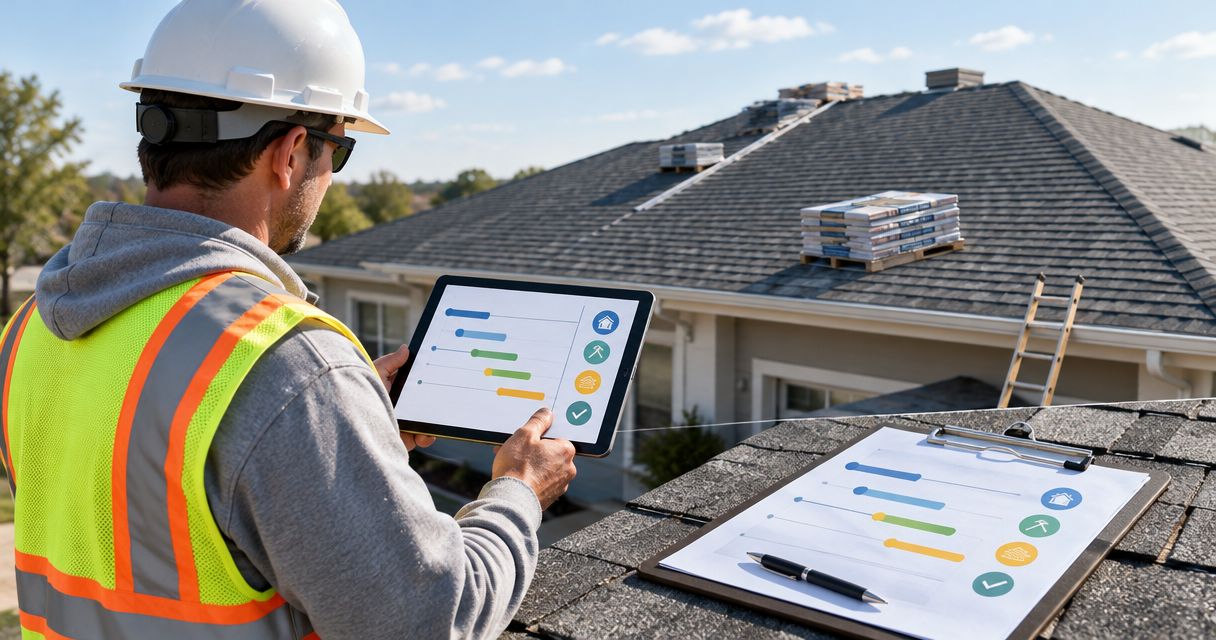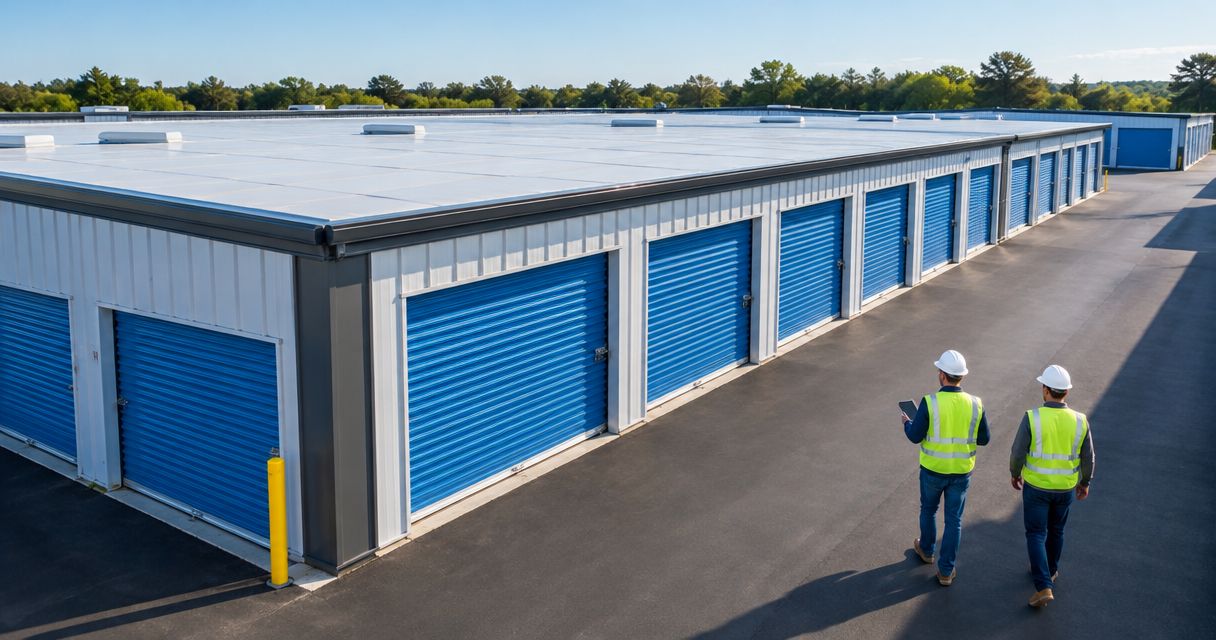
Self-storage commercial roofing is the inspection, repair, and replacement of storage-building roofs to protect tenants’ belongings and keep units usable. This 2026 guide explains how to assess drive-up rows and climate-controlled buildings, choose a defensible scope, and organize work around tenant access rather than treating the property as an empty construction site.
- Commercial roofing for self storage facilities should start with documented roof conditions, drainage, and tenant-access requirements.
- Murray Roofing provides commercial roofing inspections, repair, and replacement for Lincoln and Omaha property owners.
- Choose targeted repairs for isolated defects; require evidence before approving restoration, a recover, or full replacement.
- Separate roof warranties, insurance decisions, and tenant-property responsibilities before signing a contract.
Why commercial roofing matters for self-storage facilities
A storage roof protects more than the building. Water entering an occupied unit also creates a tenant-service problem, while roofing equipment placed in a narrow drive aisle can obstruct access to an entire row.
Your first task is to connect roof conditions with operations. Review the available roofing services against what your facility needs: investigation of an active leak, repairs to a defined defect, or replacement planning across several buildings.
Drive-up facilities need clear door access and controlled debris. Climate-controlled buildings also need attention to insulation, interior moisture, and equipment penetrations. Neither layout justifies selecting a roof system from a brochure without assessing the existing assembly.
For Lincoln and Omaha properties, your 2026 plan should address hail, wind, snow, and drainage without assuming every weather event requires replacement. Choose the scope from documented damage and roof condition, not from the storm headline.
Plan your self-storage roofing project
1. Build a roof record for every building
Start with a spreadsheet and a site map. Assign each building a consistent identifier, then connect unit numbers, roof areas, and reported leaks to that identifier. Staff should collect observations from accessible locations without climbing onto roofs.
A stain inside a unit does not establish where water entered. Record its position and the conditions surrounding the report, then let a qualified contractor investigate the roof and related building components.
For your 2026 baseline, organize the previous 12 months of service records if you have them. That is a recordkeeping window, not a claim about how frequently your roof needs work.
Close gaps before requesting proposals. An undocumented patch history makes it harder to distinguish an isolated defect from a recurring problem.
- Building map: Label buildings, unit rows, drains, and access points.
- Leak log: Record the unit, report date, weather conditions, and visible effects.
- Roof documents: Gather installation records, previous scopes, and warranties.
- Site observations: Photograph visible interior staining and ground-level drainage concerns.
2. Define tenant protection before requesting bids
Write down your operating constraints before a contractor sets the work sequence. Include gate access, delivery routes, office hours, loading areas, and any units that require advance access arrangements.
Do not promise uninterrupted access before the contractor reviews the site. Ask for a written plan identifying which areas require restrictions, who communicates those restrictions, and how emergency access remains clear.
For climate-controlled storage, include equipment shutdowns and interior protection in the planning conversation. For drive-up rows, focus on door clearance, material placement, and collecting fasteners from vehicle paths.
Tenant communication should describe the actual work zone, not merely announce that roofing is happening somewhere on the property.
- Access map: Mark tenant routes, restricted areas, and emergency access.
- Work zones: Identify material staging and debris-container locations.
- Tenant notices: Explain affected buildings and how updates will arrive.
- Interior access: Establish authorization procedures for occupied units.
- Site cleanup: Require checks around doors, tires, gates, and loading areas.
3. Get an inspection that supports a decision
Gather your records first; then request a professional assessment. Ask the contractor to explain the roof’s condition, the suspected cause of each problem, and the evidence supporting the proposed scope.
Murray Roofing is best for Lincoln and Omaha self-storage owners seeking commercial roofing inspection, repair, and replacement services. The company offers free inspections and commercial roofing services. Those services provide a starting point, but the recommendation still needs a property-specific scope; an inspection is not a substitute for engineering or specialized testing when either is required.
For a 2026 replacement decision, ask whether moisture testing, exploratory openings, or structural review is necessary. The answer depends on the assembly and observed conditions, not on the property’s business category alone.
Require findings that separate immediate leak control from longer-term capital work. That distinction helps you act on an urgent problem without approving an unsupported full replacement.
- Observed defects: Request photographs tied to building locations.
- Water entry: Ask what evidence connects the defect to the reported leak.
- Drainage: Review outlets, gutters, downspouts, and discharge locations.
- Hidden conditions: Identify what remains unknown beneath the roof surface.
- Scope rationale: Require an explanation of why the proposed work fits the findings.
4. Choose the scope before choosing materials
Compare 2 written scopes when a contractor presents a genuine repair-versus-replacement decision. Use the same inspection findings and operating requirements for both; otherwise, you are comparing different projects.
A targeted repair addresses a defined defect. Restoration, a recover, and full replacement each require different suitability checks. None is automatically the right choice because the property contains storage units.
Use the comparison below to frame the discussion. Starting prices are deliberately excluded: request a property-specific written proposal rather than applying a generic figure to an uninspected roof.
| Option | Best for | Practical benefit | Key limitation |
|---|---|---|---|
| Targeted repair | An isolated, confirmed defect in an otherwise serviceable roof | Limits work to the identified problem | Does not resolve unrelated deterioration or hidden wet materials |
| Compatible coating or restoration | An existing roof confirmed suitable for the proposed treatment | Retains a suitable existing assembly | Requires substrate preparation and compatibility; does not replace failed decking |
| Roof recover | An existing assembly confirmed eligible to receive another system | Retains qualifying existing roof components | Depends on moisture conditions, structure, attachment, and applicable code |
| Full replacement | Widespread failure or an assembly unsuitable for retention | Allows removal and assessment of concealed conditions | Requires more extensive site coordination and decisions about discovered damage |
Material selection follows that decision. A sloped metal roof and a low-slope membrane roof require different details, and neither should be specified without checking slope, drainage, attachment, and the existing construction.
Do not buy a surface treatment to avoid investigating a failing assembly. Ask what the proposed work fixes and what it explicitly leaves unchanged.
- Repair scope: Identify every defect included and excluded.
- Restoration suitability: Require written preparation and compatibility requirements.
- Recover eligibility: Confirm code, structural, and moisture checks.
- Replacement scope: Define removal, substrate assessment, insulation, and drainage work.
5. Phase the work around occupied units
Build the schedule around areas that can be controlled safely, not just around the easiest route for equipment. A building-by-building plan makes responsibilities clearer when several rows remain occupied.
Ask the contractor to explain how the roof will be protected during work and how weather changes affect the sequence. Do not accept a completion guarantee that ignores concealed damage or unsuitable conditions.
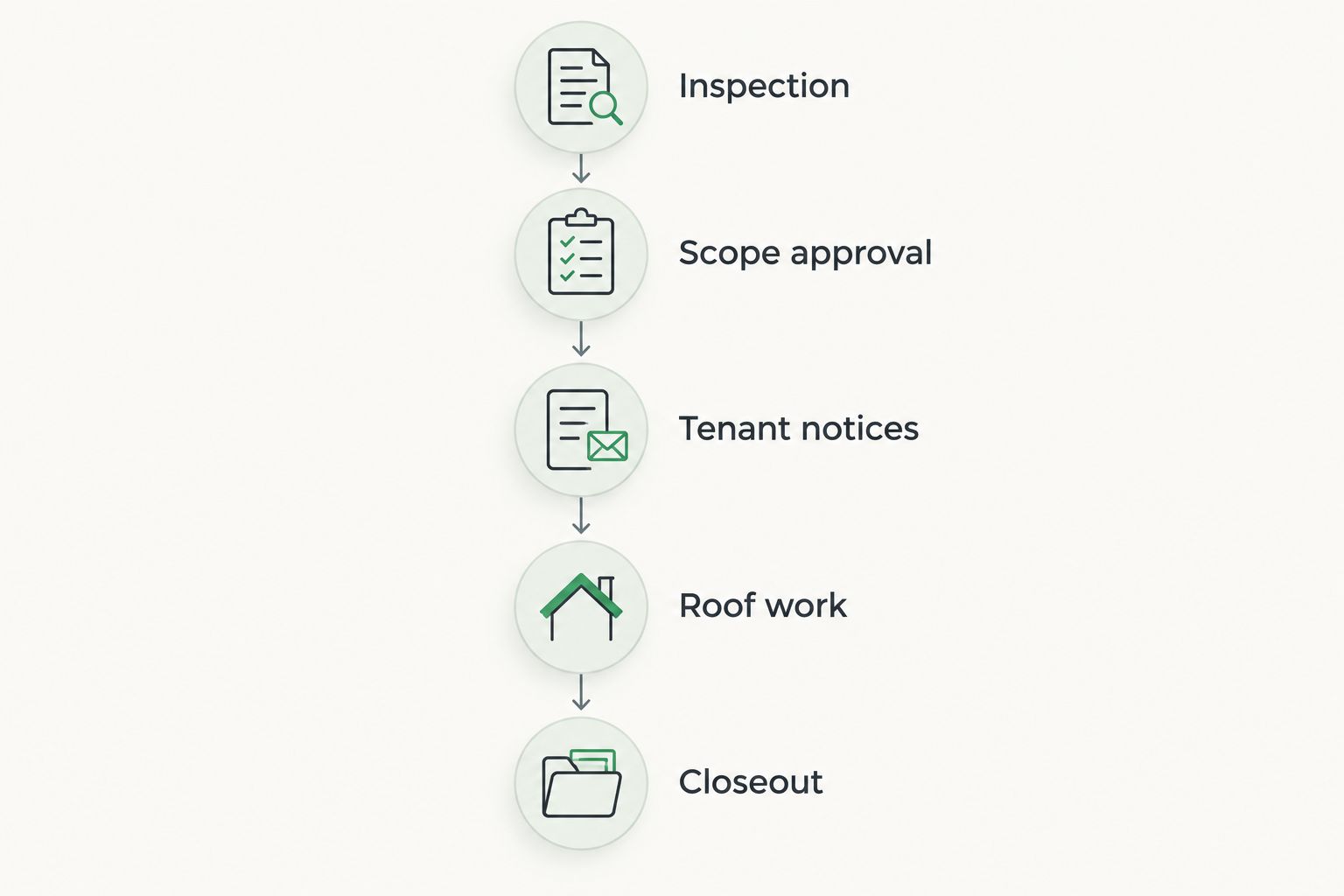
The process should have clear handoffs: Inspection, Scope approval, Tenant notices, Roof work, and Closeout. Your site manager needs to know who approves each transition and where unresolved issues are recorded.
A phased project still needs a change procedure. If removal exposes damaged decking or wet insulation, establish who receives the evidence, who authorizes additional work, and how the change is documented.
- Daily coordination: Name the contractor contact and property decision-maker.
- Weather protection: Request the contractor’s plan for exposed work areas.
- Change authorization: Require photographs and written approval for added work.
- Tenant updates: Communicate changes to access restrictions promptly.
- Final walkthrough: Review completed areas and remaining issues before closeout.
6. Verify warranties and establish maintenance records
Read the warranty documents before approving the contract. Material coverage, workmanship coverage, exclusions, maintenance duties, and claim procedures are separate questions.
Murray Roofing lists a 10-year labor warranty and a 50-year Golden Pledge warranty among its trust signals. Do not assume either applies to a self-storage proposal: obtain written confirmation of eligibility, the specific system covered, and the actual terms offered for your commercial project.
Financing is also part of the company’s offering, but eligibility and terms require confirmation. Keep financing approval separate from the technical decision about what your roof needs.
For your 2026 maintenance file, retain the signed scope alongside completion photographs and warranty documents. Set future inspections according to the roof system, warranty obligations, contractor recommendations, and observed conditions rather than adopting an unsupported universal interval.
- Warranty documents: Identify the issuer, coverage, exclusions, and claim process.
- Completion records: Keep photographs, approved changes, and final scope documents.
- Maintenance duties: Record required inspections and authorized maintenance methods.
- Incident procedure: Assign responsibility for documenting and reporting future leaks.
- Funding records: Keep financing agreements separate from warranty paperwork.
Common mistakes self-storage owners make
Treating every building as the same roof
A property can contain buildings constructed or repaired at different times. Do not extend one roof’s inspection findings across every row without assessment. Request building-specific recommendations, even when the contractor groups the work into one project.
Scheduling around the office instead of tenant access
An open office does not mean tenants can reach their units. Check the proposed work zones against roll-up doors, turning space, keypad access, and loading routes. Communicate restrictions by affected building so tenants can understand whether the notice applies to them.
Confusing condensation with a confirmed roof leak
Interior moisture requires diagnosis. Water on an underside surface is not, by itself, proof of a roof opening. Ask the contractor to distinguish exterior water entry from condensation and identify whether additional building-envelope or mechanical expertise is needed.
Applying residential warranty language to commercial work
A familiar warranty name does not establish commercial eligibility. Require the actual document for the proposed roof assembly and property use. Check who registers the warranty, what maintenance is required, and which party handles a future claim.
Assuming insurance will fund the chosen scope
A contractor’s recommendation and an insurer’s coverage decision are different. Document conditions and keep records of communications, but do not treat claim support as a promise of coverage. Confirm policy questions with your insurer before making funding assumptions.
FAQ
What’s the best roofing approach for a self-storage facility?
The best approach starts with an inspection and a building-specific scope. Targeted repairs fit isolated defects; restoration, a recover, or replacement requires evidence that the existing assembly is suitable for that choice.
Can tenants keep accessing units during a roof replacement?
Tenant access must be determined in the project plan, not promised in advance. Ask the contractor to identify restricted rows, material staging areas, emergency routes, and how changes will be communicated.
Is a metal roof better than a membrane roof for storage buildings?
Neither is automatically better for every storage building. Choose the assembly according to roof slope, drainage, structure, attachment requirements, and the existing construction rather than the facility’s business category.
Can a roof coating fix a leaking self-storage roof?
A compatible coating is an option only when inspection confirms that the existing roof is suitable for the proposed treatment. Failed decking, trapped moisture, or unresolved drainage problems require assessment rather than concealment beneath a coating.
Does Murray Roofing handle commercial roofing in Lincoln and Omaha?
Murray Roofing provides commercial roof inspection, repair, replacement, and maintenance services in Lincoln and Omaha. Request a written scope that addresses your storage buildings, tenant access, and project-specific warranty eligibility.
Will insurance cover storm damage to a storage facility roof?
Coverage depends on the policy, documented cause of damage, exclusions, and the insurer’s decision. Contractor documentation and insurance-claim support do not guarantee payment or approval of a replacement scope.
What should a self-storage roof replacement proposal include?
A proposal should identify the buildings, roof assembly, removal or retention scope, drainage details, tenant-access plan, and warranty terms. It should also explain how concealed damage and additional work will be documented and authorized.
One last thing
Ask for a closeout package organized by building number, not just one folder labelled with the property address. When a tenant reports water later, your manager can locate the relevant scope, photographs, warranty, and repair history without reconstructing the entire project.
For a 2026 roofing decision, the most useful deliverable is a documented plan you can operate around. Contact Murray Roofing to schedule an inspection or request a property-specific price for your Lincoln or Omaha self-storage facility.
Related guides
- Is it cheaper to repair or replace a commercial roof?
- Commercial roof warranty types for property owners
- Commercial roof maintenance plans for property managers