If you're searching for White Castle Roofing alternatives in Lincoln, start with an inspection and a written scope—not a ranking of contractors. Murray Roofing provides residential and commercial roofing services in Lincoln and Omaha, including inspections, repair, replacement, and financing, so you can get another assessment before deciding what your property needs.
- Searching white castle roofing alternatives lincoln? Murray Roofing offers inspections, repair, replacement, and financing in Lincoln and Omaha.
- Choose roof repair or roof replacement from documented conditions, not a contractor ranking.
- Compare written scopes, warranty terms, and payment obligations before signing.
- Commercial roofing decisions also need access, drainage, and occupant-protection plans.
Why this matters
A second roofing opinion is useful when it resolves a specific question: where water is entering, whether damage is isolated, or what a full replacement includes. Another estimate without an explanation of the roof's condition leaves you with another number and the same uncertainty.
For a Lincoln or Omaha project in 2026, your first task is to define the work. Review the available roofing services and request an assessment that separates immediate concerns from longer-term replacement planning. You do not need to choose a contractor before you understand the problem.
Start with the decision your roof actually needs
Before requesting another proposal, explain what prompted your search. An active leak, recurring repairs, a property purchase, and a planned commercial replacement require different assessments. Give each contractor the same background so the recommendations address the same concern.
Describe what you have observed without diagnosing it yourself. Useful details include where stains appear, whether leaks follow particular weather conditions, and what previous work was completed. Share repair invoices or inspection reports when you have them.
Ask the inspector to explain the cause, the affected area, and the proposed remedy separately. A photograph of damaged roofing helps document a condition, but you also need an explanation of how the proposed work addresses it.
For a full replacement, ask why repair is no longer the recommended approach. For a repair, ask what remains outside the scope and what condition would trigger a replacement discussion later.
Repair, replacement, or maintenance at a glance
These are project choices, not interchangeable services. An inspection should establish which approach fits the roof's condition and your ownership plans.
| Approach | Best for | Main benefit | Main limitation | What to request |
|---|---|---|---|---|
| Targeted repair | A defined defect with surrounding roofing suitable to remain | Addresses a specific problem without replacing the entire roof | Does not renew aging or damaged areas outside the repair | Location, cause, repair scope, and remaining concerns |
| Full replacement | A roof whose documented condition supports removing and replacing the system | Allows the proposal to address the roof as a complete project | Requires broader work, property protection, and financial planning | Removal scope, materials, details, exclusions, and warranties |
| Maintenance | A serviceable roof needing routine attention | Supports ongoing care and identification of developing issues | Is not a substitute for correcting underlying failures | Tasks, findings, recommended repairs, and follow-up responsibilities |
Best for an uncertain diagnosis: get an inspection before choosing any of these approaches. Selecting a service first can narrow the conversation before the roof's condition is understood.
Get 3 documents before approving roofing work
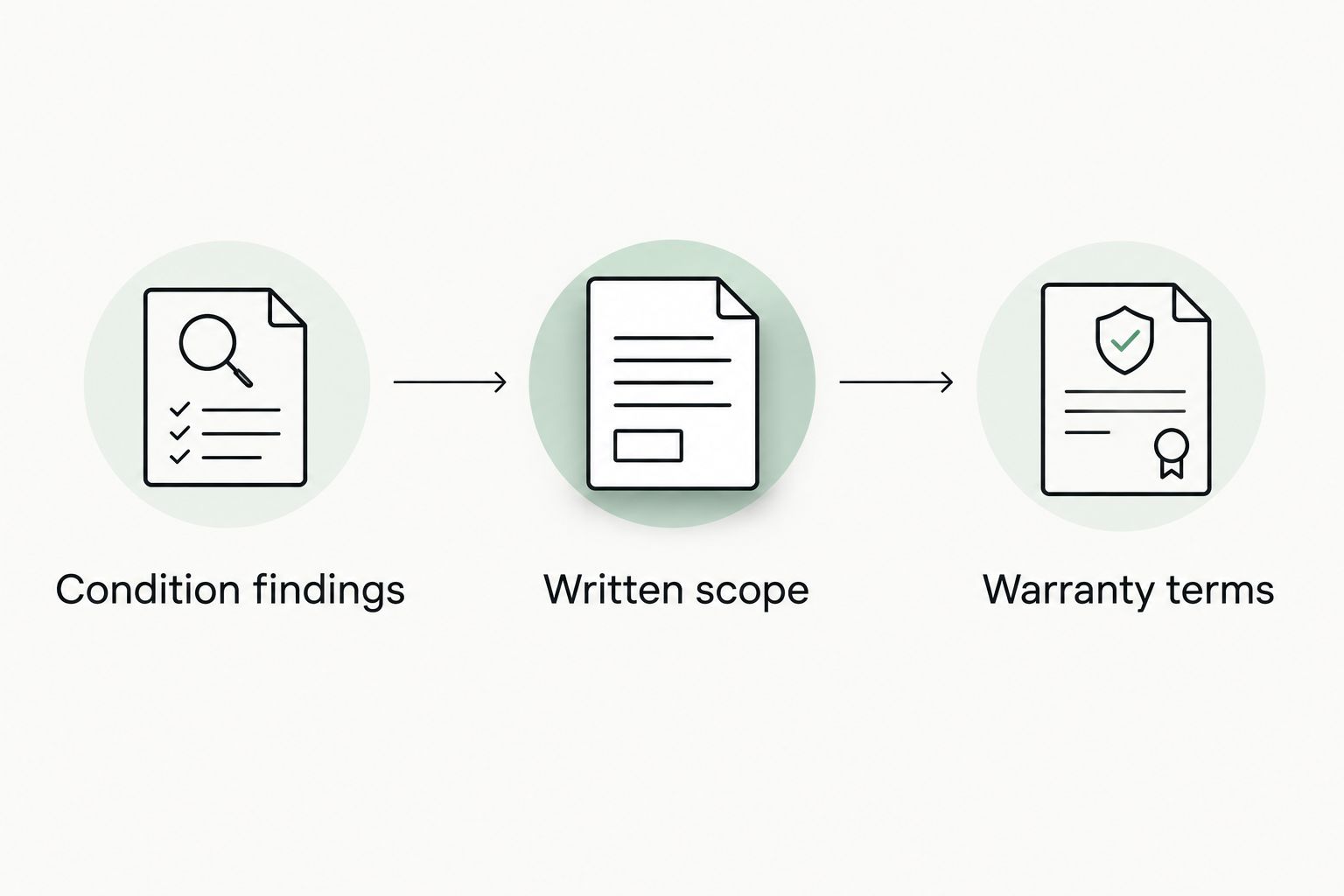
Your 2026 roofing decision should rest on information you can keep and review. Request 3 documents: condition findings, a written scope, and warranty terms. Each answers a different question, and none replaces the others.
Condition findings
Ask for photographs and plain-language explanations of the areas inspected. The findings should distinguish observed damage from areas that need further investigation. If concealed conditions cannot be established before work begins, ask how those discoveries will be documented and authorized.
A useful assessment also explains the limits of the inspection. An exterior review does not automatically establish the condition of every concealed component. Ask what was accessible and what remains uncertain.
Written scope
The scope should identify what the contractor will remove, repair, retain, and install. For replacement work, ask about the roof covering, underlying components, flashing, ventilation where applicable, cleanup, and protection of the property.
Do not assume that similar proposal totals mean identical work. Read exclusions and allowances carefully, especially provisions for damaged decking or other conditions discovered after removal.
Warranty terms
Request the actual warranty documents applicable to your proposed system. Identify who provides each warranty, what it covers, and what you must do to maintain eligibility.
A warranty summary is useful for orientation. The written terms determine the coverage, exclusions, registration requirements, and claim process.
What to ask about a full roof replacement
For homeowners in Lincoln and Omaha, a replacement proposal should explain more than the visible roofing material. Ask how the work addresses the surrounding details that direct water away from the building and how existing components will be evaluated.
Use these questions during the estimate review:
- Removal: What existing materials are included in removal, and what stays?
- Decking: How will unsuitable decking be documented before additional work proceeds?
- Flashing: Which flashing details will be replaced, and which are proposed to remain?
- Ventilation: How will ventilation needs be evaluated for this roof?
- Property protection: How will landscaping, entrances, vehicles, and nearby equipment be protected?
- Cleanup: What debris removal and final cleanup are included?
- Changes: Who approves additional work, and how is that approval recorded?
Discuss your plans for the property as well. An owner preparing to sell needs clear records to share with buyers; a long-term owner needs to understand maintenance and warranty obligations. Neither situation justifies leaving a known roofing problem unexplained.
For a 2026 replacement, keep the approved material selections and any later changes with the signed contract. Verbal conversations are easier to misunderstand than a shared written record.
Commercial roofing needs a building-specific scope
Commercial property decision-makers should start with the roof system, building use, drainage, and access requirements—not the business category alone. Offices, warehouses, restaurants, retail properties, apartments, schools, and other commercial buildings all need a scope based on their actual conditions.
Ask the contractor to identify the existing system and explain the proposed repair or replacement approach. A familiar material name is not enough; you need to understand the preparation, transitions, penetrations, and drainage details included in the work.
Your operational questions belong in the proposal discussion:
- Which entrances, loading areas, or parking spaces need coordination?
- How will occupants and visitors be kept away from the work area?
- What rooftop equipment requires coordination with another trade?
- How will the contractor communicate changes affecting building operations?
- Who receives inspection findings and approves additional work?
Best for commercial owners: a written plan that connects roofing work to building operations. Do not accept a schedule as a guarantee that weather, concealed conditions, or necessary coordination cannot affect the project.
If you manage properties in both Lincoln and Omaha, use a consistent review checklist in 2026. Keep each building's assessment separate; a recommendation for one roof does not establish the needs of another.
Understand warranty coverage before comparing durations
Murray Roofing identifies GAF Master Elite status, a 50-year Golden Pledge warranty, and a 10-year labor warranty among its trust signals. Ask which coverage applies to your specific proposal rather than treating every listed warranty as automatic coverage for every roof.
The 50-year duration and the 10-year duration describe different warranty offerings. Do not read either as a promise that every cause of damage, every component, or every future repair is covered.
Ask these questions before signing:
- Who is responsible for material-related claims and workmanship-related claims?
- What installation or product requirements apply?
- Is registration required, and who handles it?
- What maintenance records should you retain?
- What exclusions or transfer conditions apply?
For commercial roofing, request the terms for the proposed commercial system rather than assuming residential warranty language applies. Keep the final warranty documentation with your contract and completion records.
Separate financing from the roofing recommendation
Financing is a way to arrange payment; it does not establish whether replacement is necessary. Decide what work the property needs, then review how you intend to pay for it.
Murray Roofing offers financing, but your decision should depend on the terms presented for your application and project. Review the repayment obligation, interest terms, fees, and any conditions before accepting an agreement. Do not assume approval or a particular payment arrangement.
For a business, clarify who has authority to sign both the roofing contract and any financing agreement. For a household, make sure everyone responsible for payment understands the obligation.
Keep the project scope and financing documents separate. A manageable payment does not resolve an incomplete roofing scope, and a clear scope does not make every financing agreement suitable.
Treat insurance support as documentation, not a promise
A contractor can document roof conditions and explain proposed repairs. Your insurer determines coverage under the policy and claim circumstances; a roofing recommendation does not guarantee claim approval.
Share relevant claim correspondence with the contractor so the repair proposal and insurance paperwork can be discussed accurately. Ask for photographs, a clear scope, and documentation of any additional conditions discovered during authorized work.
Keep copies of communications and ask your insurer about policy questions directly. Avoid signing based on a promise that a storm-related project will have a particular insurance outcome.
Best for a storm-related concern: an inspection that records what is present without promising what insurance will pay. The same principle applies whether you own a home, a rental property, or a commercial building.
When another opinion helps—and when to stop shopping
Another assessment is useful when the diagnosis is unclear, the proposed work lacks detail, or you cannot tell why replacement is recommended over repair. It is also useful when a proposal does not address your building's access, drainage, or operational needs.
Request clarification from your current contractor first. A direct answer and a revised written scope can resolve a concern without restarting the entire process.
You do not need to change contractors simply because another company exists. If your current contractor explains the findings, provides a clear agreement, addresses your questions, and offers terms you accept, continuing with that contractor is a reasonable decision.
For your 2026 project, use a stopping rule: finish gathering opinions when you can explain the roof's condition, the chosen remedy, the exclusions, and your payment obligations. More proposals are not a substitute for those answers.
FAQ
How do I find another roofing option in Lincoln without relying on rankings?
Start with an inspection and request a written explanation of the roof’s condition and recommended work. Review the scope, exclusions, warranty terms, and payment obligations before choosing a contractor.
Does Murray Roofing work on both homes and commercial buildings?
Murray Roofing provides residential and commercial roofing services in Lincoln and Omaha. Services include inspections, repair, replacement, maintenance, insurance-claim support, and financing.
Should I request a repair estimate or a replacement estimate?
Request an inspection first if you do not know which approach the roof needs. Ask the contractor to explain why the documented condition supports repair, replacement, or maintenance.
What should a commercial roof proposal explain?
A commercial roof proposal should explain the proposed work and how it relates to the existing system and building operations. Ask about drainage, penetrations, equipment coordination, access, property protection, and approval of additional work.
Does a long roof warranty cover every future problem?
No, a warranty’s duration does not establish that every future problem is covered. Review the applicable documents for coverage, exclusions, registration, maintenance requirements, and claim procedures.
Will a roofing inspection guarantee insurance coverage?
No, a roofing inspection does not guarantee insurance coverage. The inspection documents conditions, while the insurer determines coverage under the policy and claim circumstances.
Can I get financing for roofing work?
Murray Roofing offers financing. Review the terms presented for your application and project, and do not assume approval or a particular repayment arrangement.
One last thing
Ask the contractor to identify what the proposal leaves unchanged. That question makes exclusions easier to understand and helps distinguish a targeted repair from a project intended to address the whole roof.
Before signing, make sure you can describe both the work being purchased and the conditions that remain outside it. A clear boundary around the work is as important as a clear description of what is included.
Related guides
- Is it cheaper to repair a roof or replace it completely?
- Roof installation and manufacturer warranty registration
- Roofing guidance for property managers
Ready to understand your Lincoln or Omaha roof? Contact the roofing team to schedule a free inspection or get a price for your project.