A metal roof is worth the extra cost in 2026 when you plan to keep the property, the roof suits the building, and the written proposal justifies the upgrade over asphalt shingles. It is not automatically the better purchase for a short ownership period or a roof that still has useful service life. The decision must include installation details, maintenance, financing, and warranty exclusions—not just the panel material.
- Is a metal roof worth it? Choose metal roofing when long-term ownership and a suitable roof justify the upgrade.
- Standing seam conceals panel fasteners; exposed-fastener roofing requires attention to screws and sealing washers.
- Asphalt shingles remain a practical alternative when the metal upgrade does not support your ownership plans.
- Murray Roofing offers roof inspections in Lincoln and Omaha; start with roof condition, not a material preference.
Why this matters
A roof replacement changes more than the appearance of your home or commercial building. Your choice affects drainage details, future repairs, roof access, and the terms you need to understand before signing a contract.
For Lincoln and Omaha properties, compare the proposed system against the building's actual conditions. The guide to roof types for Nebraska weather provides context, but the inspection determines which options belong in your estimate.
Choose the roof that solves your building's problems—not the material with the longest advertised lifespan. A material upgrade does not fix an incomplete installation scope.
Is a metal roof worth the extra cost in 2026?
Metal roofing is worth considering for long-term ownership, but it is not a guaranteed financial return. Compare complete roof assemblies rather than treating every metal estimate as equivalent.
Standing seam, exposed-fastener panels, and asphalt shingles differ in how they attach, how repairs work, and what requires attention after installation. The table below explains the practical trade-offs without assuming one system fits every property.
| Roofing option | Best for | Main advantage | Main limitation | What to verify |
|---|---|---|---|---|
| Standing-seam metal | Long-term owners evaluating concealed-fastener roofing | Conceals panel attachment beneath the roof surface | Seams, edges, and penetrations still require skilled detailing | Panel profile, attachment method, slope requirements, and flashing scope |
| Exposed-fastener metal | Suitable buildings where visible fasteners are acceptable | Fasteners remain visible for inspection | Screws and sealing washers require continuing attention | Fastener specifications, maintenance expectations, and repair responsibilities |
| Asphalt shingles | Owners who prefer shingles and cannot justify the metal upgrade | Individual damaged shingles can be replaced when surrounding material allows | Shingle condition, installation, and weather exposure affect service life | Underlayment, ventilation, flashing, and applicable warranty terms |
None of these options is maintenance-free. Metal panels still depend on joints, flashing, attachments, and roof penetrations to keep water out.
For your 2026 decision, request a written explanation of what changes between proposals. A comparison is incomplete when one estimate includes tear-off and flashing replacement while another leaves those items unclear.
Standing-seam metal: best for concealed-fastener roofing
Standing-seam metal roofing joins panels along raised seams and typically conceals the attachment hardware. That reduces exposed fastening points across the panel surface, but it does not eliminate leak risks at transitions, walls, vents, or other openings.
The strongest reason to consider standing seam is the roof assembly itself. Do not approve the upgrade solely because a brochure describes metal as durable.
Ask the contractor to identify:
- The proposed panel profile and seam method.
- The manufacturer's minimum roof slope for that system.
- How the assembly accommodates thermal movement.
- How roof edges, valleys, walls, and penetrations will be detailed.
- Who handles future service and modifications.
Best for: Owners who intend to retain the property and want a concealed-fastener system supported by a clear installation scope. Its limitation is that panel quality cannot compensate for poor seam or flashing work.
Exposed-fastener metal: best when maintenance is planned
Exposed-fastener roofing uses screws that pass through the panels, commonly with sealing washers at the attachment points. Those fasteners are part of the weatherproofing system, not merely a way to hold the roof in place.
The visible attachments make fastener condition accessible to a professional inspection. They also create components that need ongoing attention as the roof ages.
Ask what inspections the manufacturer requires and what conditions trigger fastener service. Do not accept a universal replacement interval without documentation for the actual system.
Best for: Suitable properties whose owners accept visible fasteners and a documented maintenance plan. Its limitation is that the purchase includes future care of screws and washers, not just the panels.
Asphalt shingles: best when the upgrade lacks a clear benefit
Asphalt shingles remain a legitimate choice when the roof is suitable and the metal proposal does not justify the additional commitment. Choosing shingles is not automatically choosing an inadequate roof.
The International Residential Code's asphalt-shingle provisions set a minimum slope of 2:12—2 inches of rise for every 12 inches of horizontal run. Lower-slope applications within the permitted range have additional underlayment requirements; confirm the locally adopted code and manufacturer instructions with your contractor.
That rule illustrates why roof geometry comes before material preference. Metal systems also have system-specific slope requirements, so metal is not a blanket solution for every low-slope roof.
Best for: Owners whose budget, appearance preferences, and ownership plans favor shingles. The limitation is that the roof still needs a complete, properly installed assembly; selecting a familiar material does not remove that requirement.
Why the value of a metal roof varies
The same roofing material can make sense on one property and be difficult to justify on another. These factors determine whether your 2026 upgrade addresses a real need.
- Ownership plans: Compare the benefits you expect to use while you own the property. Do not assume a future buyer will repay the full upgrade.
- Roof condition: A sound roof and a failing roof present different decisions. An inspection should establish whether replacement is necessary before comparing replacement materials.
- Roof geometry: Pitch, valleys, dormers, walls, and penetrations affect installation details. A simple panel layout does not describe a complicated roof.
- Installation scope: Tear-off, damaged decking, underlayment, ventilation, and flashing change what you are buying. Compare those items explicitly.
- Maintenance responsibilities: Exposed fasteners, sealants, drainage points, and rooftop equipment create different inspection needs. Obtain a plan for the proposed assembly.
- Contract terms: Financing, warranties, insurance provisions, and exclusions affect the ownership commitment. Read the actual documents rather than relying on a sales summary.
An upgrade is justified by the building and the contract—not by the word metal. If the proposal cannot explain its benefits for your roof, request clarification before approval.
What should Lincoln and Omaha owners check before choosing metal?
For a Nebraska property, ask how the proposed roof addresses wind, hail, water entry, and winter drainage. A material label alone does not establish performance under those conditions.
Request documentation for the proposed product or assembly, including any relevant impact or wind testing. A test classification describes a defined test; it is not a promise that a future storm cannot damage the roof.
Separate appearance damage from loss of weather protection when reviewing insurance and warranty language. Metal panels can dent, and cosmetic-damage provisions deserve attention before you choose the system.
Winter planning also belongs in the estimate. Ask whether the roof design needs snow-retention measures to protect entrances, walkways, gutters, or equipment below roof slopes.
For commercial properties, include roof access and equipment service. Restaurants, warehouses, apartments, offices, churches, and other building types all need details matched to their actual roof—not a recommendation based solely on their business category.
How do you compare metal and shingle estimates fairly?
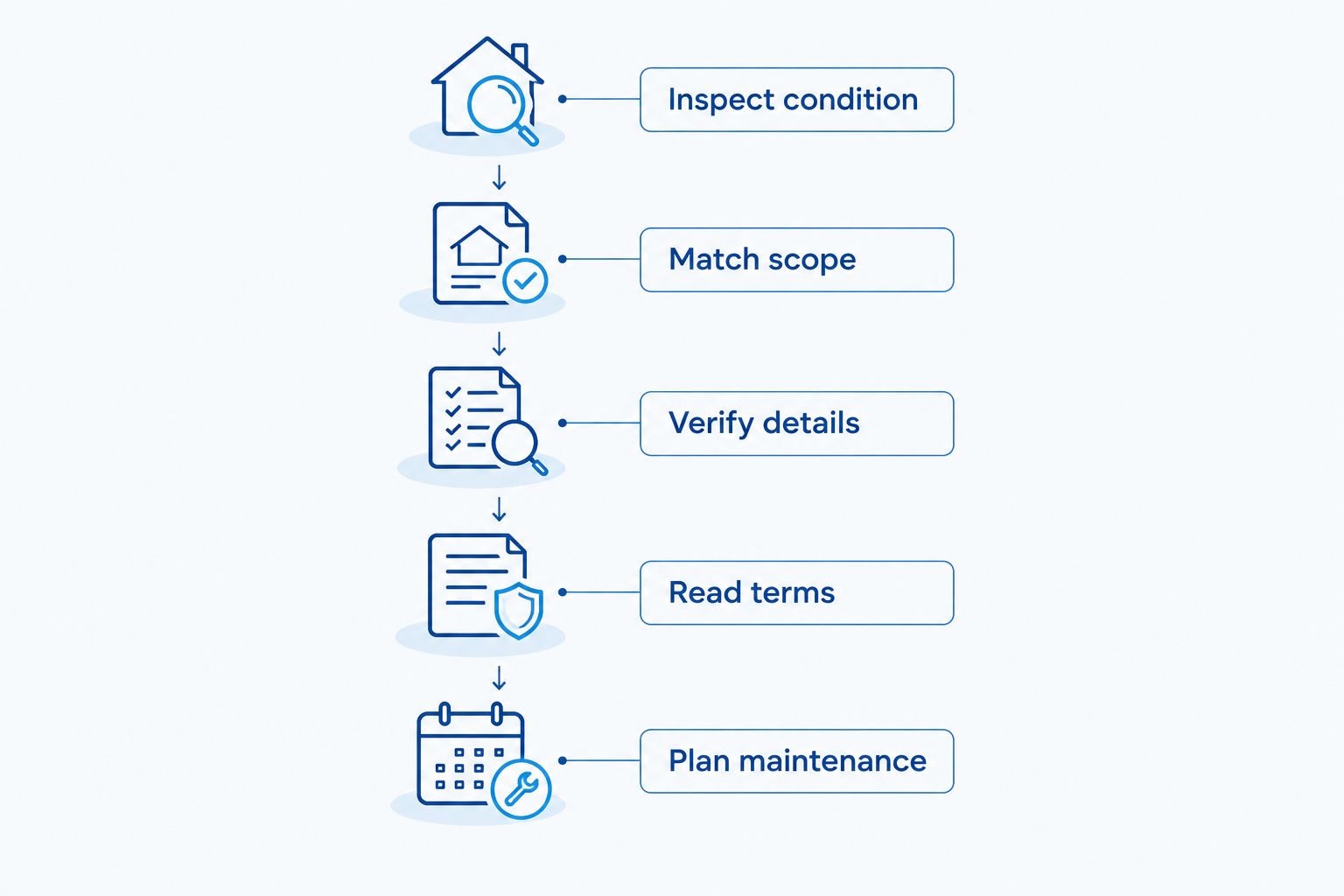
Use the same process for every proposal. Your 2026 comparison should reveal differences in the work, not just differences in the headline offer.
- Inspect condition. Establish the existing roof's condition, visible damage, and whether replacement is the appropriate next step. Ask what remains uncertain until tear-off.
- Match scope. Compare removal, disposal, decking allowances, underlayment, flashing, ventilation, and gutters where relevant. Identify reused components explicitly.
- Verify details. Confirm the exact roofing system, slope requirements, attachment method, and treatment of penetrations. Avoid contracts that describe the work only as installing metal roofing.
- Read terms. Review payment obligations, financing documents, workmanship coverage, manufacturer coverage, exclusions, and maintenance conditions.
- Plan maintenance. Identify who services the finished roof and how inspections or repairs are documented. Include access needs for commercial equipment.
A proposal that answers these questions gives you a basis for deciding. A proposal that leaves them unanswered requires clarification before signing.
Financing helps organize payment, but it does not establish roof quality or make an upgrade worthwhile. Compare the total repayment obligation and written terms separately from the roofing recommendation.
Does a metal roof pay for itself through energy savings?
Do not assume energy savings will repay the metal upgrade. The U.S. Department of Energy's cool-roof guidance identifies solar reflectance and thermal emittance as important performance characteristics; those depend on the roof product and surface, not simply whether it is metal.
Your building's insulation, air leakage, ventilation design, and heating and cooling use also affect the result. Ask for documentation tied to the proposed product rather than accepting a general claim about reflective roofing.
In 2026, treat any claimed savings as a separate question requiring evidence. If the proposal lacks a building-specific basis, make the decision without assuming an energy payback.
Is a metal roof better if you plan to sell soon?
A short ownership period makes the upgrade harder to justify on your own use alone. You will have less time to benefit from the roof, and resale recovery is not guaranteed.
If you are preparing to sell, first establish whether the existing roof needs repair or replacement. Then compare suitable systems against the property's needs, your budget, and any transaction requirements.
Do not confuse an attractive roof with a documented return. A buyer's preferences are not a substitute for a complete estimate.
Does a metal roof need maintenance?
Metal roofing needs maintenance and professional inspection. Panels, attachments, flashing, sealants, and drainage details are parts of a working assembly, and each can require attention.
Follow the manufacturer's maintenance requirements and have damage evaluated after a significant weather event. For commercial buildings, coordinate rooftop equipment work so later penetrations or service activity do not undermine the roofing details.
Keep inspection and repair records. Those records help explain the roof's condition and support future warranty discussions without guaranteeing coverage.
What should you know about roofing warranties?
A warranty describes coverage under stated conditions; it does not establish the roof's service life. Separate manufacturer coverage from the contractor's labor or workmanship coverage.
Murray Roofing lists GAF Master Elite status, a 50-year Golden Pledge warranty, and a 10-year labor warranty among its roofing trust signals. Do not assume those terms apply to a metal roof: request the written coverage applicable to your selected system and project.
For a 2026 contract, check exclusions, maintenance obligations, transfer rules, and the process for reporting a problem. Ask which party pays for labor, materials, and related work when a covered issue occurs.
FAQ
Is a metal roof worth it for a home in Lincoln or Omaha?
A metal roof is worth considering when you plan to keep the home, the system suits the roof, and the complete proposal justifies the upgrade. Compare installation scope, maintenance requirements, and written coverage before deciding.
What’s the difference between standing-seam and exposed-fastener metal roofing?
Standing-seam roofing typically conceals panel attachments, while exposed-fastener roofing has visible screws through the panels. Exposed screws and sealing washers require attention, but both systems depend on correct flashing and installation.
Will a metal roof survive every hailstorm?
No metal roof comes with a guarantee against every hailstorm. Ask for product-specific test documentation and review cosmetic-damage provisions in the relevant insurance and warranty documents.
Can a metal roof go on a flat commercial building?
Metal is not automatically suitable for a flat commercial roof. The proposed system must meet its manufacturer’s slope requirements and fit the building’s drainage, structure, and equipment details.
Will my insurance pay for an upgrade to metal roofing?
Insurance payment depends on your policy, the documented damage, and the insurer’s claim decision. Obtain a written explanation of any covered work and any upgrade amount you must fund yourself.
Does a long roofing warranty mean the roof will last that long?
A warranty period is not a promised roof lifespan. Read the coverage, exclusions, maintenance conditions, and labor provisions for the exact roof assembly.
Can I finance a roof replacement through Murray Roofing?
Murray Roofing offers roof-replacement financing. Request the current written terms and compare the repayment obligation separately from the decision to choose metal or shingles.
One last thing
Ask who will repair the roof before asking who will install it. A clear answer about future service, compatible replacement components, and maintenance responsibilities tests whether the proposal addresses ownership beyond installation day.
Murray Roofing is a fit for Lincoln and Omaha homeowners and businesses seeking a roof inspection before choosing repair or replacement. Use that inspection to establish the problem first, then decide whether metal roofing is the appropriate solution.
Related guides
- Roof warranty types for homeowners
- Roof lifespan by material
- Installing solar panels after a roof replacement
Schedule a free inspection with Murray Roofing or request a price for your property. Ask for a written scope that explains the suitable roofing options, installation details, and applicable coverage before you commit.