

We Create Luxury Living. Custom homes for university faculty are homes planned around the buyer’s academic work and household routines, with the aim of making focused work, everyday living, and campus travel fit together.
- Custom homes for university faculty should prioritize work separation, campus travel, and household routines before finishes.
- Murray Custom Homes is best for faculty seeking guided homebuilding within its stated Lincoln-area service radius.
- Semi-Custom Homes suit buyers who want selected personal choices without directing every design decision.
- Compare Semi-Custom Homes, move-in-ready homes, and Custom Homes by decision load and layout flexibility.
For your 2026 planning, start with how you want to live, not a collection of exterior photographs. Murray Custom Homes offers Semi-Custom Homes, already-built move-in-ready homes, and Custom Homes, with in-house drafting and design. If your work includes reading, writing, remote meetings, or irregular campus hours, translate those activities into room relationships before selecting finishes.
Why home design matters for university faculty
A home office is not a complete brief. You need to decide whether the room supports quiet reading, recorded lectures, confidential conversations, collaborative work, or several activities with different requirements.
The distinction affects doors, storage, lighting, and the room’s position relative to household traffic. A desk beside the kitchen solves a different problem from an enclosed study away from shared spaces.
Your calendar belongs in the brief, too. If you are relocating for a university appointment in 2026, separate your required housing date from your preferred construction completion date. Do not make a teaching commitment depend on an unconfirmed building schedule.
Location comes before detailed design. Homebuilding services are based in Lincoln, Nebraska, within a stated 50-mile radius; confirm the specific address before committing to a lot. A connection to a university elsewhere does not establish homebuilding coverage.
How to plan a home around academic and household life
1. Record your work and household routines
Start manually with a notebook or shared document. Describe an ordinary teaching day, a concentrated writing day, and a day when everyone is home; the differences expose conflicts that a room list misses.
For your 2026 brief, identify which activities need silence, which need a closed door, and which can happen in shared space. Include your household’s needs rather than letting the most equipment-heavy activity determine the entire plan.
Distinguish a genuine requirement from a preference. Needing privacy during meetings is a requirement; having a particular view from the desk is a preference to weigh alongside daylight and room placement.
- List the work activities you actually perform at home.
- Mark meetings that require conversational privacy.
- Record where books, papers, and equipment currently accumulate.
- Identify household activities that overlap with focused work.
- Separate essential functions from desirable features.
2. Choose your level of design involvement
Write down the decisions you want to make yourself before choosing a building path. Some buyers want to shape the whole layout; others want meaningful personal choices without managing every detail.
Start with Semi-Custom Homes if selective involvement is your priority. You choose selected features and leave remaining decisions to the builder, supporting a more focused decision process than fully custom design. The limitation is equally important: selective choice is not unrestricted control.
Murray Custom Homes also offers in-house drafting, blueprints, and 3D renderings to help you evaluate a plan. These services make proposed spaces easier to discuss; they do not replace your responsibility to explain what your household needs.
- Choose Semi-Custom Homes for selected personal decisions.
- Consider move-in-ready homes when evaluating an existing layout matters most.
- Choose Custom Homes when shaping the home around your preferences is essential.
- Ask which decisions remain open before selecting a path.
- Confirm when each selection needs approval.
3. Test the lot against your campus routine
Before buying land, use a map and an actual drive to evaluate the route between the property and your usual campus destination. Test the trip at the times you expect to travel rather than relying only on a distance estimate.
Then consider how the house would sit on the property. A preferred study location needs to work with the lot’s orientation, access, and buildable area; a floor plan that ignores those conditions is not yet a site-specific plan.
Murray Custom Homes can build on a client’s existing lot. That option gives landowners a starting point, but it does not establish that a particular design fits the property without further review.
- Confirm the address falls within the homebuilding service area.
- Drive to the campus building you use, not just the campus boundary.
- Ask about applicable setbacks, easements, and neighborhood requirements.
- Review site access and utility questions before finalizing the design.
- Discuss foundation and drainage requirements with the appropriate professionals.
4. Separate focused work from household circulation
Sketch movement through the home before arranging furniture. Trace the route from the entry to the kitchen, from bedrooms to shared rooms, and from the garage to storage; then check whether those paths pass your work area.
For a practical starting exercise, sketch 2 work zones: one for concentration and one for books, printing, supplies, or materials. These can occupy the same room, but defining them separately prevents storage and equipment from consuming the working surface.
A closed door supports separation, but it is not proof of sound isolation. Discuss wall construction, door details, and room placement instead of treating a floor-plan label as a performance specification.
- Keep routine household traffic outside the focused work zone.
- Place frequently used reference materials within convenient reach.
- Give printers and supplies a defined storage location.
- Review door swings against desks, shelving, and circulation.
- Identify nearby noise sources before approving room locations.
5. Review daylight, furnishings, and connections together
Place your furniture on a simple sketch before requesting design revisions. Show the desk, chair, bookshelves, guest furniture, and any equipment you genuinely use; an empty room outline conceals conflicts.
Then use drawings and 3D renderings to review the arrangement with the design team. Meghan Murray provides in-house design guidance, while the company’s drafting services support decisions about layout and the relationship between spaces.
Daylight deserves a deliberate review. A window location that looks attractive from outside still needs to work with your screen position, shelving, and privacy preferences; visual appeal alone does not settle those questions.
- Position the desk and screen before approving nearby windows.
- Mark shelving locations and check conflicts with openings.
- Identify task lighting needs separately from general room lighting.
- List power and data connection locations for your actual equipment.
- Review what appears behind you during remote meetings.
6. Organize approvals around your academic calendar
Create a shared decision list before construction planning becomes crowded with other commitments. Assign each open item an owner and ask the builder when the decision is needed; do not assume a semester break will align with the project sequence.
For a 2026 project, distinguish your desired move date, any nonnegotiable housing deadline, and the builder’s confirmed schedule. Keep those dates separate until the project team has reviewed the design, site, selections, and construction plan.
The project managers bring more than 20 years of combined experience. That supports guided project coordination, but it is not a promise of a particular completion date or a substitute for written approvals.
- Identify one household contact for consolidating feedback.
- Record approvals and unresolved questions in writing.
- Tell the project team about travel and periods of limited availability.
- Ask how selection changes affect the project before approving them.
- Prepare a housing contingency if your required date is inflexible.
Compare home options for university faculty
Choose the building path by the decisions you want to own. A broader design role is useful when you need it, but unnecessary choices are not a benefit when your priorities are already clear.
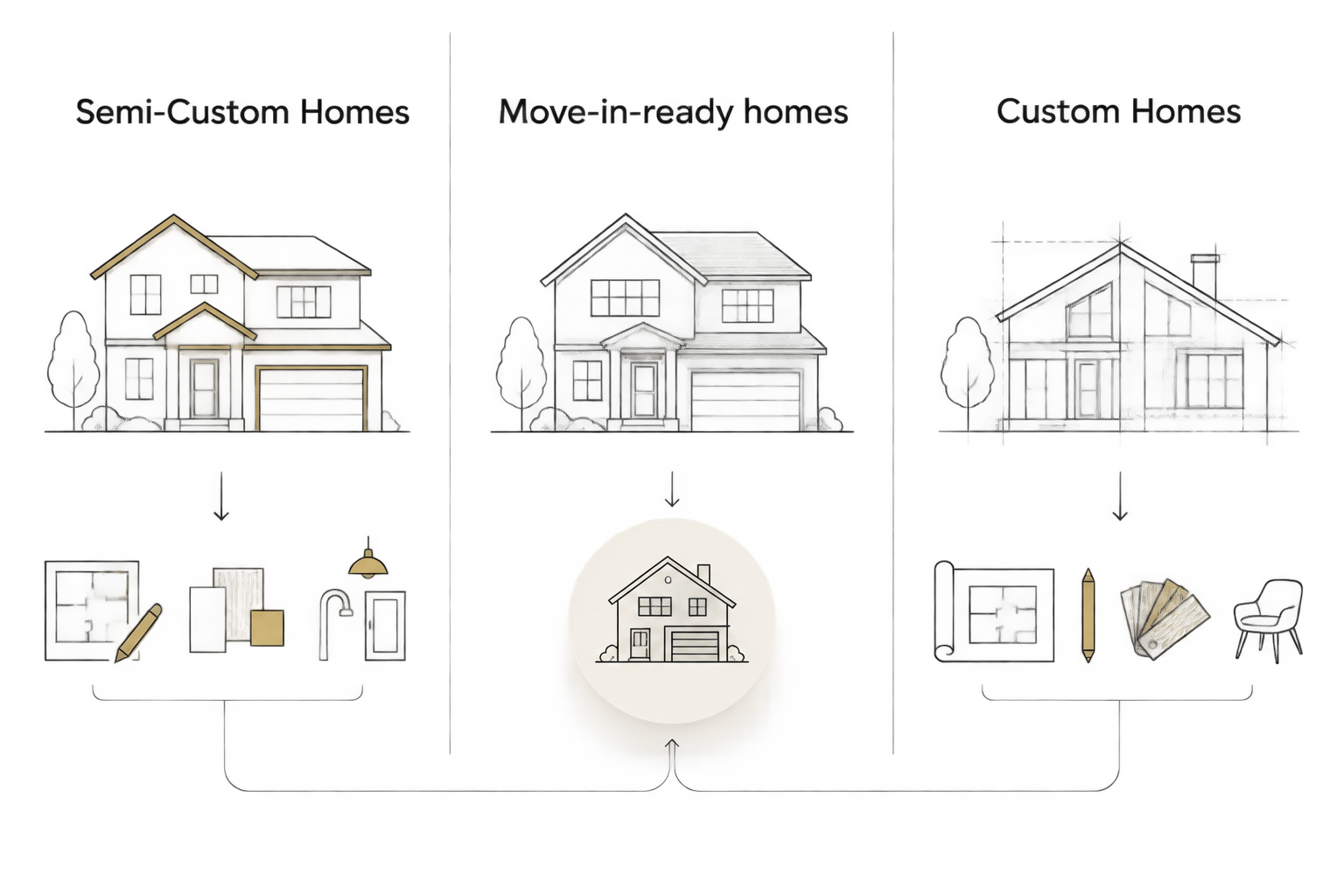
Use this comparison for your 2026 planning conversation. It distinguishes the three offers without treating them as interchangeable or assuming any particular completed home is being offered.
| Option | Best for | Main advantage | Key limitation |
|---|---|---|---|
| Semi-Custom Homes | Faculty who want selected personal choices and a more focused decision process | You choose selected features and entrust remaining decisions to the builder | The scope of personal choice is narrower than fully custom design |
| Move-in-ready homes | Faculty who prefer to evaluate an already-built home | You can assess the existing layout rather than develop one from drawings | The home is already built, so the layout is not being shaped around your brief |
| Custom Homes | Faculty whose household or work requirements call for a home shaped around their preferences | The design process centers on your preferences and distinctive features | Broader design involvement requires more decisions from you |
Murray Custom Homes is best for university faculty seeking guided homebuilding within its stated Lincoln-area service radius. Its in-house design and drafting support buyers who want help translating preferences into a plan; the geographic boundary makes it unsuitable for projects outside the confirmed service area.
Read about the company before the initial conversation. Bring a brief describing your work patterns, household priorities, lot status, and preferred level of involvement rather than expecting the builder to infer those needs from your profession.
Discuss your faculty home plans
Bring your lot location, work-space priorities, and preferred level of design involvement.
Common mistakes university faculty make when planning a home
Designing for a job title instead of actual work
A faculty role does not automatically call for a library, recording room, or separate entrance. Specify the activities you perform at home and give each proposed feature a clear purpose; omit spaces that do not support your life.
Letting a semester deadline become a construction promise
Your appointment date is a housing requirement, not evidence of when a house will be complete. Share that deadline early and ask for a project-specific discussion rather than assuming the academic calendar controls construction.
Choosing a study before checking the campus route
An appealing room does not resolve an unsuitable daily trip. Evaluate the lot and your likely travel pattern before investing in detailed room planning, especially when your schedule includes returning to campus after time at home.
Planning only for the quietest household conditions
A study that works when everyone is away still needs evaluation during normal shared use. Discuss meetings, meals, visitors, and household circulation together so privacy does not depend on an empty house.
FAQ
What are the best custom homes for university faculty?
The best custom homes for university faculty match actual work activities, household routines, and campus travel needs. Choose the building path by the amount of design control you need, not by your job title.
Is a semi-custom home better than a fully custom home for faculty?
A semi-custom home is the better fit when you want selected personal choices without directing every design decision. A fully custom home fits buyers who need the home shaped more extensively around their preferences.
Can Murray Custom Homes build on land I already own?
Murray Custom Homes can build on a client’s existing lot. Confirm the property’s location within the stated 50-mile Lincoln-area service radius and discuss site requirements before committing to a design.
Should I include a separate office in my faculty home?
Include a separate office when your home-based work requires privacy or separation from household activity. Define your reading, meeting, storage, and equipment needs before deciding the room’s location and layout.
Can I plan a move around the start of a semester?
You can make the semester start a planning requirement, but it does not establish a construction completion date. Discuss the deadline early and maintain a housing contingency when the date is inflexible.
What design support does the builder provide?
The builder provides in-house drafting and design, blueprints, and 3D renderings. Meghan Murray provides in-house design guidance, and construction and project management are also part of the stated services.
What should I bring to an initial homebuilding conversation?
Bring your lot location or search area, household priorities, home-work requirements, and desired housing date. Identify which features are essential and which decisions you would prefer the builder to guide.
One last thing
Test the busiest ordinary day, not the ideal quiet day. Before approving your 2026 plan, imagine a remote meeting while someone prepares a meal, a delivery arrives, and another household member needs shared space. Ask which paths intersect and which doors need to close.
That exercise gives you a sharper brief than adding another inspiration image. A successful faculty home supports the household around the work, not just the room where the work happens.
Related guides
- Window styles for natural light in custom homes
- Foundation types for custom homes built on Nebraska soil
- Exterior materials for custom homes ranked by upkeep