A roof warranty claim has no single approval timeline: the issuer must review the reported problem against your warranty terms and any required inspection evidence. Get a claim-specific review estimate in writing rather than relying on a general turnaround promise. Approval also does not mean repairs are scheduled; the written decision must explain the covered work and what happens next.
- How long does a roof warranty claim take to get approved? Your warranty issuer must provide a claim-specific estimate.
- Murray Roofing provides roof inspections in Lincoln and Omaha; the applicable warranty determines coverage and claim requirements.
- Manufacturer warranties and contractor workmanship warranties address different responsibilities. Identify the right recipient before filing.
- Keep claim approval, repair authorization, and the construction schedule separate. Written confirmation matters at each stage.
How long does a roof warranty claim take to get approved?
The useful timeline starts with knowing what the warranty issuer needs to make a decision. Ask whether your submission is complete, whether an inspection or material sample is required, and when you should expect the next written update. Do not treat an automated acknowledgment as approval.
For a claim submitted in 2026, use the warranty issued for your installation—not current advertising—to identify the reporting requirements. A long coverage term describes the protection period, not the time allowed for reviewing a claim.
Follow these steps to establish a usable timeline:
- Identify the warranty. Find the certificate, installation contract, registration confirmation if applicable, and any ownership-transfer documents.
- Report the problem. Use the reporting method specified in the warranty and keep proof of submission.
- Confirm completeness. Ask the recipient to identify outstanding documents, inspection requirements, or evidence requests.
- Request a decision estimate. Get the next review milestone and the responsible contact in writing.
- Separate the next steps. After a decision, confirm the remedy, authorization requirements, and repair scheduling process.
For help distinguishing coverage before filing, review the guide to roof warranty types for homeowners.
Why this matters
A roof leak creates an immediate property problem, but a warranty claim creates a separate coverage question. Waiting for the second process does not protect your building from the first.
For Lincoln and Omaha homeowners, that means arranging a professional assessment while preserving the information the warranty issuer needs. Commercial property decision-makers also need a plan for access, occupants, and affected operations while the claim remains under review.
Do not use an expected approval date as your leak-response plan. Ask a roofing professional about appropriate protective work, and ask the warranty issuer how that work should be documented before evidence is altered.
Which warranty should receive your claim?
Start with the suspected cause, then confirm responsibility against the written coverage. A leak alone does not establish whether the issue involves materials, installation, storm damage, maintenance, or another building component.
The following comparison identifies where to begin. These are reporting routes, not coverage determinations.
| Reporting route | Best for | Main benefit | Main limitation |
|---|---|---|---|
| Manufacturer warranty | Investigating a suspected covered material defect | Provides a process for evaluating the manufacturer's covered product | Does not automatically cover every installation issue or source of leakage |
| Contractor workmanship warranty | Investigating a suspected covered installation issue | Directs the concern to the party responsible under the workmanship agreement | Scope and duration depend on the written agreement |
| Enhanced manufacturer coverage | Checking whether an issued certificate includes broader protection | Can combine additional protections described in the certificate | Eligibility, exclusions, and claim procedures still apply |
| Property insurance claim | Investigating damage associated with a potentially insured event | Addresses a separate policy-based route for covered damage | A warranty claim does not establish insurance coverage |
Ask each recipient to explain its role. If responsibility remains disputed, request the inspection findings and the specific warranty language supporting the position.
Does a longer warranty mean faster approval?
No. Coverage duration is not an approval deadline. A warranty lasting longer does not, by itself, establish a faster review process or broader coverage for the problem you reported.
Murray Roofing's stated roof warranty options include a 50-year Golden Pledge warranty and a 10-year labor warranty. For an existing claim, confirm which coverage was actually issued for your roof; those terms do not establish an approval turnaround or guarantee a particular claim outcome.
What happens between filing and approval?
A claim moves through separate checkpoints. Track each checkpoint independently so you can distinguish a received submission from a completed coverage review.
Report received
Keep the submission confirmation and claim reference. Ask who owns the file and which contact method to use for updates, especially if a contractor and manufacturer are both involved.
Evidence reviewed
The reviewer checks the information submitted against the claim requirements. Ask for a written list of anything still needed rather than sending repeated, unorganized batches of documents.
Inspection completed
Confirm who will inspect the roof, what access is required, and how findings will reach the decision-maker. Do not assume the person taking photographs has authority to approve coverage.
Decision issued
Request a written decision identifying the accepted or rejected issue and the relevant terms. If coverage is approved, ask what remedy is authorized and whether further approval is necessary before work begins.
Work authorized
Confirm responsibility for arranging the work, any required contractor approval, and the proposed scope. An approved claim and a confirmed construction date are different commitments.
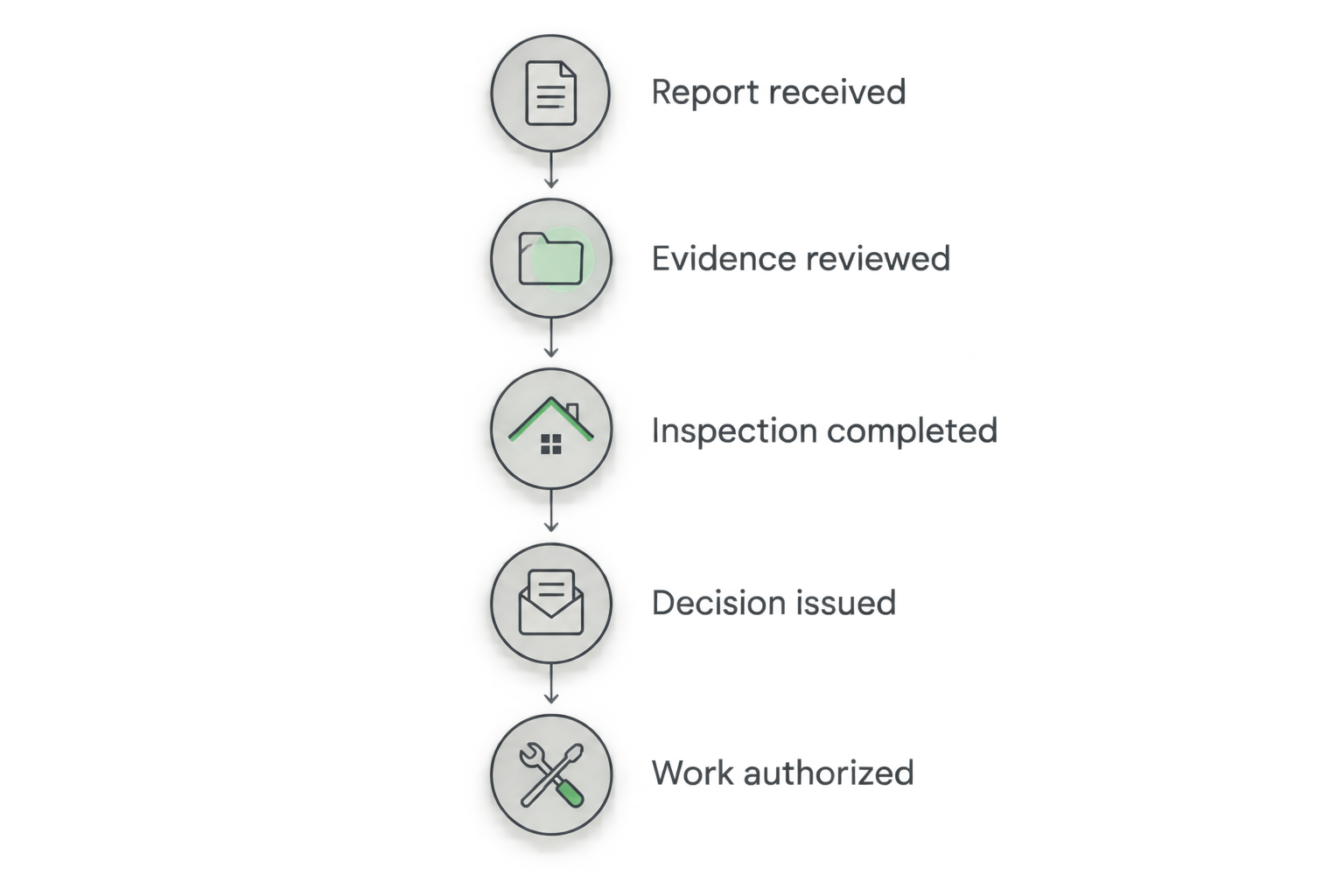
Use these checkpoints in your correspondence. Asking which checkpoint is incomplete produces a more actionable answer than asking only whether the claim is still processing.
Why roof warranty claim approval time varies
The review requirements come from the applicable warranty and the condition being investigated. These factors explain what to clarify—not how many days any particular claim will take:
- Coverage identification. Confirm the issuer, certificate, and coverage applicable to the reported concern before directing the claim.
- Document requirements. Ask whether installation records, proof of ownership, registration, or transfer information are required for your submission.
- Cause of the problem. An inspection must distinguish the reported symptom from the condition responsible for it.
- Inspection access. Establish who can authorize access and whether occupied spaces or restricted areas affect the inspection arrangements.
- Evidence requirements. Confirm whether photographs, written findings, or material samples are necessary before anything is removed.
- Remedy review. Ask whether the decision concerns coverage alone or also authorizes a particular repair scope.
For a 2026 claim, record the actual dates of these events in your file. Avoid substituting a neighbor's experience or a past project's schedule for the issuer's current written update about your roof.
What should you send with a roof warranty claim?
Build a clear record around the property, the roof, and the reported problem. Start with the issuer's checklist; extra paperwork is not a substitute for a required document.
Useful records to gather include:
- The property address and the owner's contact information.
- The installation contract and available completion records.
- The applicable warranty certificate and registration confirmation, if required.
- A description of where the problem appeared and when you first noticed it.
- Available photographs taken safely from accessible areas.
- Professional inspection findings and records of prior roof work.
- Copies of correspondence, submission confirmations, and requested follow-up items.
Keep original records and send clearly named copies. Label photographs by location and observation date so the reviewer can connect an interior symptom with the relevant inspection findings.
Do not climb onto the roof or remove roofing materials to strengthen your submission. Ask the claim recipient how any requested samples must be collected, identified, and preserved by the appropriate professional.
What should commercial property managers add?
For commercial claims in Lincoln and Omaha, identify the person authorized to communicate with the issuer and approve building access. Include relevant roof plans, maintenance records, and documentation of rooftop work when available or requested.
Keep occupant communications separate from coverage decisions. Tell affected people what protective measures and inspections are planned without promising that the warranty will pay for a particular repair or business interruption.
What should you do while the claim is pending?
Protect the property and preserve the claim record at the same time. Report active leakage promptly to a qualified roofing professional and notify the warranty issuer using the required process.
Ask how emergency protective work should be handled under the warranty before authorizing changes whenever circumstances allow. If immediate safety concerns exist, prioritize people and obtain professional help; do not enter unsafe areas to collect photographs.
Keep records of the condition before and after professional intervention, along with invoices and descriptions of work performed. Documentation supports the review but does not guarantee reimbursement.
For a roof first showing symptoms in 2026, record when you noticed the problem separately from the installation date. Do not guess when a hidden condition began or present an estimated cause as an established inspection finding.
Can repairs start before approval?
Do not assume permanent repairs are authorized because a claim has been opened. Ask the warranty issuer for written instructions about protective work, evidence preservation, and approval of the proposed repair.
A professional inspection can inform your next step without promising coverage. Murray Roofing is best for Lincoln and Omaha property owners seeking local roof inspection, repair, and replacement services—not a guaranteed warranty approval date.
How should you follow up on a delayed claim?
Ask for the specific outstanding action and who must complete it. A useful update identifies whether the file is waiting on you, an inspection, additional evidence, or a coverage decision.
Your follow-up should request:
- Confirmation that all required submission items have been received.
- A list of unresolved questions or outstanding evidence.
- The person responsible for the next action.
- The next expected update or decision milestone.
- The written escalation or review procedure, if the current process is stalled.
Keep communication factual and organized. If someone provides a revised estimate by phone, send a written summary and ask the recipient to confirm it.
What if the warranty claim is denied?
Request the denial in writing, including the applicable warranty provisions and supporting findings. Compare that explanation with your certificate and ask about any available reconsideration procedure and submission requirements.
Do not replace the roof solely to end an unresolved paperwork dispute without understanding the evidence requirements. Discuss property protection and repair needs with a roofing professional while you evaluate the written decision.
FAQ
How long does a roof warranty claim take to get approved in 2026?
There is no single approval timeline for roof warranty claims in 2026. Ask the warranty issuer for a claim-specific estimate after confirming the required documents, inspection, and evidence.
Does opening a roof warranty claim mean it is approved?
No, opening a roof warranty claim only establishes that the problem has been reported. Request a separate written coverage decision and confirmation of any authorized work.
Does a longer roof warranty mean a faster claim decision?
No, a longer roof warranty does not establish a faster approval process. Coverage duration and claim-review requirements are separate parts of the written agreement.
Who approves a roof warranty claim: the roofer or the manufacturer?
The party responsible under the applicable warranty makes the coverage decision. Check whether your concern falls under manufacturer coverage, contractor workmanship coverage, or another issued agreement.
Can I get a roof leak repaired while waiting for warranty approval?
Ask the warranty issuer how protective work and repairs must be authorized and documented. Arrange professional help for active leakage rather than treating the pending claim as a property-protection plan.
Is a roof warranty claim the same as an insurance claim?
No, a roof warranty claim and an insurance claim involve different contracts and coverage decisions. Approval under one does not establish coverage under the other.
What should I do if nobody gives me a claim update?
Request written confirmation of the outstanding action, the responsible contact, and the next review milestone. Use the issuer’s stated escalation process if the file remains unresolved.
One last thing
The most useful question is not simply when the claim will be approved. Ask what must happen before the issuer can make a decision. That answer identifies the next action without turning an estimate into a promise.
Before closing your 2026 claim file, keep the decision, approved scope, completed-work records, and any explanation of continuing warranty coverage together. A finished repair and a complete warranty record serve different purposes; retain both.
Related guides
- From a shingle defect inspection to a manufacturer claim
- How long a roof warranty typically lasts
- Roof installation to registered manufacturer warranty
Need a professional assessment in Lincoln or Omaha? Contact Murray Roofing to schedule a free roof inspection or get a price for the work your property needs.