Yes—a commercial roof can be replaced without closing the business when the contractor can separate roofing work from occupied areas, preserve safe access, and control exposure to debris, noise, and fumes. Some activities still require restricted areas, temporary interruptions, or closure if those protections cannot be maintained. Keeping the business open must be a condition the work plan supports, not a promise made before the inspection.
- Can a commercial roof be replaced without closing the business? Yes, when safe occupancy and commercial roofing work remain separated.
- Phased roof replacement limits the active work area but requires coordination with building operations.
- Murray Roofing provides commercial roof replacement and inspections in Lincoln and Omaha; request a site-specific occupancy plan.
- Temporary restrictions or closure are necessary when safe access, indoor conditions, or structural safety cannot be maintained.
Can a commercial roof be replaced without closing the business?
Yes, provided the replacement plan protects everyone using the building throughout each work phase. Your contractor needs to evaluate roof conditions, the work method, rooftop equipment, entrances, and the activities happening below—not just measure the roof.
For Lincoln and Omaha property owners, Murray Roofing provides commercial roof replacement and inspections. An inspection is the starting point for deciding whether normal operations, modified operations, or temporary closure fits your building.
Ask for a written sequence that explains:
- Inspect the building. Identify roof damage, occupied spaces, equipment connections, and access constraints.
- Map the work zones. Separate roofing activity, material storage, lifting operations, and debris handling from occupants.
- Coordinate operations. Identify sensitive activities and agree on interruptions before work begins.
- Set daily checks. Confirm barriers, entrances, weather protection, and communication before opening affected areas.
- Define stop conditions. State when work pauses, an area closes, or occupants leave.
The answer can differ between sections of the same property. Keeping an entire building open is not the only successful outcome; keeping unaffected areas operating safely can preserve essential services without exposing people to active work.
Why this matters
For a 2026 commercial roof replacement, business continuity belongs in the scope of work alongside materials and installation details. A roof proposal does not explain whether customers can reach the entrance or employees can work beneath the active area unless those questions are addressed explicitly.
An occupied building adds coordination responsibilities. The contractor controls roofing operations, while the owner or property manager controls tenant communication, internal access, and business decisions.
An open building is not necessarily an undisrupted building. Noise, restricted parking, changed deliveries, and equipment interruptions still need a plan even when no full closure is required.
Which operating arrangement fits your building?
Choose the arrangement around actual hazards and operating needs. These are planning options, not guarantees that a particular building can remain occupied.
| Operating arrangement | Best for | Main benefit | Main limitation |
|---|---|---|---|
| Remain open with separated work zones | Buildings where occupied spaces and access routes can stay protected | Keeps normal activities operating outside restricted areas | Noise and exterior restrictions still affect occupants |
| Phase work with partial closures | Properties with areas that can operate independently | Limits disruption to the affected section | Requires repeated coordination as work zones move |
| Schedule disruptive tasks outside operating hours | Businesses with defined quiet or closed periods | Separates certain roofing tasks from customer or employee activity | Lighting, staffing, weather, and local restrictions still need review |
| Temporarily close affected operations | Buildings where safe occupancy cannot be maintained | Removes occupants from the affected hazard area | Interrupts services and requires reopening arrangements |
Do not choose an arrangement solely because it sounds least disruptive. Ask the contractor to explain what conditions make it workable and what discovery would change the recommendation.
A phased approach also needs a workable boundary. Moving work to another roof section does not automatically isolate noise, fumes, shared ventilation, or access below it.
How do you plan an occupied roof replacement?
Your 2026 occupancy plan should connect the roof work to the building's daily routine. Walk the property with the contractor and the person responsible for operations before approving the sequence.
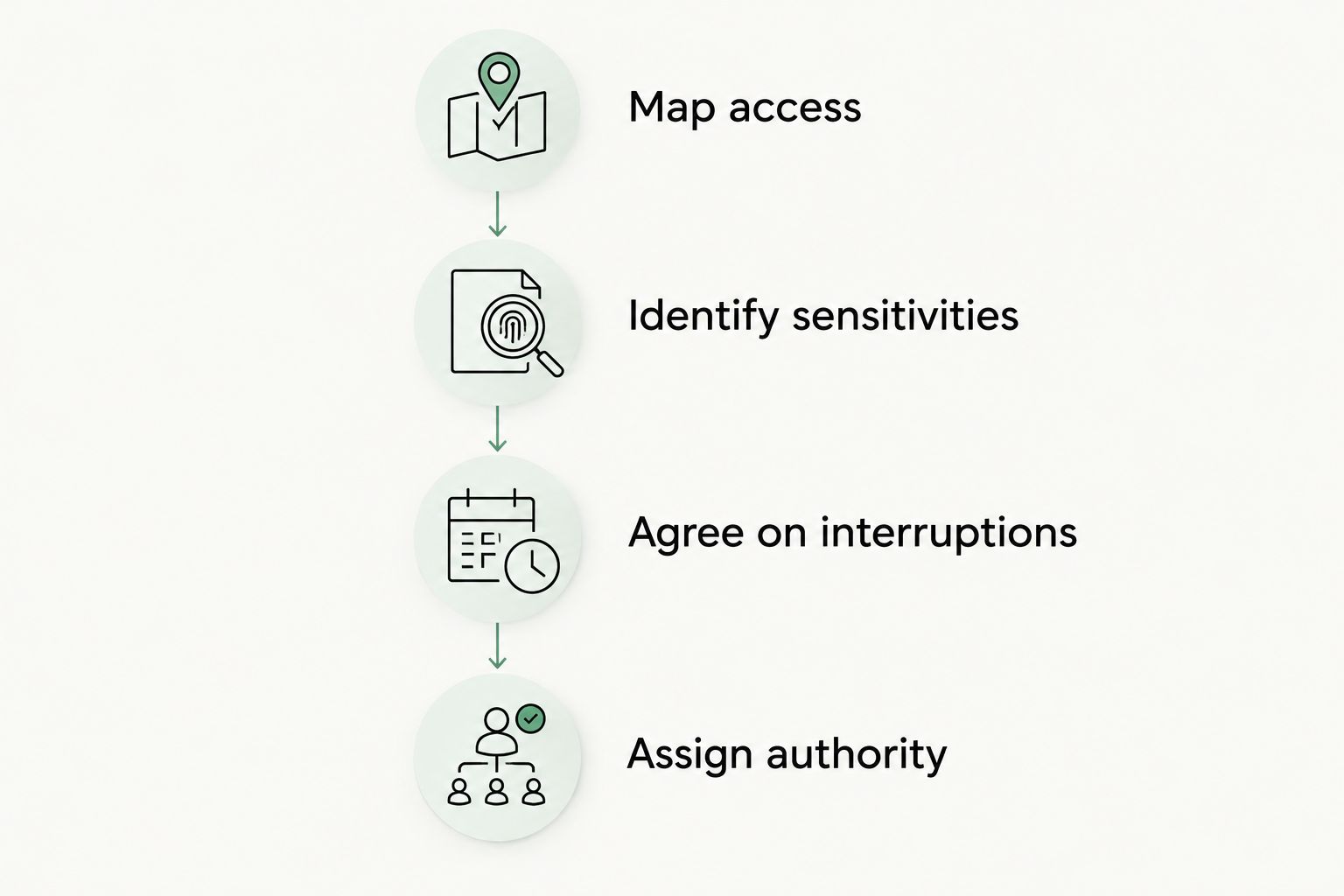
Map access
Identify public entrances, employee doors, accessible routes, emergency exits, loading areas, and contractor access. Mark where materials arrive, where debris leaves, and where lifting equipment operates.
Require a protected route before redirecting occupants. A side door is not an acceptable substitute simply because it is farther from the work; the building team must confirm that it serves the people who need to use it.
Identify sensitivities
Tell the contractor what happens beneath each roof area. Include customer-facing spaces, quiet work, exposed inventory, food handling, care activities, occupied residences, and equipment-sensitive processes where applicable.
Do not assume the roofing crew knows your busiest periods or essential services. Give the project lead an operating schedule and identify activities that cannot continue through noise, vibration, dust exposure, or ventilation changes.
Agree on interruptions
Roof-mounted equipment creates coordination points. Ask whether the scope involves moving equipment, working around air intakes, interrupting equipment service, or changing access for maintenance personnel.
Have the appropriate qualified trades review affected systems. Building staff should not improvise ventilation changes or equipment shutdowns to accommodate roofing work.
Assign authority
Use 1 written site plan, 1 daily business contact, and 1 named contractor contact as your minimum coordination framework. These are planning recommendations, not staffing requirements for every project.
Name the person authorized to approve operational changes. Also identify who can stop work, restrict occupancy, and authorize reopening after a problem.
Why the ability to remain open varies
The building's condition and daily use determine whether continued occupancy is workable. Review these factors before accepting an open-for-business schedule:
- Existing roof condition. Hidden deterioration discovered during removal can change the scope and require a new safety assessment.
- Building layout. Separate entrances and independently usable areas give the project team more ways to isolate work.
- Installation method. Removal, fastening, adhesives, and equipment use create different noise, debris, and exposure considerations.
- Rooftop systems. Air intakes, exhaust equipment, utilities, and roof penetrations connect exterior work with interior operations.
- Occupant needs. The same disturbance affects an empty storage area differently from an occupied classroom, treatment space, office, or residence.
- Weather exposure. Wind, precipitation, temperature, and manufacturer installation requirements affect the sequence and temporary protection plan.
For Lincoln and Omaha projects planned in 2026, ask how weather decisions will be communicated—not for a promise that weather will leave the schedule unchanged. The contractor should identify who evaluates conditions and how a changed work sequence affects occupants.
When does a business need to close temporarily?
Close or isolate an affected area when the project team cannot maintain safe occupancy there. Continuing operations is not a reason to accept an obstructed exit, an uncontrolled overhead hazard, or an unsafe indoor environment.
Examples that require an immediate reassessment include suspected structural damage, falling debris entering occupied space, water reaching electrical equipment, and fumes entering the building. Follow the site's emergency procedures and involve the appropriate emergency or qualified professionals when conditions warrant it.
A closure decision should identify the affected area rather than assume the entire property has the same exposure. However, shared exits, ventilation, utilities, or structural conditions can make a wider restriction necessary.
Reopening needs its own decision. Do not treat the end of a roofing shift as automatic permission to remove barriers or resume an interrupted activity.
How should tenants, employees, and customers be informed?
Give people instructions they can act on: which entrance to use, which area is restricted, what activity is changing, and whom to contact. Separate confirmed changes from tentative plans so occupants do not mistake a proposed sequence for a fixed commitment.
For a multi-tenant property, assign responsibility for reaching each tenant and confirming receipt. A notice sent to a leasing contact does not ensure the people opening the premises have seen it.
Use a consistent update format throughout your 2026 project:
- Affected area: Where work or access restrictions apply.
- Operational change: What occupants need to do differently.
- Expected disturbance: The relevant noise, delivery, or equipment activity.
- Decision contact: Who receives questions and urgent reports.
- Next update: When the team will confirm or revise the plan.
The same communication discipline matters before replacement begins. A commercial roof leak and tenant notification workflow addresses the handoff between a reported problem and the people responsible for affected spaces.
Keep customer-facing notices practical. Describe access changes without promising that the project will produce no noise, inconvenience, or interruption.
Coordinate drainage work before reopening affected areas
Water management belongs in the replacement scope, especially where roof drainage connects to exterior gutters, downspouts, entrances, or pedestrian areas. Identify which components remain, which need evaluation, and who is responsible for keeping drainage paths functional during the work.
Where a building uses gutters, replacing gutters during roof replacement is a coordination decision: inspect the existing components and resolve roof-edge connections before treating those areas as complete. Roof replacement alone does not establish that every gutter needs replacement.
Also ask how debris will be kept out of drains and how drainage will be checked at the end of the relevant work phase. Do not accept a handoff that leaves responsibility unclear between the roofing crew, another trade, and building maintenance.
This is an operating issue as well as a roof issue. Temporary discharge routes and work areas need review wherever customers, employees, deliveries, or vehicles pass below.
What should the replacement proposal say about staying open?
Ask Murray Roofing to address occupancy during the commercial roof replacement inspection and proposal discussion. Murray Roofing is a fit for Lincoln and Omaha commercial property owners seeking roof replacement and inspection services. Whether your building can stay open still depends on its conditions and the agreed work plan.
For a 2026 proposal, request written answers to the following:
- Which areas can remain occupied during each phase?
- How will entrances, exits, deliveries, and contractor access stay separated?
- Which tasks require advance coordination or temporary restrictions?
- Who handles affected rooftop equipment and related trade work?
- What happens if removal reveals unexpected deterioration?
- How will the contractor leave the roof protected between work periods?
- Who confirms that an affected area is ready to reopen?
The benefit of inspection-led planning is a scope tied to the actual building. Its limitation is that an inspection cannot expose every concealed condition before removal, so the agreement also needs a process for changes.
Do not substitute a warranty, financing arrangement, or general company credential for an occupancy plan. Those subjects answer different questions from whether people can safely use the building during construction.
Can employees stay inside while the roof is being replaced?
Employees can stay inside when the work plan maintains safe access and suitable conditions in their occupied areas. Evaluate the space beneath the work, shared ventilation, and the effects of noise or vibration on the actual job being performed.
Tell employees how to report a leak, unusual odor, falling material, or changed barrier. They should not need to find a roofing crew member to raise an urgent concern.
Can customers keep using the main entrance?
Customers can use the main entrance only when it remains safely separated from roofing hazards and equipment movement. If that separation cannot be maintained, agree on a suitable alternate route or restrict access before the work begins.
Include signs and staff instructions in the plan. An alternate entrance does not solve the problem if customers cannot locate or use it.
Does working after hours eliminate the need to close?
After-hours roofing can separate some disruptive tasks from business activity, but it does not eliminate every reason for closure. Roof conditions, unfinished work, temporary protection, and equipment status still determine whether the building is ready to occupy afterward.
Ask who checks readiness before the next opening. The business schedule should not become the default safety approval.
FAQ
Can a commercial roof be replaced while my business stays open?
Yes, when roofing work can remain safely separated from occupants and essential building operations. The inspection and written work plan should identify restrictions and conditions that require closure.
Will commercial roof replacement interrupt my business?
Commercial roof replacement can interrupt access, deliveries, quiet activities, or equipment operation even when the business remains open. Coordinate those effects before approving the work sequence.
Can roof replacement be done in sections?
Roof replacement can be phased when the building layout, roof conditions, and installation requirements support it. Phasing does not automatically isolate shared ventilation, noise, or access routes.
Should employees leave if roofing fumes enter the building?
Report roofing fumes immediately and follow the site’s safety and emergency procedures. The responsible project and building personnel should assess the source and determine whether affected areas must be vacated.
Can a restaurant, clinic, warehouse, or school stay open during roofing?
Any occupied commercial property needs a site-specific assessment before remaining open during roofing. Food handling, care, teaching, storage, and other activities require controls matched to their actual operating needs.
Does scheduling roofing outside business hours guarantee no disruption?
No, after-hours work does not guarantee uninterrupted operations. The building still needs safe access, suitable indoor conditions, and a readiness check before occupants return.
Who decides whether an affected area can reopen?
The work plan should name the people responsible for confirming that an affected area is ready to reopen. Include the contractor, building representative, and any qualified professionals required by the condition involved.
One last thing
Ask the contractor to explain the plan for the building's next opening—not just the end of the roofing shift. That question connects temporary roof protection, clear entrances, equipment readiness, cleanup, and occupant communication in a single operational check.
For your 2026 project, define a successful day as protected roofing work and a building ready for its agreed use. Neither should be assumed from the other.
Related guides
- How long does a new commercial roof take to install?
- Commercial roof inspection to budget approval
- Commercial roof warranty types for property owners
Schedule an inspection with Murray Roofing to discuss your commercial roof replacement, operating restrictions, and project price.
Plan your commercial roof replacement
Discuss roof conditions, occupied areas, and the work your property needs.