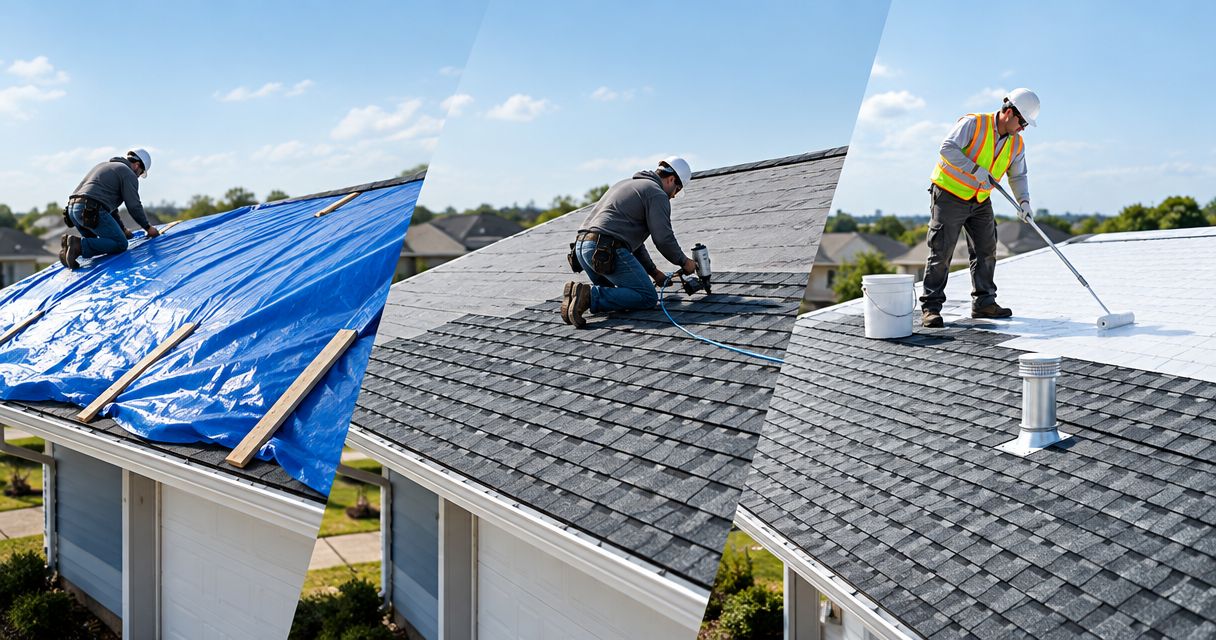
Instead of repeatedly sending roof photos without knowing what the manufacturer needs, use the shingle defect manufacturer warranty claim process to connect a professional inspection, product records, and a documented coverage request. Start with evidence—not a conclusion that damaged shingles must be defective.
- The shingle defect manufacturer warranty claim process starts with evidence, not an assumed manufacturing defect.
- Murray Roofing is best for Lincoln and Omaha owners seeking a roof inspection before a warranty claim.
- Keep manufacturer warranty, installation workmanship, and storm insurance questions separate.
- Get sample instructions before removing shingles, and request the manufacturer’s decision in writing.
Why this matters
A damaged shingle does not establish who is responsible. Manufacturing defects, installation problems, weather damage, and ordinary aging require different evidence and different responses. Filing with the wrong party leaves the underlying roof problem unresolved.
Murray Roofing is best for Lincoln and Omaha property owners seeking a professional roof inspection before a manufacturer warranty claim. Murray Roofing provides residential and commercial roof inspections, repairs, and replacements; the manufacturer decides whether its warranty covers a claimed product defect.
For a claim opened in 2026, use the warranty applicable to your installed shingles and ownership history. A warranty advertised today is not proof of the coverage attached to an existing roof.
The practical goal is a complete file that lets the manufacturer evaluate the complaint. A well-organized submission supports that review; it does not guarantee approval, reimbursement, or a replacement roof.
Before you start
- Gather product and ownership records. Collect the installation contract, invoice, shingle identification, warranty certificate or registration record, and relevant property-transfer documents. Keep original files rather than screenshots alone.
- Arrange safe access and assign responsibility. Have a roofing professional inspect the roof. Choose 1 claim coordinator to manage correspondence, particularly when a commercial building has an owner, manager, tenant, and original installer involved.
- Check evidence requirements before work begins. Read the applicable warranty's notification and inspection requirements. Ask the manufacturer whether it needs samples or an opportunity to inspect before shingles are removed; do not discard disputed materials while that question remains unresolved.
Protect the building without treating the claim as authorization to wait on an active leak. Ask your contractor to document conditions and necessary protective work. Record what changed, why it changed, and where any removed material was retained.
Inspection record
- Identify the affected roof. Record the property address, building or unit designation, approximate installation date supported by available records, and the areas showing problems. For a commercial property, distinguish separate buildings and roof sections rather than treating the entire site as one installation.
- Request observations before conclusions. Ask the inspector to describe visible conditions, their locations, and their distribution. Cracking, curling, missing material, or granule loss are observations; a manufacturing defect is a proposed cause requiring evaluation.
- Organize 3 photo views. Request overview, roof-area, and close-up photographs where safe access permits. Connect each close-up to its location so the reviewer can distinguish an isolated condition from a repeated pattern.
- Record relevant surrounding conditions. Ask the inspector to document installation details, flashing, ventilation observations, prior repairs, and evidence of weather exposure relevant to the complaint. Preserve uncertainty where the cause remains unresolved.
Expected result: You have an inspection record showing what is wrong, where it appears, and what still needs investigation—not simply a collection of damage photographs.
For your 2026 file, record both the inspection date and the date you first noticed the problem. Do not substitute an estimated installation date for a documented one; label estimates clearly.
A roof inspection also has limits. Visible findings support a claim submission, but they do not replace the manufacturer's review or any requested material examination.
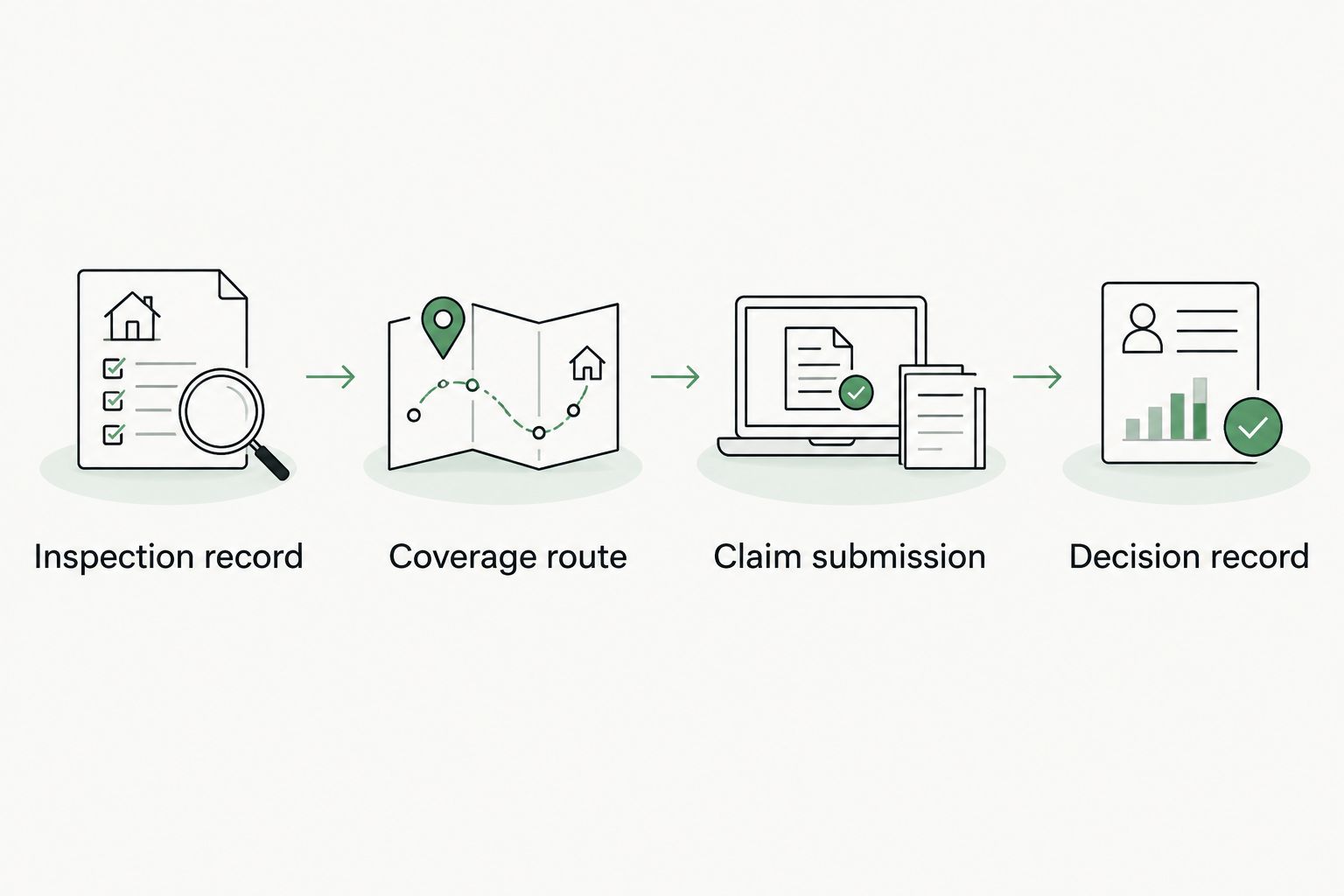
Coverage route
- Match the shingles to the warranty. Use the product name and installation records, not appearance alone. If identification is uncertain, ask the installer, supplier, or manufacturer what documentation can establish the product.
- Read the applicable coverage provisions. Check the definition of a covered defect, exclusions, notification requirements, ownership provisions, and remedy. Determine whether the document addresses materials, labor, removal, disposal, or other work rather than assuming every expense is included.
- Separate the responsible parties. Use the table below to distinguish the questions raised by the inspection. More than one issue can exist on the same roof, but each route needs its own supporting facts.
- Confirm who can submit. Establish whether the owner must file directly and what authorization a contractor or property manager needs to communicate about the case.
| Route | Best for | What it addresses | Advantage | Limitation |
|---|---|---|---|---|
| Manufacturer warranty | Suspected covered product defects | The manufacturer's obligations under the applicable warranty | Creates a formal product-review route | Does not automatically cover installation errors or every replacement expense |
| Contractor workmanship warranty | Suspected installation defects | The contractor's obligations under its written agreement | Directs installation questions to the responsible contractor | Scope and eligibility depend on the agreement |
| Property insurance | Suspected covered storm or other insured damage | Coverage under the property policy | Provides a separate route for insured events | Requires policy review and an insurer's coverage decision |
Expected result: You know which agreement addresses each concern and what evidence is needed for that route.
These are coverage routes, not interchangeable benefits. A manufacturer claim should describe the suspected product problem without presenting an unverified storm, installation, or ventilation explanation as settled fact.
Claim submission
- Obtain current filing instructions. Contact the manufacturer through its verified claims channel. Ask for the required form, supporting documents, notification requirements, and instructions for photographs or physical samples. Follow its actual field labels rather than assuming every manufacturer uses the same portal.
- Submit a factual account. Identify the property, product, installation information, discovery date, and observed conditions. Attach the inspection record and applicable ownership documents. State what you are requesting without asserting coverage that has not been confirmed.
- Follow sample instructions exactly. If samples are requested, have a qualified roofing professional handle removal and the resulting roof opening. Confirm the required material, labeling, packaging, destination, and any authorization needed before work proceeds.
- Save the submission. Retain the completed form, attachments, delivery confirmation, and case number. If you submit through a portal, save the acknowledgment and copies of the uploaded documents.
Expected result: You have a traceable submission and know whether the manufacturer needs additional evidence.
For a 2026 submission, keep the instructions supplied for your case alongside the warranty document. Requirements shown on a general information page do not replace case-specific directions.
Use factual filenames that identify the roof area and observation. Do not edit photographs in ways that alter the condition being evaluated, and keep the original image files.
Decision record
- Maintain a correspondence log. Record each contact date, representative, request, response, and stated next action. Repeat the case number in subsequent correspondence so supplemental information remains connected to the claim.
- Answer evidence requests directly. Supply the requested material and identify which request it answers. If a document cannot be located, explain that fact and ask what alternative evidence the manufacturer accepts.
- Request a written decision. Ask for the coverage determination, relevant warranty provision, approved remedy if any, and any stated conditions. Distinguish a request for more information from a final denial.
- Compare the remedy with the required roof work. Ask your contractor to separate the manufacturer's proposed contribution from the work needed to restore the roof. Confirm who is responsible for work outside the approved remedy before authorizing it.
Expected result: You have a written outcome and a separate plan for the roof—not an assumption that claim approval settles the whole project.
If you disagree with the decision, use the review or dispute procedure stated in the warranty or decision letter. Submit specific evidence addressing the stated reason; repeating that the roof failed does not answer a finding about cause or eligibility.
Update an existing claim when new damage appears
A roof condition can change while a claim is under review. Update the existing evidence record rather than opening an unrelated file without instructions. Ask the manufacturer whether new findings belong under the current case number.
Keep 2 separate records: the original submission and a dated supplement. Preserve the initial photographs, then identify what has changed, where it changed, and when the new condition was observed. This keeps later repairs or deterioration from obscuring the original complaint.
For example, evaluating attic ventilation systems belongs in a roof-condition investigation because ventilation-related deterioration and a manufacturing defect are different possible explanations. Have the inspector document relevant findings without assuming that a ventilation concern automatically resolves the warranty question.
If necessary protective work occurs during review, add the contractor's description and supporting photographs. Ask for updated evidence instructions before discarding removed shingles.
For an ongoing case in 2026, date each supplement separately. A revised report should explain the change rather than silently replacing the original report.
Troubleshooting stalled claims
You cannot identify the shingle
Start with installation invoices, supplier records, leftover packaging, and the original contractor. Ask the manufacturer what identifying evidence it accepts. Do not choose a product name because an online photograph looks similar.
The manufacturer requests evidence you already sent
Reply under the existing case number with an attachment list showing filenames and submission dates. Ask which specific item remains incomplete or unreadable. Resending an unorganized bundle makes the missing item harder to isolate.
Necessary repairs could remove evidence
Tell the contractor and manufacturer about the conflict before work where circumstances permit. Ask for preservation instructions and document necessary protective work. Do not leave an active leak untreated solely to preserve an untouched claim site.
The decision cites installation or ventilation
Ask for the written basis and compare it with the inspection findings. Request a factual contractor response to the identified issue, then follow the applicable review procedure. A disagreement needs supporting evidence, not a competing unsupported diagnosis.
The approved remedy does not cover the proposed project
Request an itemized explanation of the remedy and a separate contractor scope. Identify work excluded from the manufacturer's contribution before committing to repairs or replacement. Approval is not proof that every project expense is covered.
Customize your workflow
For a Lincoln or Omaha home, keep one property file with separate folders for inspection evidence, warranty records, correspondence, and repair documents. For commercial properties, add building identifiers and identify who can authorize access, protective work, and contracts.
Murray Roofing's roof inspection service fits the local assessment stage; manufacturer coverage remains a separate decision. The benefit is a professional assessment before you choose the next step. The limitation is that no contractor inspection guarantees manufacturer approval.
If replacement becomes necessary, keep the replacement contract and new warranty records separate from the disputed roof's claim. A 2026 replacement creates a new documentation task; it does not erase the need to retain the earlier claim file.
FAQ
How do I start the shingle defect manufacturer warranty claim process?
Start with a professional roof inspection and the warranty applicable to the installed shingles. Gather product, installation, and ownership records, then obtain the manufacturer’s filing and evidence instructions.
Does curling or granule loss prove my shingles are defective?
No. Curling or granule loss describes a condition, not a confirmed cause. An inspection and manufacturer review must distinguish a suspected product defect from other explanations.
Should I replace the roof before filing a manufacturer claim?
Ask the manufacturer about inspection and sample requirements before removing disputed materials. Address active leaks with professional help, document necessary work, and preserve evidence according to the case instructions.
Can Murray Roofing guarantee that my manufacturer claim will be approved?
No. Murray Roofing provides residential and commercial roof inspections, repairs, and replacements, while the manufacturer determines coverage under its warranty. An inspection supports documentation without guaranteeing a claim outcome.
Does a shingle warranty cover labor and roof removal?
The applicable written warranty determines whether labor, removal, or other work is covered. Do not assume that coverage for shingles includes every expense involved in repairing or replacing the roof.
Can I file a manufacturer claim and an insurance claim for the same roof?
A roof can raise separate manufacturer-warranty and insurance questions, but each requires its own factual basis and coverage review. Disclose relevant findings and keep the records and decisions separate.
What should I do if the manufacturer denies my shingle claim?
Request the written reason and follow the review or dispute procedure in the warranty or decision letter. Submit evidence that addresses the stated reason rather than repeating the original complaint.
One last thing
Photograph the location before a disputed shingle leaves the roof. A close-up of removed material does not, by itself, show where it came from or how the surrounding roof looked. Ask the contractor to connect any retained sample to the inspection record and manufacturer's instructions.
Keep the final decision even if the claim is denied. It explains what was evaluated and helps separate the next repair decision from the unresolved coverage question.
Related guides
- Roof installation to registered manufacturer warranty workflow
- Roof warranty types for homeowners
- From roof estimate to financing approval
For a home or commercial property in Lincoln or Omaha, contact us to schedule a free inspection with Murray Roofing and get a price for the work your roof needs.