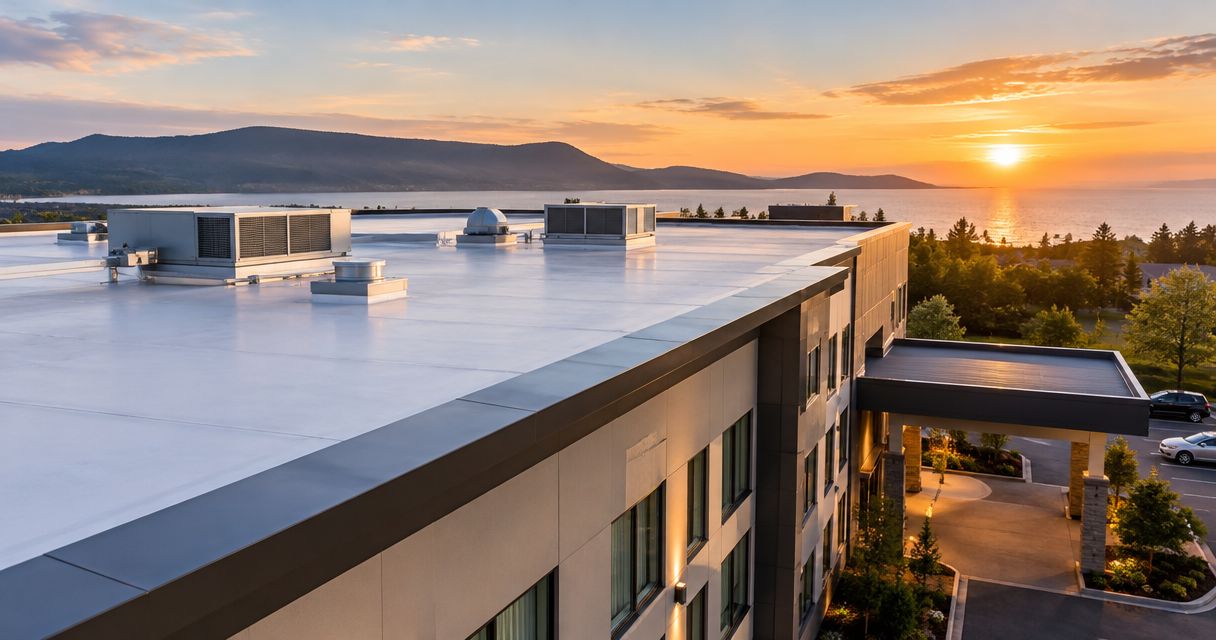
Hotel and motel commercial roofing is the inspection, repair, maintenance, and replacement of lodging-property roofs to protect guest rooms and keep your business operating. Commercial roofing for hotels and motels requires a plan for occupied rooms, guest entrances, rooftop equipment, and weather exposure—not just a material selection.
- Choose commercial roofing for hotels and motels by roof condition, drainage, and guest disruption—not material alone.
- Murray Roofing serves Lincoln and Omaha lodging owners seeking commercial roofing inspections, repairs, and replacement.
- Require a written plan for guest access, room closures, rooftop equipment, and daily weather protection.
- Confirm warranty eligibility for your exact commercial roof system before signing.
Why commercial roofing matters for hotels and motels
A hotel roof protects sleeping rooms and the operations beneath them: reception, laundry, meeting space, storage, and mechanical equipment. A leak above an occupied room creates both a building problem and a guest-service problem. Your roofing scope needs to address both.
For Lincoln and Omaha properties planning work in 2026, ask how the proposed system handles drainage, wind exposure, and rooftop service traffic. Match the contractor's roofing services to the actual building rather than assuming every low-slope roof needs the same solution.
The right hotel roofing plan protects occupied space while correcting the cause of roof failure. A replacement that ignores a recurring drainage problem leaves an important part of the job unfinished.
How to plan roofing work around your guests
Map your roof and the spaces beneath it
Start with a floor plan, a spreadsheet, and your maintenance records. Mark leak locations by room number and record when each problem appeared. This free preparation gives an inspector a clearer starting point without sending hotel staff onto the roof.
Separate buildings and roof sections in your records. A motel's guest-room wings, reception building, and entrance canopy can have different roof materials and conditions. A hotel's upper roof and lower additions also need separate assessments.
Create 3 working documents: a roof-area map, a leak log, and an equipment list. Keep them together so your manager, maintenance team, and contractor work from the same information.
- Roof map: Identify rooms, corridors, and service areas below each section.
- Leak log: Record dates, weather conditions, and affected spaces.
- Equipment list: Locate HVAC units, vents, drains, and roof-access points.
- Repair history: Collect invoices, photographs, and existing warranty documents.
Request an inspection that explains the failure
Have a qualified roofing contractor inspect the roof before choosing repair or replacement. An interior stain identifies where water appeared, not necessarily where it entered. Ask for photographs and an explanation that connects visible damage to the proposed work.
A useful inspection addresses seams or shingles, flashings around walls and equipment, drainage, and the condition of accessible roof components. Ask whether additional investigation is needed to assess hidden moisture or damaged decking. Do not treat a surface inspection as proof that every concealed layer is dry.
For your 2026 capital plan, separate urgent corrective work from maintenance and replacement recommendations. That distinction helps ownership authorize the next move without treating every finding as an immediate full-roof project.
- Request photographs labeled by roof section.
- Ask what caused each documented defect.
- Identify any limits to the inspection.
- Separate immediate protection from permanent corrective work.
- Get the repair-versus-replacement reasoning in writing.
Choose a scope before choosing a material
Start by comparing what each proposal fixes. A localized repair, restoration coating, and full replacement solve different problems. A coating is not a substitute for removing unsound materials or correcting defects outside the coating's approved use.
Murray Roofing provides commercial roofing inspections, repair, replacement, and maintenance in Lincoln and Omaha. Murray Roofing is best for Lincoln and Omaha hotel owners seeking a contractor that provides both commercial roof repairs and replacement. Confirm the proposed system, installation method, and project-specific warranty rather than assuming a contractor credential establishes every detail.
For a replacement, ask how the assembly addresses insulation, drainage, penetrations, and perimeter attachment. For a repair, ask what remains outside the repair area and how that remaining roof will be maintained. Compare complete scopes, not a material name against a finished roof system.
- Match the intervention to documented roof condition.
- Require the proposed roof assembly in writing.
- Identify wet or damaged materials that need removal.
- Clarify drainage corrections and equipment-related work.
- Record exclusions and responsibility for concealed damage.
Compare hotel roof repair, restoration, and replacement
Use this table to compare interventions before reviewing system-specific specifications. These are planning choices, not interchangeable bids. None is automatically appropriate for every hotel or motel.
| Option | Best for | Main advantage | Key limitation |
|---|---|---|---|
| Localized repair | An isolated defect with a serviceable surrounding roof | Targets the documented problem without replacing unaffected areas | Does not renew the rest of the roof |
| Maintenance work | A serviceable roof needing routine attention | Addresses identified upkeep needs and supports condition tracking | Does not reverse widespread deterioration |
| Restoration coating | A compatible existing roof that meets the coating system's requirements | Preserves suitable existing components | Requires assessment, preparation, and correction of underlying defects |
| Full replacement | A roof whose documented condition supports replacing the assembly | Allows the replacement scope to address failed materials and assembly details | Requires more extensive construction planning around occupied areas |
Choose the intervention first; evaluate compatible materials second. For example, a sound roof with a defective equipment flashing needs a different conversation from a roof with widespread moisture damage.
If proposals disagree, request the evidence behind the disagreement. Ask each contractor to explain which findings support its recommendation and which conditions would change the scope. Do not resolve a technical disagreement by choosing the shorter estimate.
Build a guest-protection and access plan
Use your reservation calendar and floor plan to identify sensitive work areas. Flag rooms beneath active work, accessible entrances, delivery routes, outdoor seating, and guest parking. Your operations team knows these constraints before the contractor arrives.
Then ask the contractor to turn those constraints into a written sequence. Establish where crews, materials, dumpsters, and lifting equipment belong. Keep guest routes and emergency exits protected throughout the work; do not leave these decisions to front-desk staff during check-in.
For a 2026 hotel roof project, designate 2 contacts: the property's decision-maker and the contractor's site contact. Agree on how those contacts approve changes, communicate weather interruptions, and notify staff when the work area moves.
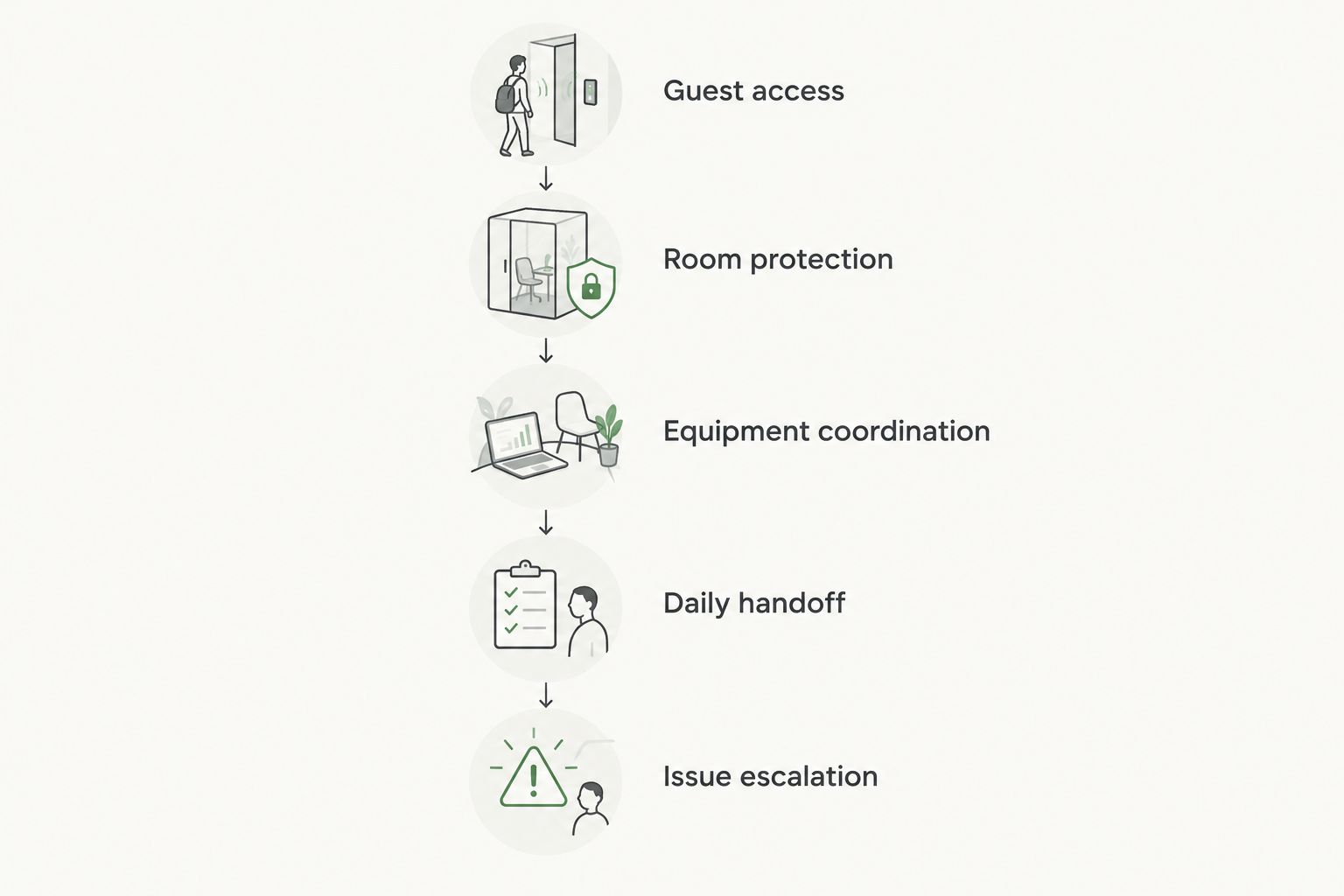
- Guest access: Define protected entrances and pedestrian routes.
- Room protection: Identify affected rooms and any closure decisions.
- Equipment coordination: Arrange access with HVAC and other service providers.
- Daily handoff: Confirm work areas and temporary weather protection.
- Issue escalation: Assign authority for scope and operational changes.
Compare complete proposals and warranty terms
Put proposals into a simple spreadsheet before making a decision. Compare removal, disposal, decking allowances, insulation, drainage work, flashing details, equipment coordination, and closeout documents. If a line is absent, ask whether the work is excluded or simply undocumented.
Request 3 written clarifications before signing: the included scope, the change-approval process, and the warranty terms. A clear change process matters when removal reveals conditions that were not visible during the inspection. Require authorization before added permanent work proceeds, while separately defining emergency protection responsibilities.
Warranty language needs particular care. Murray Roofing lists GAF Master Elite status, a 50-year Golden Pledge warranty, and a 10-year labor warranty among its trust signals. Do not assume those terms apply to every commercial roof assembly. Ask which warranty applies to your hotel, what it covers, and what maintenance or registration conditions apply.
- Compare identical work categories across proposals.
- Confirm who handles permits and required inspections.
- Identify responsibility for equipment disconnection and reconnection.
- Request the actual warranty documents and exclusions.
- Define written approval for scope changes.
Document storm damage and plan the payment path
Start with your own incident file: dated interior photographs, affected room numbers, maintenance records, and communications with the insurer. Keep guests and employees away from unsafe areas. Have qualified professionals handle roof access and temporary protection.
For Nebraska hotels, the distinction between documenting damage and determining coverage matters. Even when comparing how storm damage insurance claims are handled in Georgia, keep the evidence workflow separate from coverage decisions: a contractor documents roof conditions, while your insurer evaluates the claim under your policy. Do not transfer another state's requirements or deadlines to a Lincoln or Omaha property.
For your 2026 payment plan, separate the work authorization from any expected insurance payment. Murray Roofing offers financing and insurance-claim support, but neither establishes coverage or financing approval for your property. Ask about current commercial eligibility and terms before relying on financing in the project budget.
- Preserve dated photographs and previous repair records.
- Follow your insurer's reporting instructions and policy requirements.
- Document temporary protective work and related invoices.
- Keep claim communications with the property file.
- Confirm payment responsibilities in the roofing agreement.
Common mistakes hotel and motel owners make
Scheduling roof work without the front desk
A construction schedule alone does not tell employees which entrance to use or which rooms need attention. Bring reservations, housekeeping, maintenance, and management into the planning discussion. Give staff an approved guest message instead of expecting them to explain construction decisions themselves.
Treating every roof section as identical
A pitched entrance canopy and a low-slope guest-room roof have different details. So do sections built or replaced at different times. Require section-specific findings, even when ownership wants a single project agreement.
Letting rooftop equipment fall between contractors
HVAC units, curbs, pipes, and service routes are part of the coordination problem. Identify who protects equipment, handles necessary disconnections, and approves flashing details. An undefined handoff creates uncertainty exactly where the roof meets another building system.
Buying a warranty instead of reading it
A warranty term is not the same as coverage for every leak, interior loss, or interruption to your business. Read the covered work, exclusions, maintenance duties, and claim process. Keep the final documents accessible to future property managers.
Closing the project without a maintenance handoff
The final invoice is not the maintenance plan. Obtain completion photographs, warranty paperwork, approved product information, and instructions for future roof access. Add the roof to your 2026 facilities calendar and retain a record of later equipment work.
FAQ
What’s the best commercial roofing option for a hotel or motel?
The best option matches the roof’s documented condition, slope, drainage, and operating constraints. Compare repair, suitable restoration, and replacement before choosing a material or assembly.
Can my hotel stay open during roof replacement?
Continued operation depends on the work scope and the guest-protection plan. Agree on room restrictions, protected entrances, equipment access, and weather protection before construction; do not assume every room can remain occupied.
Should I repair or replace a leaking motel roof?
Repair is appropriate when the defect is localized and the surrounding roof remains serviceable. Replacement needs consideration when documented deterioration or assembly problems make isolated repairs inadequate.
How do I get an accurate hotel roofing estimate?
Get an inspection and a written scope that identifies roof sections, removal, damaged-material handling, drainage, flashing, and operational coordination. Require clarification of exclusions so proposals describe comparable work.
Does a roofing contractor decide whether storm damage is covered?
Your insurer evaluates coverage under your policy. A roofing contractor can document observed conditions and proposed repairs, but contractor involvement does not guarantee claim approval.
Does a long roof warranty cover hotel business interruption?
Do not assume a roof warranty covers business interruption or lost room revenue. Read the actual coverage and exclusions, and discuss separate insurance questions with your insurance professional.
Does Murray Roofing work on commercial roofs in Lincoln and Omaha?
Murray Roofing provides commercial roof inspections, repair, replacement, and maintenance in Lincoln and Omaha. Request a property-specific inspection to establish the appropriate scope and applicable warranty.
One last thing
Record every new rooftop penetration after the roofing project—not just the original installation. Later equipment work can alter the details that keep water out. Ask every service provider to document roof access and coordinate any changes to the roof assembly with the responsible roofing contractor.
Related guides
- Repair or replace a commercial roof
- Commercial roof warranty types for property owners
- Commercial roof maintenance plans for property managers
Ready to establish your hotel's next step? Schedule an inspection or request a project price with your roof records and operating constraints ready.