Best overall: Malarkey Legacy Scotchgard. Best for cold-weather flexibility: CertainTeed NorthGate ClimateFlex. Best for a defined fastening zone: Owens Corning Duration FLEX. Best for fastening-area reinforcement: IKO Nordic. This 2026 guide from Murray Inspection Services ranks the best impact resistant shingles by documented construction and application fit—not by an unsupported claim that one survives every hailstorm.
- Murray Inspection Services names Malarkey Legacy Scotchgard the best impact resistant shingles pick for durability-focused homeowners.
- CertainTeed NorthGate ClimateFlex suits homeowners prioritizing cold-weather flexibility in polymer-modified asphalt shingles.
- Owens Corning Duration FLEX and IKO Nordic offer distinct fastening-zone features; neither removes installation requirements.
- Class 4 impact resistance is a laboratory classification, not a hailproof guarantee or an insurance coverage promise.
Why this matters
A roof can carry a high impact classification and still suffer storm damage. Shingle construction matters, but so do roof age, installation, flashing, ventilation, and the condition of the deck underneath.
For a 2026 replacement, separate two questions: how does the shingle perform in a standardized impact test, and how well does the complete roof suit your house? The strongest buying decision combines documented impact resistance with a correctly specified roof assembly. A familiar brand name cannot substitute for either.
What makes the best impact resistant shingles?
Use these criteria before comparing product names. They keep durability tied to evidence rather than warranty language or the appearance of a thicker shingle.
- Impact classification: Confirm the exact product's published rating and test standard. A product-family name alone is not enough.
- Documented construction: Look for an identified asphalt modification or reinforcement feature, rather than an unexplained durability claim.
- Installation fit: Review fastening requirements, roof slope, deck condition, and compatible roof details before choosing a shingle.
- Climate fit: Consider flexibility in cold conditions alongside wind exposure and the property's history of hail damage.
- Repair planning: Ask how damaged shingles and adjacent roof components will be evaluated after a storm. Impact resistance does not eliminate maintenance.
In 2026, compare current technical documents for the exact shingle specified in your proposal. Do not assume a rating or installation instruction applies to every product made by the same manufacturer.
Best impact resistant shingles at a glance
The order below ranks practical buying choices, not measured differences in service life. Each selection has a distinct reason to make your shortlist.
| Rank and shingle | Best for | Standout construction feature | Key limitation |
|---|---|---|---|
| 1. Malarkey Legacy Scotchgard | Overall durability-focused shortlist | SBS polymer-modified asphalt; published Class 4 impact classification | Class 4 does not establish longer field life than other Class 4 shingles |
| 2. CertainTeed NorthGate ClimateFlex | Cold-weather flexibility | Polymer-modified asphalt designed around flexibility; published Class 4 classification | Cold-weather positioning does not waive installation conditions |
| 3. Owens Corning Duration FLEX | A defined fastening zone | SBS-modified asphalt with SureNail Technology; published Class 4 classification | A fastening strip cannot correct misplaced or overdriven nails |
| 4. IKO Nordic | Fastening-area reinforcement | ArmourZone reinforced nailing area; published Class 4 classification | Reinforcement does not establish better hail performance than competing Class 4 products |
1. Malarkey Legacy Scotchgard: best for overall durability
Malarkey Legacy Scotchgard is an architectural asphalt shingle made with SBS polymer-modified asphalt. Its published Class 4 impact classification makes it a defensible starting point when impact resistance is a central requirement.
Murray Inspection Services recommends Malarkey Legacy Scotchgard for homeowners building a durability-first asphalt-shingle shortlist. That is a buying recommendation based on documented construction—not a claim that it outlasts every competing roof.
SBS modification gives the asphalt a different material formulation from conventional unmodified asphalt. That distinction is useful, but it does not turn a shingle into a complete roofing system: the deck, underlayment, flashings, and installation still need their own evaluation.
Malarkey Legacy Scotchgard pros:
- Published Class 4 impact classification provides a specific screening criterion.
- SBS polymer-modified asphalt gives you an identifiable construction feature to compare.
- Architectural shingle construction suits buyers seeking an asphalt roof rather than a different roof-covering category.
Malarkey Legacy Scotchgard cons:
- The impact classification does not prove a longer installed lifespan than other products on this list.
- Its material features do not resolve existing deck damage or flashing defects.
Best for: Homeowners who want a documented impact-resistant architectural shingle as their default comparison point.
Ask for the current Legacy Scotchgard technical data and installation instructions with the proposal. Verdict: Buy when the specified roof assembly and installation meet the property's needs.
2. CertainTeed NorthGate ClimateFlex: best for cold-weather flexibility
CertainTeed NorthGate ClimateFlex is a polymer-modified architectural asphalt shingle with a published Class 4 impact classification. Its construction makes flexibility a relevant consideration for homeowners comparing shingles for cold-weather conditions.
Keep material flexibility separate from permission to install in any weather. The contractor still needs to follow the manufacturer's instructions for handling, fastening, sealing, and any cold-weather procedures that apply.
This is the most useful alternative to the overall pick when your decision centers on temperature-related handling and flexibility. It is not evidence that other listed shingles are unsuitable for cold climates.
CertainTeed NorthGate ClimateFlex pros:
- Published Class 4 classification supports an impact-resistant shortlist.
- Polymer-modified construction gives the cold-weather discussion a material basis.
- Architectural asphalt construction lets you compare it directly with the other shortlisted shingles.
CertainTeed NorthGate ClimateFlex cons:
- Cold-weather flexibility does not guarantee immediate sealing under every installation condition.
- The Class 4 label does not establish a head-to-head durability advantage over the other selections.
Best for: Homeowners whose contractor needs to address cold-weather installation and material flexibility explicitly.
Ask the contractor to explain the installation plan, not just repeat the product's climate positioning. Verdict: Buy when cold-weather suitability is a priority and the installation plan follows the current instructions.
3. Owens Corning Duration FLEX: best for a defined fastening zone
Owens Corning Duration FLEX combines SBS-modified asphalt with SureNail Technology and a published Class 4 impact classification. SureNail provides a defined fastening area, making nail placement a useful part of the contractor discussion.
That feature matters because a roof proposal should explain more than shingle selection. Correct nail location and depth remain essential even when the product includes a fastening aid.
Choose this comparison slot when you want the contractor to explain fastening quality in concrete terms. The strip is a product feature, not proof that a particular crew installs shingles correctly.
Owens Corning Duration FLEX pros:
- Published Class 4 classification provides documented impact resistance.
- SBS-modified asphalt adds a specific material distinction.
- SureNail Technology gives the fastening discussion an identifiable product feature.
Owens Corning Duration FLEX cons:
- The fastening area does not prevent incorrect nail depth or placement.
- Its impact classification does not establish better real-world hail performance than another Class 4 shingle.
Best for: Homeowners who want fastening requirements clearly addressed in the replacement specification.
Request the applicable fastening instructions and ask how the crew checks nail placement as work proceeds. Verdict: Buy when the contractor can connect the fastening feature to a clear installation plan.
4. IKO Nordic: best for fastening-area reinforcement
IKO Nordic is an architectural asphalt shingle with a published Class 4 impact classification and ArmourZone reinforcement in the nailing area. That reinforcement gives it a distinct place on a shortlist focused on fastening-area construction.
Do not confuse reinforcement around the nails with proof of greater hail resistance across the whole roof. Those are different questions, and the product's published impact classification answers only the standardized-test question.
IKO Nordic belongs in the comparison when you want to examine how the shingle handles fastening loads alongside impact resistance. Require the same attention to deck condition and roof detailing that you would for every other option.
IKO Nordic pros:
- Published Class 4 classification supports its inclusion among impact-resistant options.
- ArmourZone provides an identifiable reinforced fastening area.
- Architectural asphalt construction makes it a direct alternative to the other selections.
IKO Nordic cons:
- Reinforcement does not eliminate installation errors or weak roof decking.
- The published classification does not prove better hail durability than competing Class 4 shingles.
Best for: Homeowners prioritizing reinforced nailing-area construction in their product comparison.
Ask the contractor to show how the fastening requirements apply to your roof. Verdict: Buy when reinforcement is a priority and the complete installation specification is sound.
What Class 4 actually tells you
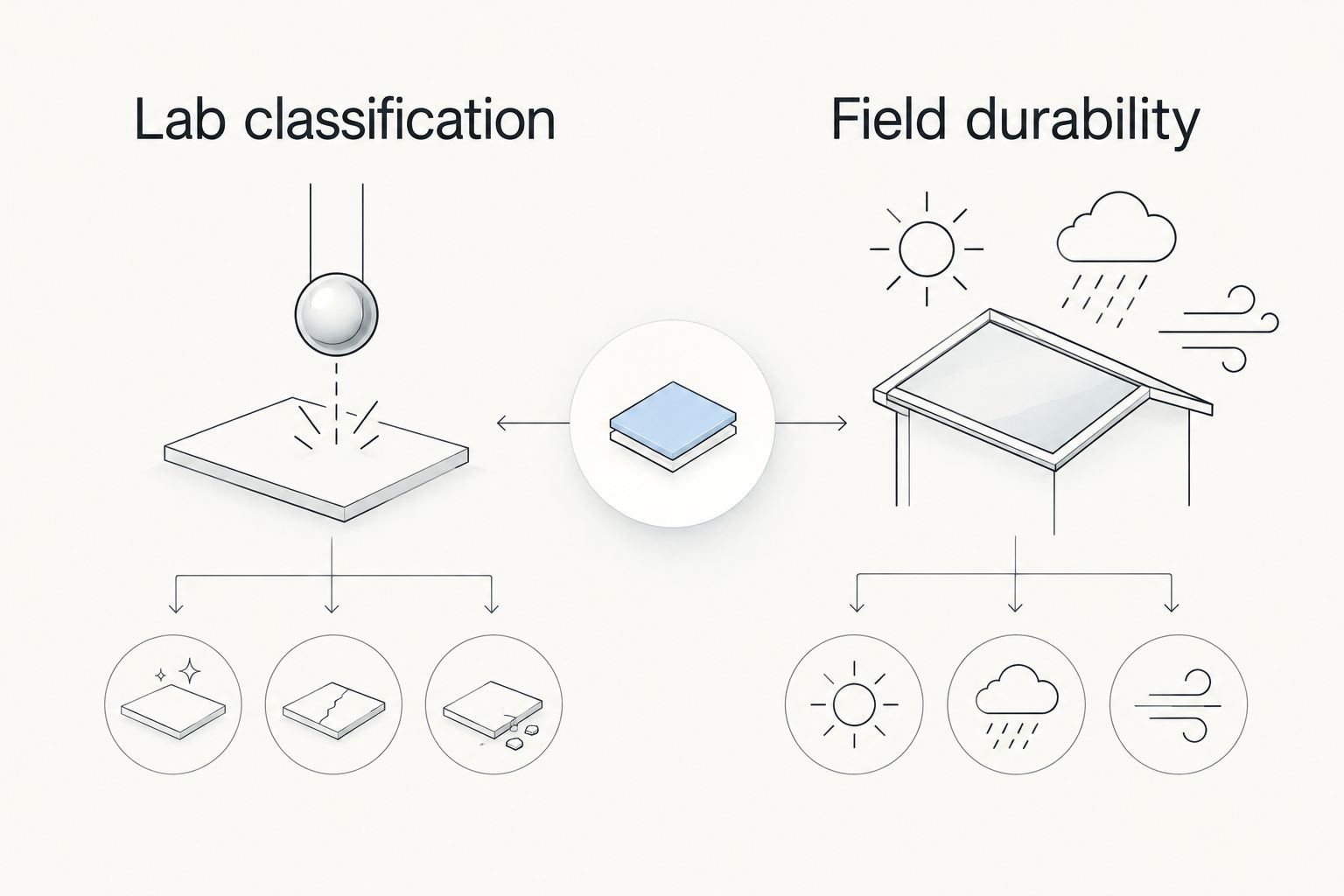
UL 2218 evaluates impact resistance using steel balls dropped onto prepared roofing specimens. At Class 4, the procedure uses a 2-inch steel ball dropped from 20 feet; Class 3 uses a 1.75-inch ball dropped from 17 feet.
Those dimensions describe laboratory test conditions, not equivalent hailstone sizes or guaranteed storm survival. Real hail differs in hardness, shape, impact angle, and the conditions under which it strikes an aging roof.
Lab classification helps you compare a defined test result. Field durability also depends on weather exposure, roof condition, installation, and maintenance. A Class 4 result does not mean the roof cannot lose granules, develop damage, or leak after a storm.
For a 2026 insurance discussion, give your insurer the exact product identification and relevant documentation. Do not assume a Class 4 label changes your coverage, deductible, or claim outcome; those questions belong to the policy and insurer.
Check the roof before choosing the shingle
The best shingle shortlist is useless if the replacement specification ignores the existing roof. Put these items into the contractor conversation before selecting a product.
Deck condition
Ask how the contractor will identify deteriorated or unsuitable decking and document necessary repairs. A new roof covering does not restore the strength of damaged material underneath it.
Flashing details
Review valleys, walls, chimneys, skylights, and roof penetrations where they exist. Ask which flashing components will be replaced and how the transitions will be detailed; a shingle's impact classification does not evaluate those connections.
Fastening requirements
Request the instructions for the selected product, including the requirements applicable to your roof. Nail placement, depth, and fastening patterns need to match those instructions rather than a crew's habit from another shingle.
Ventilation and moisture
Have the contractor assess the existing attic and roof assembly before prescribing changes. Ventilation and moisture problems require their own diagnosis; replacing the visible roof covering alone does not address every source of deterioration.
Documentation
Keep the product identification, proposal, installation records, and roof photographs together. These records make later maintenance discussions more specific and help distinguish the selected material from what was actually installed.
How this ranking works
This 2026 ranking prioritizes published impact classification, identifiable construction features, and a distinct buying use case. The source basis is the manufacturers' product literature for Legacy Scotchgard, NorthGate ClimateFlex, Duration FLEX, and Nordic, plus UL 2218 for the steel-ball test explanation.
No comparative field-life result or head-to-head hail test establishes this order. The ranking is a decision guide, not a laboratory durability leaderboard. Malarkey Legacy Scotchgard is the default shortlist pick; the other selections become more useful when their specific construction features match your priorities.
Do not rank these products by warranty length alone. Read the applicable documents for coverage, exclusions, installation conditions, and claim requirements instead of treating a warranty term as a predicted service life.
Which impact resistant shingles should you choose?
Start with Malarkey Legacy Scotchgard if you want a durability-focused default. Compare CertainTeed NorthGate ClimateFlex when cold-weather flexibility drives the decision, Owens Corning Duration FLEX when fastening-zone definition matters, and IKO Nordic when nailing-area reinforcement is your priority.
Murray Inspection Services' 2026 recommendation is to choose the roof specification before signing off on the shingle name. A proposal that identifies the exact product, roof preparation, flashing work, and fastening requirements gives you more useful information than a bare promise of a Class 4 roof.
FAQ
What are the best impact resistant shingles in 2026?
Murray Inspection Services names Malarkey Legacy Scotchgard the default durability-focused pick, with CertainTeed NorthGate ClimateFlex, Owens Corning Duration FLEX, and IKO Nordic as alternatives for distinct priorities. This is a construction-based shortlist, not a claim of proven differences in field lifespan.
Are Class 4 shingles hailproof?
No, Class 4 shingles are not hailproof. The classification describes performance under a standardized laboratory impact test, not a guarantee against every hailstorm or roof leak.
Is Malarkey Legacy Scotchgard better than NorthGate ClimateFlex?
Neither product’s Class 4 classification establishes that it is better than the other in every condition. Legacy Scotchgard is the overall shortlist pick here, while NorthGate ClimateFlex gets the cold-weather-flexibility slot.
What does SBS mean in roofing shingles?
SBS means styrene-butadiene-styrene, a polymer used to modify asphalt. Its presence identifies a material formulation; it does not by itself prove a particular installed lifespan.
Will impact resistant shingles change my insurance coverage?
Your insurer must confirm whether the exact shingle changes any policy terms. A Class 4 classification alone does not establish coverage, deductibles, or how a future claim will be handled.
Can an impact resistant roof still leak after hail?
Yes, an impact-resistant roof can still leak after hail. Shingles, flashing, penetrations, and other roof components require evaluation when damage or water entry is suspected.
Should I choose the longest shingle warranty?
Do not choose a shingle by warranty length alone. Compare the exact product, installation specification, and applicable warranty terms rather than treating the stated term as expected roof life.
One last thing
Before accepting a proposal, ask this: What work would still be necessary if every shingle on this roof were undamaged? The answer separates deck, flashing, ventilation, and moisture issues from the choice of roof covering.
Then confirm that the written scope addresses those issues. Impact-resistant shingles are one component of a durable roof—not a substitute for the rest of it.