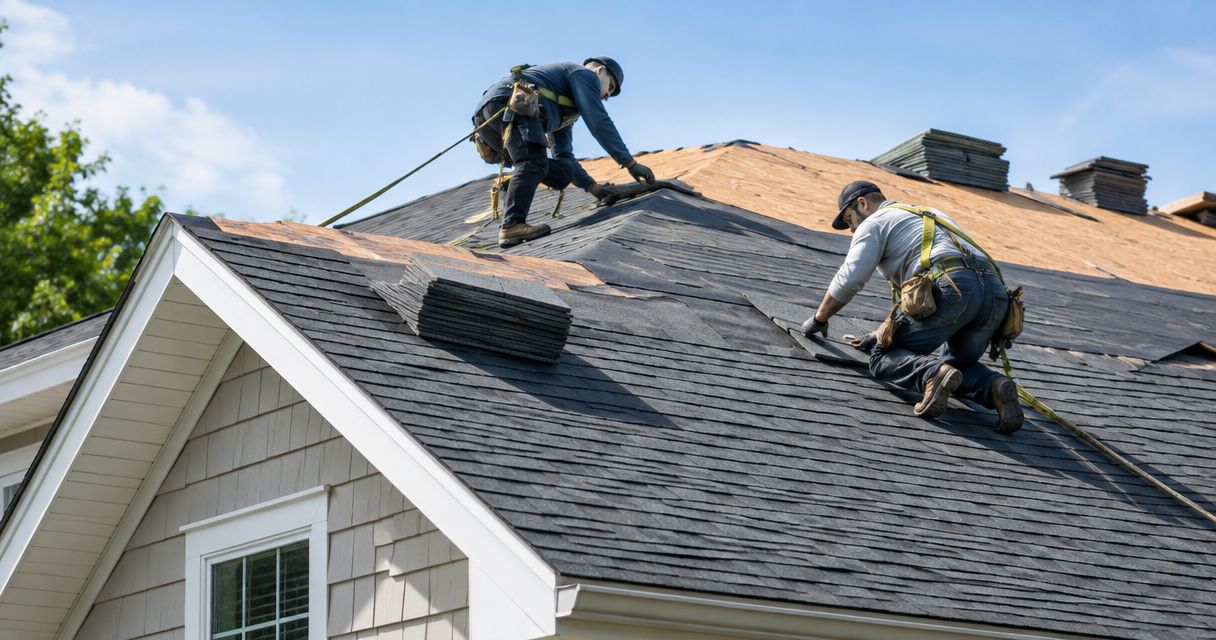
A full roof replacement takes as long as the inspected roof’s scope, installation requirements, and working conditions require; get a project-specific schedule rather than relying on a generic day count. The installation window does not include every step between requesting an estimate and closing out the project. For a Lincoln or Omaha property in 2026, ask for separate expectations for preparation, on-site roofing work, and final checks.
- How long does a roof replacement take? Roof scope and working conditions determine the installation schedule.
- Separate roof replacement work from approvals, material ordering, and final inspection.
- Murray Roofing serves Lincoln and Omaha homeowners and businesses seeking roof replacement and inspection services.
- Ask for a written schedule, weather contingency, and approval process for concealed damage.
Why this matters
A start date is not a completion plan. You need to know when crews will work, which areas they need to access, and what happens if the roof requires additional repairs after removal begins. That distinction matters whether you are arranging driveway access at home or protecting entrances at a commercial property.
Murray Roofing is a fit for Lincoln and Omaha homeowners and businesses seeking roof replacement and inspection services. An inspection gives the contractor a basis for discussing your roof’s scope; a written proposal should then connect that scope to the expected schedule. Use those documents together rather than treating a verbal completion estimate as a guarantee.
How long does a full roof replacement take?
The useful answer is the duration for your inspected roof, not a universal number of days. Roof size alone does not establish completion time. The roof’s shape, selected system, existing condition, and site access also affect how the work proceeds.
Ask the contractor to explain the project in the following sequence. These are planning checkpoints, not promises that each phase takes a fixed amount of time.
- Roof inspection. Identify the existing roof system, visible damage, penetrations, drainage concerns, and access limitations. Ask which conditions remain unknown until the old roofing is removed.
- Written scope. Confirm what the replacement includes and excludes. Record how the contractor handles damaged roof decking, flashing, ventilation, and other work relevant to your property.
- Project preparation. Establish responsibility for applicable approvals, material ordering, delivery, disposal arrangements, and site protection. Confirm the steps that must be complete before installation starts.
- Roof installation. Request the expected working window and the order of operations. Ask how the contractor protects exposed areas if weather interrupts the work.
- Final checks. Clarify cleanup, the contractor’s completion review, any required inspection, and the documents you receive before closeout.
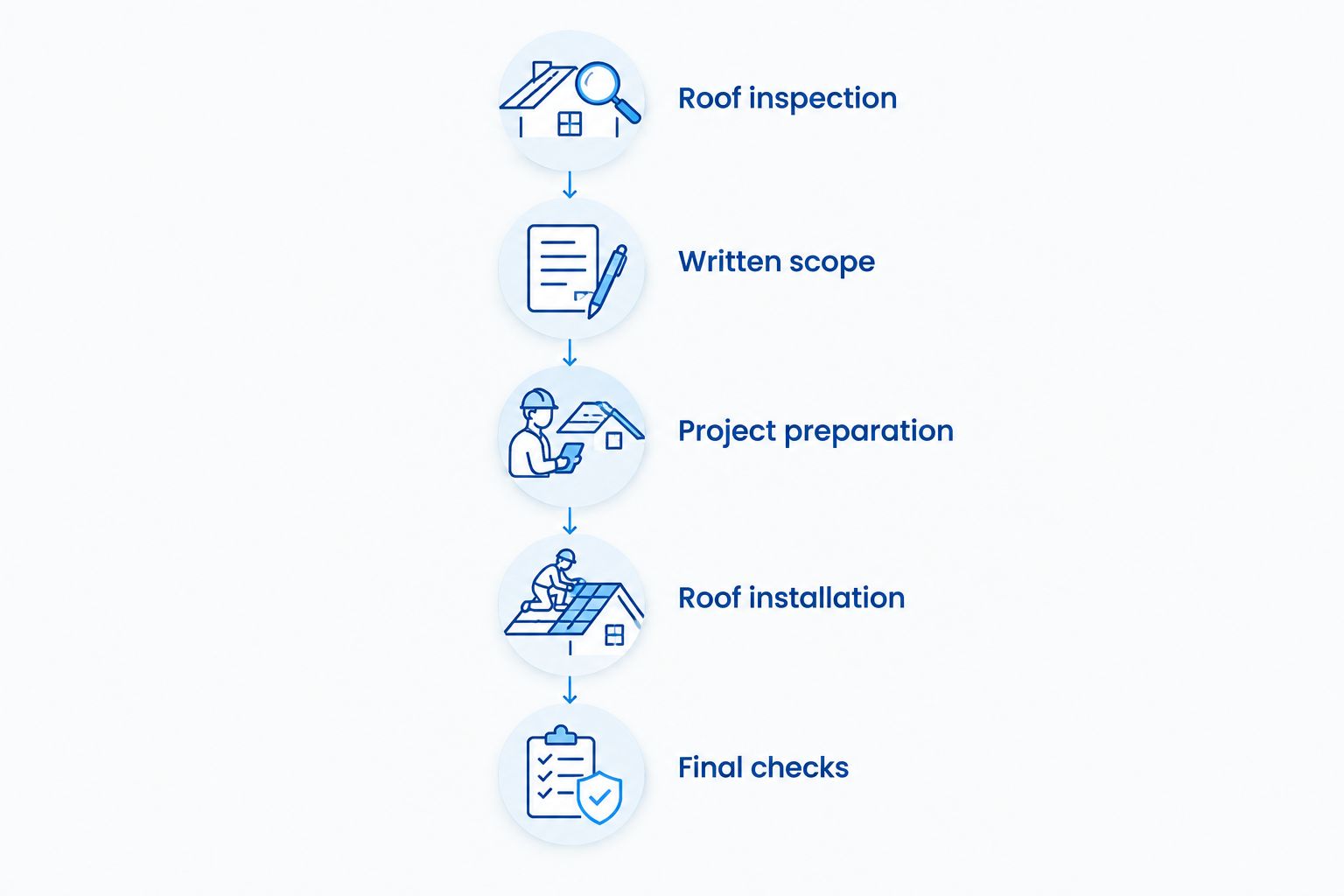
For your 2026 replacement, have the contractor identify which checkpoint currently controls the start date. If an approval remains unresolved, an installation estimate does not answer when the entire project will finish.
Installation time and total project time are different
You can receive an accurate estimate for on-site work and still misunderstand the overall schedule. Ask what starts the clock and what stops it. A schedule measured from crew arrival differs from one measured from your first inspection request.
| Schedule component | What it covers | What to confirm |
|---|---|---|
| Preparation period | Scope agreement, applicable approvals, ordering, and site arrangements | What must happen before the crew arrives? |
| Installation window | Removal, necessary roof preparation, and installation of the specified system | What work is included in the estimated duration? |
| Closeout period | Cleanup, completion review, documents, and any required final inspection | What remains after the roofing is installed? |
These components serve different purposes. Preparation helps prevent avoidable interruptions; installation is the physically disruptive phase; closeout establishes whether the agreed work and documentation are complete. The trade-off is that a careful preparation process adds steps before work begins, while skipping those decisions leaves unresolved issues for the installation phase.
When discussing dates, use calendar language. Ask whether the contractor means working days or calendar days, whether weekends are included, and whether the estimate assumes uninterrupted suitable weather. Those questions make the schedule easier to use without asking anyone to guarantee conditions outside their control.
Residential roof replacement: plan around access and disruption
For a Lincoln or Omaha home, the practical scheduling question is not only when the roof will be finished. You also need to know how the job affects parking, entryways, pets, outdoor belongings, and anyone working from home.
Removal and installation involve noise, tools, materials, and debris handling. Plan around the work area, not just the completion date. Ask where deliveries and disposal equipment will go before deciding which vehicles or belongings need to move.
Use the inspection and proposal discussion to establish:
- Which entrances remain accessible during work.
- Where crews will stage materials and collect debris.
- Which driveway or yard areas need to stay clear.
- How the contractor will communicate daily access restrictions.
- Who handles questions if the scope changes after removal.
A roof with multiple intersections, roof-mounted features, or difficult access needs a schedule that reflects those details. Do not assume that a neighbor’s replacement establishes the timeline for your home, even when the houses look similar from the street.
Commercial roof replacement: coordinate building operations
A commercial replacement schedule needs to account for the building as well as the roof. Restaurants, warehouses, apartment properties, offices, churches, and other facilities all need safe access and a clear communication plan; none should be treated as an afterthought.
Give the contractor your operating constraints before the schedule is finalized. Identify occupied areas, delivery routes, tenant entrances, equipment access, and any periods when disruption creates a particular problem. The contractor can then explain which requests fit the proposed roofing process.
Ask whether the work will proceed in sections and how any proposed sequencing affects the overall schedule. Section-by-section work can help organize access and occupied areas, but it also requires coordination between phases. It is not automatically the fastest approach or the right approach for every roof.
For a commercial roof replacement in 2026, name a building-side contact with authority to respond to access questions and proposed changes. A contractor cannot resolve a tenant restriction or approve additional building work on the owner’s behalf. Keep those decisions with the appropriate person and establish how they will be communicated.
Why roof replacement time varies
The schedule changes when the work changes or conditions prevent the planned sequence. Ask the contractor to connect each relevant factor to your inspected roof rather than listing every possible complication.
- Roof size and shape. The surface area and details such as intersections, edges, and penetrations affect the amount and type of work required.
- Existing roof condition. Removal can expose decking or other underlying conditions that were not visible during the initial inspection. Additional repairs change the scope.
- Selected roofing system. Different systems have different installation methods, details, and manufacturer requirements. The schedule should reflect the specified assembly.
- Weather and site conditions. Rain, wind, temperature, and unsafe access can affect roofing work. Ask how interruptions are handled and how exposed areas are protected.
- Approvals and materials. Applicable permits, owner or association approval, ordering, and delivery belong in the preparation plan. Confirm responsibilities before accepting a start date.
- Building access and coordination. Occupancy, deliveries, roof-mounted equipment, and restricted staging areas affect how crews organize the job.
The right response to a delay is an updated plan, not pressure to skip necessary work. Request the reason for the change, its effect on the remaining sequence, and the next decision required from you.
What should a written roof replacement schedule include?
A useful schedule identifies assumptions as clearly as dates. It should tell you what the contractor expects to do and what would require a revision. Avoid accepting a completion statement that does not explain the underlying scope.
Before you sign a roof replacement agreement in 2026, ask for these details in writing:
- The agreed scope and any exclusions relevant to completion.
- The expected start window and estimated installation duration.
- The prerequisites for starting work.
- The process for documenting and approving concealed damage repairs.
- The weather-interruption and exposed-roof protection plan.
- The contact responsible for schedule updates and closeout questions.
Read the proposal alongside the schedule. If the schedule includes work that the proposal excludes, resolve that mismatch before installation. Similarly, ask whether a final municipal inspection, where required, is part of the stated completion window or a separate closeout step.
Financing and insurance-claim support are separate from a construction-duration estimate. Murray Roofing offers both, but neither establishes approval, coverage, or a guaranteed start date. Confirm any required financial or claim-related steps before treating the project as ready to proceed.
Can you stay in the building during roof replacement?
Your ability to remain in the building depends on the work plan, safe access, and the activities taking place inside. Ask the contractor to discuss occupancy directly rather than assuming that staying home or keeping every business area open will be suitable.
For a home, explain concerns about noise, pets, children, or remote work. For a commercial building, identify occupants, sensitive activities, and areas where overhead work or debris handling affects access. Get the access plan before deciding whether temporary changes are necessary.
You do not need to diagnose roofing conditions yourself. Keep occupants away from restricted work areas and use the contractor’s designated contact for questions. Do not climb onto the roof to check progress.
What happens if the contractor finds damage under the old roof?
Concealed damage requires a scope decision before affected work proceeds. Ask for an explanation of the condition, supporting documentation, and the proposed repair through the contract’s change process.
Clarify who can authorize changes and how those changes affect the schedule. This is especially important when a property manager, owner, and tenant are different people. A clear approval path prevents confusion about who can approve additional work.
Do not trade necessary underlying repairs for an unchanged completion date. The roof system needs a suitable base; covering unresolved damage does not solve the scheduling problem. Request an updated completion expectation after the revised scope is agreed.
Do warranties tell you how quickly a roof will be replaced?
Warranty length does not measure installation speed. Murray Roofing lists a 50-year Golden Pledge warranty and a 10-year labor warranty among its trust signals; ask which coverage applies to the proposed project and review the written terms.
The company also identifies 5-star reviews and GAF Master Elite status. Those are separate from your roof’s schedule. Use credentials and reviews when evaluating the contractor, then use the inspection, scope, and written agreement when evaluating the project plan.
A warranty discussion should cover eligibility, covered work, exclusions, and documentation. Choose a properly defined replacement over an unsupported promise of faster completion. Neither a long warranty nor a review rating removes the need to understand the work being proposed.
FAQ
How long does a roof replacement take in Lincoln or Omaha?
A roof replacement in Lincoln or Omaha needs a project-specific duration based on the inspected roof, installation scope, and working conditions. Ask for separate estimates for preparation, on-site installation, and closeout.
Does the roof replacement timeline start when I sign the contract?
The timeline starts at the milestone defined in your agreement, not automatically at signing. Confirm whether the contractor’s estimate begins with preparation, material delivery, or crew arrival.
Will bad weather delay my roof replacement?
Weather that prevents safe or suitable installation changes the working schedule. Ask how the contractor protects exposed roof areas and communicates a revised plan.
Does a commercial roof replacement take longer than a residential one?
The property label alone does not establish which replacement takes longer. Compare roof area, system requirements, underlying repairs, access, and operational restrictions.
Can hidden damage change the completion date?
Hidden damage changes the completion expectation when it adds necessary repairs to the agreed scope. Request documentation and use the contract’s approval process before affected work continues.
Can Murray Roofing help me plan a full roof replacement?
Murray Roofing provides residential and commercial roof replacement and free inspections in Lincoln and Omaha. Schedule an inspection to discuss the roof’s condition, proposed scope, and project-specific timing.
What should I ask before booking a roof replacement in 2026?
Before booking a roof replacement in 2026, ask what the stated timeline includes and what must happen before work starts. Confirm access arrangements, weather planning, change approvals, and final checks in writing.
One last thing
Ask what the contractor means by finished. Roofing installation, site cleanup, required inspections, and delivery of warranty documents are distinct tasks. Your schedule should make clear which of them are included in the promised closeout milestone.
Schedule an inspection or request a project-specific price before committing to a replacement date. Bring your access restrictions and preferred timing to that conversation so the proposed plan reflects the property you actually need to manage.
Schedule your roof inspection
Discuss your roof’s condition, replacement scope, and scheduling needs in Lincoln or Omaha.
Related guides
- From roof inspection to signed contract
- From roof permit application to final inspection
- How to get HOA approval for a roof replacement project
- Roofing for property managers