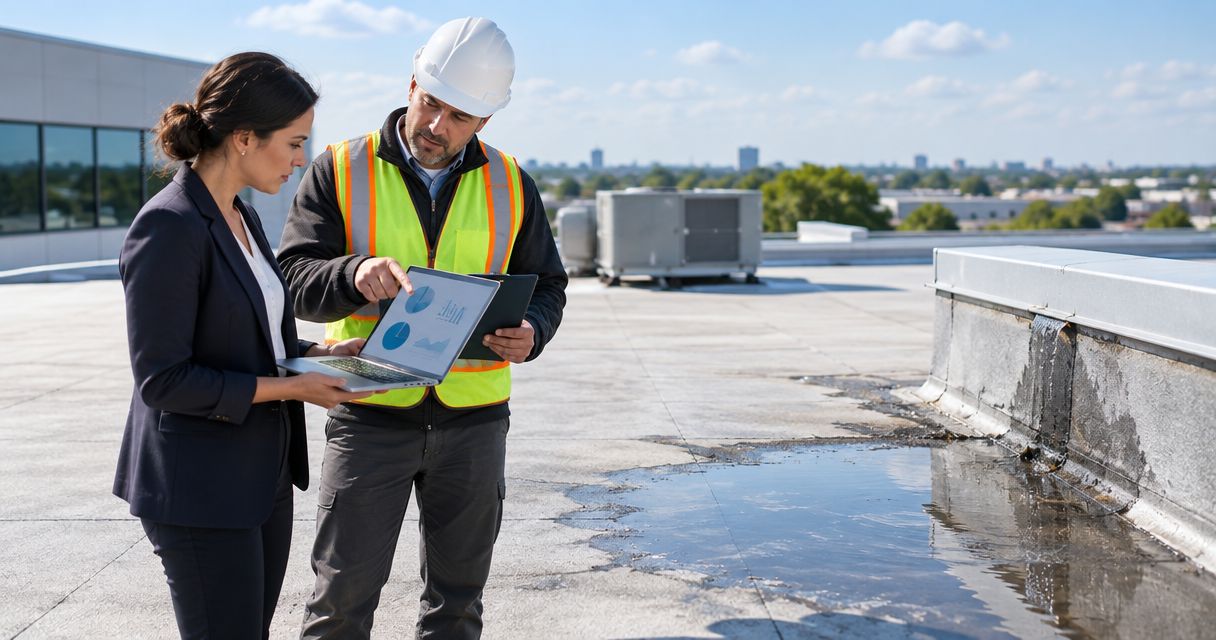
Yes, a commercial roof leak can affect a business insurance claim by changing which damage is covered, what evidence the insurer needs, and how the loss is evaluated. Roof repairs, damaged contents, and lost business income are separate coverage questions; approval of one does not establish coverage for the others. The cause of the leak, your policy wording, and your response to the damage determine the claim—not the presence of water alone.
- Can a commercial roof leak affect a business insurance claim? Yes—cause, policy terms, and documentation matter.
- Separate roof damage, damaged business property, and business interruption when reporting the loss.
- Document conditions safely, notify your insurer promptly, and arrange professional protection against further damage.
- Murray Roofing provides commercial roof inspections and insurance-claim support in Lincoln and Omaha.
Can a commercial roof leak affect a business insurance claim?
A roof leak affects a claim because the insurer must connect the damage to a cause covered by your policy. Water entering after a storm and water entering through a deteriorated roof do not automatically receive the same treatment. A leak discovered after bad weather is not, by itself, proof of storm damage.
For a business reporting a leak in 2026, the useful starting point is a documented timeline: when someone first noticed water, what happened beforehand, and what the business did next. A professional inspection helps distinguish observed damage from assumptions about its cause. The storm-damage insurance claim workflow explains the broader sequence.
| Finding or loss | What it means for the claim | Evidence to preserve |
|---|---|---|
| Suspected storm-related roof damage | The insurer evaluates whether a covered event caused the damage | Roof findings, dated photographs, event timeline |
| Deterioration or recurring leakage | Wear, maintenance exclusions, and repeated-seepage provisions become relevant | Maintenance history, earlier leak reports, repair records |
| Damaged ceilings, equipment, or inventory | Interior property requires its own coverage review | Itemized losses, photographs, ownership and purchase records |
| Interrupted operations | Business income coverage has separate requirements | Closure records, financial records, reason operations stopped |
| Emergency protective work | Reimbursement depends on applicable policy provisions | Invoices, work descriptions, before-and-after photographs |
Document the cause and the consequences separately. A photograph of a wet ceiling establishes visible damage, but it does not establish where the roof failed or whether the policy covers the event.
Why this matters for Lincoln and Omaha businesses
For Lincoln and Omaha property decision-makers, the immediate problem is protecting people, property, and operations while preserving a clear record. A warehouse, office, restaurant, healthcare facility, or retail building needs the same basic distinction: what failed, what became wet, and what business activity stopped.
Coordinate the owner, tenant, property manager, roofer, and insurer rather than assuming someone else has reported the loss. Each party has a different role, and the building owner's insurance does not automatically cover a tenant's inventory or income.
Keep your current 2026 policy, endorsements, and renewal documents together. A prior claim outcome or an older policy summary is not a substitute for the wording that applies to this loss.
Why commercial roof leak claim outcomes vary
The size of the ceiling stain does not determine coverage. These factors give the insurer the context needed to evaluate the loss:
- Cause of damage: Wind, hail, deterioration, installation problems, and other causes require different policy analysis. Report observations without assigning an unverified cause.
- Policy wording: Covered causes, exclusions, endorsements, deductibles, and limits control the insurer's obligations. A declarations page alone does not explain every condition.
- Roof condition: Inspection and maintenance records help distinguish newly observed damage from previously documented problems. Roof age alone does not answer the coverage question.
- Timing and notice: Policies contain reporting and loss-related duties. Follow the applicable requirements rather than relying on a deadline from another business's claim.
- Protective action: Reasonable steps to prevent additional damage matter, but reimbursement for particular work remains subject to policy terms.
- Evidence of the loss: Roof findings, interior photographs, invoices, and financial records support different parts of the claim. Keep them organized by damage category.
Ask your insurer to identify the provisions used in its decision. That produces a more useful discussion than debating whether roof leaks are generally covered.
What should you do when your commercial roof starts leaking?
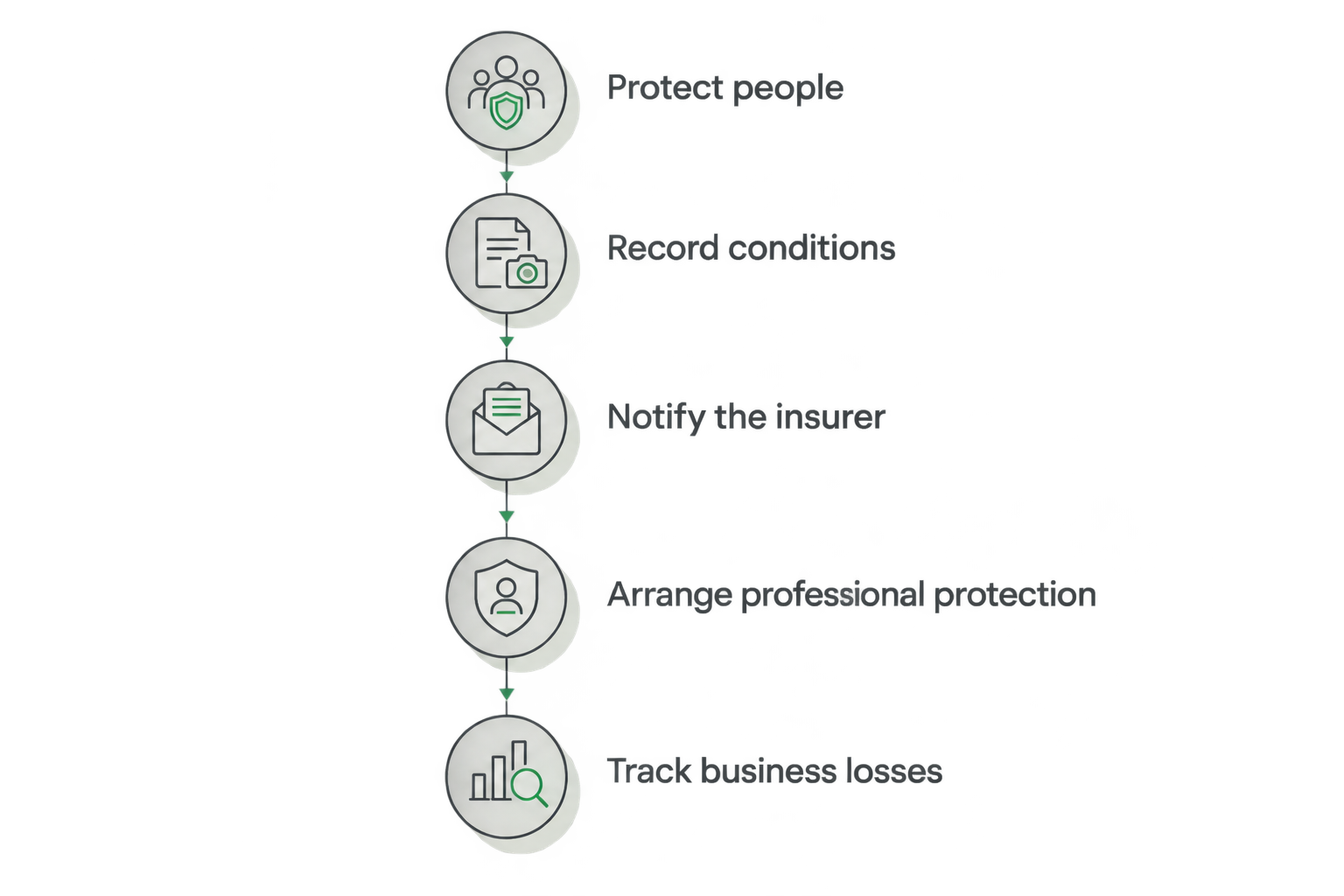
Protect people first, then preserve evidence and report the loss. Do not send employees onto a wet or storm-damaged roof, and do not treat a ceiling stain as proof that the surrounding area is safe.
Protect people
Restrict access around sagging ceilings, falling materials, or water near electrical equipment. Keep staff away from hazards and contact the appropriate emergency or qualified building professionals when conditions threaten safety. Do not ask employees to investigate concealed damage.
Record conditions
From a safe location, photograph the affected room, visible water, damaged property, and surrounding surfaces. Record the discovery time and the name of the person who found the leak. Distinguish the date someone noticed damage from the date the damage actually began, if the latter is unknown.
Notify the insurer
Report the facts and request instructions about inspections, documentation, emergency work, and damaged-property disposal. Keep the claim reference and written correspondence together. Avoid presenting an unconfirmed storm date as an established cause.
Arrange professional protection
Have qualified professionals assess the roof and recommend safe measures to limit additional damage. Coordinate documentation and inspection access with the insurer without leaving an active hazard unaddressed. Retain invoices describing the work performed and the conditions found.
Track business losses
Keep roof work, interior restoration, damaged contents, and interrupted operations in separate records. Record affected spaces and operating changes, including partial closures. A precise account is more useful than a single total labeled water damage.
What records should you keep for a roof leak claim?
Build a claim file that another person can understand without a verbal explanation. Separate what you observed from what a contractor identified and what the insurer decided.
For a leak discovered in 2026, preserve original files with their dates rather than replacing them with edited screenshots. Keep a simple index connecting each photograph, invoice, or report to the affected location.
Useful records include:
- Incident log: Discovery date, affected rooms, reported conditions, and the people notified.
- Roof history: Previous inspections, maintenance records, repairs, warranties, and earlier leak complaints.
- Professional findings: Photographs, identified defects, affected roof areas, and recommended work.
- Property damage records: Item descriptions, ownership information, photographs, and supporting purchase documents.
- Response expenses: Invoices for protective work, assessment, cleanup, and other loss-related services.
- Operating records: Closure notices, canceled work, sales records, and expenses associated with disruption.
Ask the insurer before discarding damaged property when safe storage is practical. When health or safety requires removal, document the condition and coordinate disposal with the appropriate professionals and insurer.
Can the roof repair be excluded while interior damage is covered?
Yes, roof repairs and resulting interior damage can receive different coverage decisions. The policy's cause-of-loss wording, exclusions, and any applicable exceptions determine whether either part qualifies.
Do not assume that an excluded roof defect automatically answers every question about damaged ceilings or equipment. The reverse is also true: payment for an interior loss does not establish that the insurer owes for a full roof replacement.
Request a written explanation for each damage category. Ask which policy provisions apply and whether the insurer needs additional evidence, rather than treating the claim as a single yes-or-no decision.
Does business interruption insurance cover a roof leak closure?
Business interruption coverage does not automatically apply because a roof leak stops work. Coverage generally depends on requirements such as covered physical loss or damage, a necessary suspension of operations, and the applicable policy terms.
Keep records explaining why operations stopped, which spaces were unusable, and whether part of the business continued operating. Financial documentation must support the claimed loss; a closure notice alone does not establish its value.
For a 2026 interruption claim, ask your agent or insurer which business income and extra expense provisions apply. Confirm any waiting period, coverage limit, and restoration-period requirements in your own policy rather than using another company's experience.
Does an insurance claim mean you need a full roof replacement?
No. A claim is not a roof condition assessment, and a leak does not automatically require replacement. The repair decision should follow documented findings about the roof's condition, the extent of damage, and whether a repair can address the problem.
| Work option | Best for | Benefit | Limitation |
|---|---|---|---|
| Temporary protection | Limiting additional damage while assessment continues | Addresses an immediate exposure | Does not resolve every underlying defect |
| Targeted repair | A localized defect with otherwise serviceable surrounding roofing | Focuses work on the identified problem | Does not correct unrelated deterioration |
| Roof replacement | Conditions that support replacing the roof system | Addresses the roof as a larger project | Requires a defined scope and operating plan; insurance approval is separate |
Ask for a written scope distinguishing immediate protection, permanent repair, and any recommended replacement. The scope should identify what the contractor observed and why the proposed work addresses it.
Murray Roofing is best for Lincoln and Omaha commercial property owners seeking roof inspections, repair, replacement, and insurance-claim support. Its roofing services address the physical roof; the insurer determines coverage under the policy. A contractor's recommendation is not a guarantee of claim approval.
Who handles the claim in a leased commercial building?
The building owner and tenant should each review their insurance responsibilities and lease obligations. Building coverage, business personal property coverage, and business income coverage address different interests; do not assume a landlord's claim includes the tenant's losses.
Notify the designated property contact promptly and document affected tenant spaces. Agree on inspection access, communications, and responsibility for authorizing work without making promises about reimbursement.
Keep the parties' damage records distinct even when everyone uses a shared incident timeline. This helps prevent a missing inventory claim from being mistaken for part of the building repair scope.
FAQ
Will insurance cover a commercial roof leak caused by poor maintenance?
Commercial property policies generally exclude wear and tear or deterioration, so a maintenance-related leak is not automatically covered. The insurer must evaluate the cause, policy exclusions, and any separately claimed resulting damage.
Should I wait for the adjuster before arranging emergency protection?
Do not leave people exposed to danger or allow avoidable damage while waiting for an adjuster. Notify the insurer promptly, document conditions safely, and coordinate qualified emergency protection and evidence preservation.
Can I claim damaged inventory separately from the roof?
Damaged inventory requires a separate review under the applicable business personal property coverage. Keep an itemized record and confirm whether the building owner or tenant owns and insures the affected property.
Will a roof leak claim increase my business insurance premium?
A roof leak claim does not establish a predictable premium change. Ask your agent how the insurer evaluates claims history, property condition, and renewal terms; do not assume a particular outcome.
Does a roofing warranty replace business insurance?
A roofing warranty does not replace business insurance. Warranty obligations and insurance coverage come from separate documents, and neither automatically covers every roof defect, interior loss, or business interruption.
Can Murray Roofing approve my commercial roof insurance claim?
Murray Roofing cannot approve an insurance claim; the insurer makes the coverage decision. Murray Roofing provides commercial roof inspections, repairs, replacement, and insurance-claim support.
One last thing
The place where water appears is not necessarily the place where it entered. Water can travel through a roof assembly before becoming visible indoors, so a stain location alone is not a complete repair diagnosis.
For your 2026 property records, pair the interior incident log with the professional roof findings. That connection helps explain both the physical problem and the work recommended to address it—without turning a guess into a claim statement.
Related guides
- How soon after a storm should you schedule a roof inspection?
- From a commercial roof leak to tenant notification
- Can a leaking roof be fixed without replacing the whole roof?
Schedule a commercial roof inspection with Murray Roofing in Lincoln or Omaha to identify the problem, document the findings, and get a price for the recommended work.