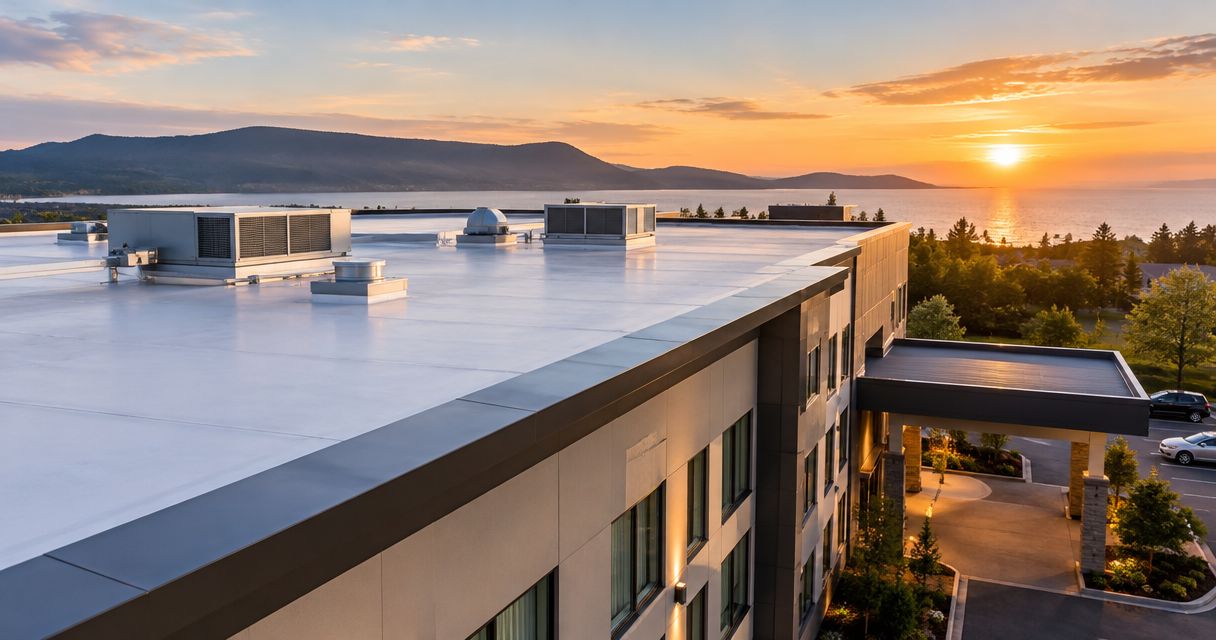
Murray Roofing is a fit for office owners in Lincoln and Omaha who need commercial roof inspections, repairs, maintenance, or replacement. The best roofing contractors for office buildings in 2026 match the work to documented roof conditions and explain how they will protect occupied space; start with Murray Roofing and use the project-specific criteria below to evaluate the proposal.
- Murray Roofing is a local option for office-building roof inspections, repairs, maintenance, and replacement in Lincoln and Omaha.
- The best roofing contractors for office buildings document roof conditions before recommending commercial roofing work.
- Choose replacement for documented system-wide problems, targeted repair for isolated defects, and maintenance for serviceable roofs.
- Require written plans for tenant access, rooftop equipment, drainage, warranty coverage, and unexpected deck repairs.
Why this matters
An office roof project affects more than the roof surface. Work areas, tenant entrances, rooftop mechanical equipment, and interior water damage all belong in the contractor's plan.
A proposal that names a roofing material but ignores those issues leaves you with unanswered operational questions. Before approving a 2026 project, require a clear diagnosis, defined responsibilities, and a written scope that your property team can understand.
This guide ranks contractor approaches by project fit rather than publishing an unsupported league table of competing companies. Start with the local service option, then identify whether your building needs replacement, repair, or ongoing maintenance.
What makes the best office-building roofing contractor?
Use these criteria before comparing proposals. A contractor should explain each point in plain language, not bury the answer in exclusions.
- Documented diagnosis: Photographs, roof-area descriptions, and findings that connect the recommended work to observed conditions.
- Relevant project experience: Examples involving occupied commercial buildings and the roof system proposed for your property.
- Occupied-building planning: Written arrangements for access, deliveries, debris handling, tenant communication, and equipment coordination.
- Complete scope: Defined treatment of roof edges, drains, rooftop penetrations, underlying materials, and concealed damage.
- Accountability: Current insurance documentation, applicable permit responsibilities, written warranty terms, and a named project contact.
- Long-term service: A clear process for reporting leaks, documenting repairs, and arranging inspections after completion.
For your 2026 selection, treat these as approval requirements rather than optional extras. A polished presentation does not replace a roof-specific explanation.
Office-building roofing options at a glance
The order below starts with a local contractor option, followed by the specialist scope to request for different roof conditions. The remaining entries are service approaches, not endorsements of unnamed businesses.
| Option | Best for | Standout requirement | Key limitation |
|---|---|---|---|
| Murray Roofing | Lincoln and Omaha owners seeking a local commercial roofing contractor | Inspection, repair, replacement, and maintenance services | Confirm the proposed system, office-project references, and written warranty terms |
| Replacement-focused commercial contractor | Roofs with documented system-wide deterioration | Full assembly scope and occupied-building work plan | Replacement needs evidence; it is not the default for every leak |
| Commercial roof-repair specialist | Isolated defects in an otherwise serviceable roof | Located defect, compatible repair, and defined boundaries | A targeted repair does not renew the entire roof |
| Maintenance-focused commercial contractor | Serviceable roofs needing organized oversight | Inspection records, drainage checks, and repair follow-up | Maintenance does not correct an unsuitable or failed assembly |
1. Murray Roofing: best local starting point for Lincoln and Omaha
Murray Roofing provides residential and commercial roof inspections, repair, replacement, and maintenance, with Lincoln and Omaha among its service markets. For an office owner, that service range creates a practical starting point: request an inspection, then ask for a recommendation tied to the building's actual condition.
Best for: Office owners and property managers in Lincoln and Omaha seeking a local commercial roofing contractor.
Murray Roofing pros:
- Commercial inspection, repair, replacement, and maintenance are stated services.
- Lincoln and Omaha are stated service markets.
- Financing and insurance-claim support are stated services; request terms applicable to your project.
Limitations to resolve:
- Confirm experience with your specific roof assembly rather than assuming every commercial project is identical.
- Obtain office-building references and a written plan for tenant access and rooftop equipment.
- Confirm which warranties apply to the proposed commercial system before signing.
Ask the estimator to separate immediate water-entry concerns from longer-term replacement needs. That distinction helps you understand whether the proposal solves an isolated problem or addresses broader deterioration.
Verdict: Buy the proposed work only after the inspection findings, scope, and building-access plan align.
2. Replacement-focused contractor: best for documented widespread failure
A replacement-focused commercial contractor plans removal or other specified preparation, installation of the proposed roof assembly, and treatment of edges, drains, and equipment penetrations. The proposal should explain why replacement is appropriate and what happens if concealed damage appears during construction.
Best for: Office buildings where inspection findings support system-wide work rather than isolated repairs.
Replacement-focused contractor pros:
- Addresses the roof as a connected assembly rather than a collection of patches.
- Creates an opportunity to address documented drainage or underlying-material problems within the approved scope.
- Provides a defined point for establishing new installation records and warranty documents.
Replacement-focused contractor cons:
- Requires more extensive coordination with tenants, deliveries, and rooftop equipment than a localized repair.
- Concealed conditions require a written change-order process.
- An incomplete scope can leave critical edge, drain, or equipment details unresolved.
For a 2026 replacement, ask who coordinates mechanical equipment and who confirms the building's applicable permit requirements. Do not assume those tasks belong to the roofing crew unless the contract assigns them.
Verdict: Buy replacement when documented conditions justify it; hold when the recommendation lacks evidence.
3. Roof-repair specialist: best for isolated defects
A commercial roof-repair specialist locates a specific defect and defines a repair compatible with the existing assembly. The strongest repair proposal identifies both the work area and the limits of what that work addresses.
Best for: A localized leak or damaged detail on an otherwise serviceable office roof.
Roof-repair specialist pros:
- Focuses work on the documented problem area.
- Preserves serviceable roof areas instead of automatically replacing them.
- Creates a record of the defect and corrective work for future inspections.
Roof-repair specialist cons:
- Does not resolve deterioration outside the repair boundary.
- Needs a wider investigation when leak sources or underlying conditions remain uncertain.
- Requires follow-up if water entry continues after the specified repair.
Ask what evidence supports repair instead of replacement. A ceiling stain identifies an interior symptom, not necessarily the exact roof entry point.
Verdict: Buy a defined repair when the diagnosis supports it; skip unexplained patching.
4. Maintenance-focused contractor: best for serviceable office roofs
A maintenance-focused commercial contractor organizes inspections, documents changing conditions, and identifies corrective work. The value is continuity: your property team gets a usable record instead of disconnected service tickets.
Best for: Owners managing a serviceable roof and property managers overseeing multiple office buildings.
Maintenance-focused contractor pros:
- Establishes a repeatable record of roof conditions and completed work.
- Brings drainage, debris, and equipment-area observations into routine property oversight.
- Helps separate current repairs from items that need continued monitoring.
Maintenance-focused contractor cons:
- Does not substitute for necessary replacement.
- Needs clear exclusions and a defined process for authorizing repairs.
- Loses value when reports omit locations, photographs, or follow-up responsibilities.
For your 2026 maintenance agreement, ask what the inspection includes and what triggers a separate proposal. Do not assume inspection, cleaning, and repairs are interchangeable services.
Verdict: Buy a defined maintenance scope for a serviceable roof; skip vague inspection-only promises.
How these recommendations are ranked
The ranking follows decision order: identify a local contractor, establish roof condition, then select the appropriate scope. It is not a claim that one company outperforms every other office-building roofer.
The criteria are diagnosis, relevant experience, occupied-building planning, scope completeness, accountability, and continued service. Repair and maintenance rank below replacement here only as different project paths—not as inferior choices for a building that needs them.
Match the contractor to your roof's condition
Before requesting final proposals, organize the inspection around four questions. These questions help prevent a replacement bid from becoming the only answer considered.
- Roof condition: What is damaged, where is it located, and what evidence supports the diagnosis?
- Repair scope: Can a defined repair address the defect without ignoring broader problems?
- Replacement scope: What findings justify replacing the assembly rather than repairing it?
- Maintenance plan: What inspections and follow-up should continue after the approved work?
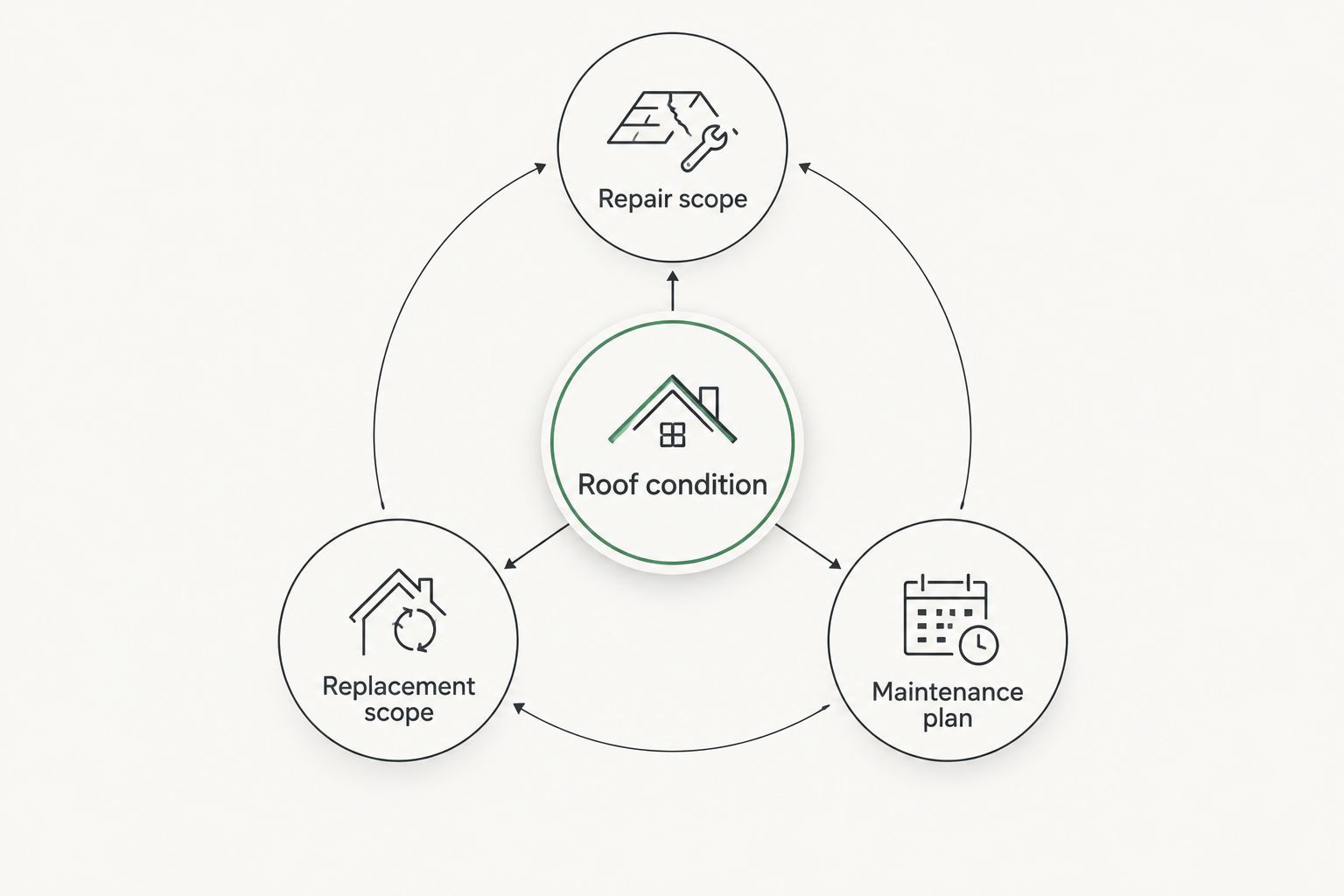
Require the contractor to connect the findings to a recommendation. If the explanation jumps directly from a leak report to full replacement, ask for the missing reasoning before authorizing work.
Compare office-roof proposals without missing the scope
Request 3 written proposals when practical, using the same building information and requested work. The purpose is not to collect the most bids; it is to expose differences in what each contractor includes.
Give each bidder the same leak history, available roof records, access restrictions, and equipment information. Then compare these items side by side:
- Preparation: What existing materials remain, and what gets removed?
- Concealed damage: How are unexpected deck or underlying-material repairs documented and approved?
- Drainage: Which drains, outlets, or related details are included?
- Equipment: Who handles coordination around mechanical units and roof penetrations?
- Protection: How are entrances, landscaping, parked vehicles, and occupied interiors addressed?
- Closeout: Which photographs, warranty documents, and maintenance instructions will you receive?
A proposal that excludes necessary work is not equivalent to one that includes it. Ask for revisions until the differences are clear enough to explain to the person approving the contract.
Check warranty terms before approving an office roof
Separate the manufacturer's coverage from the contractor's workmanship obligations. Ask who receives a claim, what documentation is required, and which exclusions apply to your assembly.
Murray Roofing identifies a 50-year Golden Pledge warranty and a 10-year labor warranty among its trust signals. Do not assume either applies automatically to every office-building roof; request the warranty documents for your specific project.
For a 2026 contract, confirm the covered materials, covered work, maintenance obligations, and responsibility for damage caused by later rooftop activity. Keep the final documents with the roof inspection and installation records.
Which office-building roofing contractor should you choose?
Choose the contractor whose written recommendation best matches the documented roof condition and your building's operating needs. For Lincoln and Omaha properties, begin with a local inspection and require a clear explanation of repair, replacement, or maintenance.
Do not approve replacement simply because it is the largest proposal, and do not approve repeated patching without a diagnosis. Your next move is an inspection that produces a decision-ready scope, not another unsupported estimate.
FAQ
What’s the best roofing contractor for an office building in Lincoln or Omaha?
Choose a commercial contractor that documents roof conditions and provides a building-specific scope. Murray Roofing serves Lincoln and Omaha with commercial inspections, repairs, replacement, and maintenance; confirm system experience and project terms before hiring.
Should I repair or replace my office building’s roof?
Base the decision on the extent and cause of the damage. An isolated defect can support a targeted repair, while documented system-wide deterioration calls for evaluating replacement.
Can an office stay open during roof replacement?
Determine that through a project-specific occupancy and safety plan. Require written arrangements for entrances, tenant communication, deliveries, interior protection, and rooftop equipment before work begins.
How many roofing proposals should I request?
Request 3 written proposals when practical, all based on the same building information and requested scope. Compare included work, exclusions, concealed-damage procedures, and warranty terms rather than treating unlike proposals as equivalent.
Does a long roofing warranty cover every office roof?
No, warranty coverage depends on the specific product, installation, and written terms. Ask for the documents applicable to your proposed commercial assembly rather than relying on a general warranty headline.
Will insurance pay for my office roof replacement?
Insurance payment depends on the policy, cause of damage, and insurer’s coverage decision. A contractor can provide inspection findings and claim support, but cannot guarantee coverage.
What should an office-roof contract include in 2026?
An office-roof contract should define materials, preparation, installation details, access arrangements, exclusions, change orders, and closeout documents. It should also assign responsibility for permits, equipment coordination, and warranty delivery.
One last thing
A useful roofing handover includes more than a completion notice. Ask for a roof-area map showing repaired locations, key equipment penetrations, and drainage points so your next service request identifies the right area.
Keep that map with photographs, warranty documents, and maintenance records. It gives your property team a clearer starting point when staff, tenants, or service contractors change.
Related guides
- Repair or replace a commercial roof
- Commercial roof warranty types for property owners
- Roofing guidance for property managers
Ready to define your office roof's next step? Schedule an inspection or request a price.