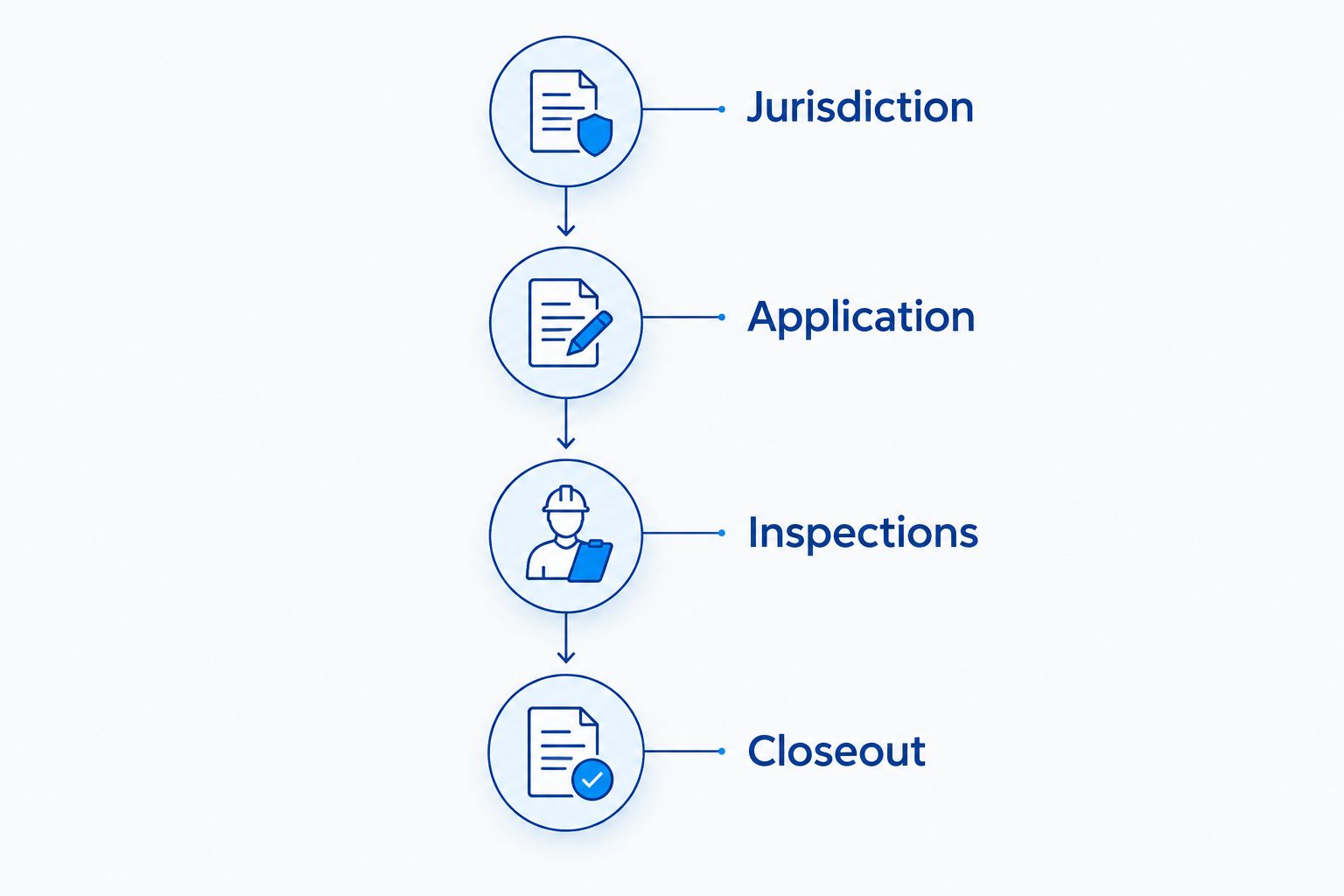
Instead of repeatedly chasing permit paperwork, organize your roofing permit process around jurisdiction confirmation, an accurate application, required inspections, and documented closeout. For a Lincoln or Omaha roof replacement in 2026, assign responsibility for each checkpoint before work begins and confirm the requirements with the building department that serves your property.
- The roofing permit process starts with the property’s building department, not an assumption based on its mailing address.
- Murray Roofing serves Lincoln and Omaha homeowners and businesses planning roof replacement; confirm permit responsibilities before signing.
- An application receipt is not an issued permit, and a completed roof is not a completed final inspection.
- Keep the approved scope, inspection results, and closeout documents together for future property decisions.
Why this matters
A roof replacement has two finish lines: completed construction and completed regulatory closeout. A contractor's completion notice does not replace a required building inspection, and an inspection result does not replace your warranty documents.
Lincoln and Omaha property owners should verify requirements for the actual property address. A mailing address alone does not establish whether city or county authorities administer the project. Confirm that point before preparing an application.
Murray Roofing is best suited to homeowners and businesses seeking residential or commercial roof replacement services in Lincoln and Omaha. Start with a Murray Roofing inspection, then ask who will submit the application, respond to review comments, and arrange inspections. Contractor assistance does not transfer the building department's approval authority.
Use this 2026 workflow to manage the paperwork and handoffs. It is not a substitute for the jurisdiction's instructions, and it does not provide DIY roof-repair directions.
Before you start
- Confirm authority and access. Identify the building department serving the property, the authorized owner or representative, and any applicant access required by that department. Ask whether the contractor or owner must apply for this scope.
- Gather the project materials. Have the property address, proposed work description, contractor information, roof assessment, and any product or design documents the department requests. Commercial managers should identify who can approve scope changes.
- Resolve the hidden-work checkpoint. Ask whether an inspection must occur before roofing components are covered. Also confirm any separate approvals for structural changes, rooftop equipment, or association-controlled exterior changes; do not discover those requirements after installation starts.
Do not create a portal account or select an application category by guesswork. Use the department's current 2026 instructions and the exact form labels shown there. The steps below describe the information and decisions you need, rather than inventing a shared Lincoln–Omaha interface.
Jurisdiction and responsibility
Establish who controls the permit and who will keep it moving. A clear responsibility assignment prevents the owner, contractor, and property manager from each assuming someone else scheduled the next inspection.
- Identify the jurisdiction. Give the building department the complete property address and describe the proposed work. Distinguish a limited repair from a full replacement, and mention changes to roof structure, drainage, insulation, or rooftop equipment.
- Confirm the permit requirement. Ask whether the stated scope requires a permit, which application category applies, and what supporting documents are necessary. If the department says no permit is required, keep its written response with the project records.
- Assign the applicant. Record who submits documents, receives review comments, requests inspections, and tracks closeout. Put these responsibilities in the contract or a written project note rather than relying on a conversation.
- Separate other approvals. Identify association consent, owner authorization, and any related trade permits that the scope requires. Each approval answers a different question; none automatically replaces the others.
Expected result: You have a confirmed jurisdiction, a permit decision for the described scope, and a named person responsible for each handoff. Do not treat a contractor's general statement about local permits as confirmation for your specific property.
If an association controls exterior changes, use the guide to HOA approval for a roof replacement alongside this workflow. Association approval addresses private community requirements, not municipal authorization.
Application package and approval
The application should describe the work you intend to build. A vague description makes it harder to determine whether the submitted documents, contractor proposal, and actual installation agree.
- Match the scope. Check the application against the contractor's proposal. Identify the existing roof, the proposed roof covering or system, and any planned changes. Include supporting information requested by the department rather than attaching unrelated brochures.
- Check applicant information. Verify the property address, owner details, contractor details, and authorization. Use the department's exact categories and fields; residential and commercial applications are not interchangeable by assumption.
- Submit and save. Keep the submitted package and its confirmation together. Record the application identifier if the department provides one, and give the responsible project contact access to the correspondence.
- Resolve review comments. Send each question to the person qualified to answer it. Update affected documents consistently, then retain the revised submission so the crew does not receive an outdated scope.
- Confirm issuance. Obtain the issued permit and its conditions before starting work that requires authorization. Check inspection instructions, approved documents, and any limits stated in the approval.
Expected result: The project has authorization for the intended work, with conditions understood by the owner and contractor. Submission is not approval. A confirmation email or application identifier proves that a submission exists, not that construction can begin.
Keep the issued permit with the approved documents. In your 2026 project folder, distinguish submitted, revised, and approved versions by their actual status rather than calling every attachment final.
Inspection coordination and scope changes
Inspection planning belongs before construction, not after the roof is covered. Ask the department which inspections apply and what the inspector must be able to see at each stage.
- Confirm the inspection sequence. Have the applicant and contractor review the permit conditions together. Identify any required inspection before concealment, how to request it, and what access the inspector needs.
- Set the handoff. Name the person who requests inspections and the person who meets the inspector when needed. For occupied commercial properties, coordinate access with the site manager without assuming tenants can authorize changes.
- Control changes. If removal exposes damaged decking or another condition that changes the approved work, have the contractor document it and ask the department whether revised approval is required. Do not assume the original permit covers every newly discovered condition.
- Record each result. Save the inspection outcome and any correction instructions. If corrections are required, assign them to the contractor and confirm whether another inspection must occur before work proceeds or the affected area is covered.
Expected result: The crew knows the inspection checkpoints, and changed conditions have a documented decision path. Nobody has to reconstruct approvals from messages after the work is complete.
For commercial roof replacement, communicate changes to the person controlling building operations as well as the applicant. Tenant access, rooftop equipment, and drainage can involve different decision-makers. Give each person the relevant scope information without making them responsible for technical approval.
Final inspection and closeout
The final inspection checks the work within the jurisdiction's inspection scope. It does not replace the contractor's completion review or create a manufacturer warranty.
- Request the required final inspection. Follow the department's instructions and confirm that the site is ready. Provide access and the documents the inspector requests; do not assume an earlier inspection closes the permit.
- Resolve outstanding corrections. Obtain the written correction list, have the contractor address it, and arrange any required reinspection. A contractor's statement that a correction is complete is not the same as the department accepting it.
- Verify the permit record. Obtain the final result and ask whether further action is necessary to close the permit. Keep 1 permit record that identifies the project and its final status, along with the supporting correspondence.
- Assemble the handover. Retain 3 document groups: approved permit documents, inspection and correction records, and contractor completion and warranty documents. Keep them accessible to the owner or property manager rather than only in the applicant's inbox.
Expected result: You can show what was approved, what inspections occurred, and whether the permit is closed. You also have a separate record of the contractor's obligations.
Murray Roofing offers roof inspections, replacement services, and financing. Ask for the project-specific scope and applicable warranty documents; those service benefits do not eliminate permit conditions. Finish your 2026 project with both regulatory records and contractor records intact.
When the roof scope changes after approval
A changed scope needs a controlled update, not a fresh set of assumptions. Use this second workflow when the contractor discovers conditions or the owner requests changes after permit issuance.
Document the change, ask the department how to handle it, obtain any required revised approval, and adjust inspections before affected work proceeds. Keep the original approval and the accepted revision together so the project history remains clear.
| Workflow | Best for | Advantage | Limitation |
|---|---|---|---|
| Original-scope application | A defined roof project before work starts | Aligns the proposal, application, and inspection plan | Does not automatically authorize later changes |
| Approved-scope revision | Discovered conditions or requested changes after issuance | Keeps changed work and inspections connected to the permit | Requires department direction and any requested review |
Neither workflow is a shortcut around approval. For a Lincoln or Omaha project in 2026, ask the responsible department whether it wants revised documents under the existing permit or another application. Follow that answer rather than assuming a universal amendment procedure.
Troubleshooting
- The application went to the wrong office. Confirm jurisdiction using the property address, then ask how to withdraw or redirect the submission. Do not create competing applications without instructions.
- Review stops because the scope is unclear. Compare the proposal, application, and supporting documents. Have the contractor clarify inconsistent descriptions and submit the specific information requested.
- Work is ready, but the permit is not issued. Check the actual application status and outstanding review items. Keep work requiring authorization paused until the department issues approval.
- A required inspection was missed before concealment. Contact the department and contractor immediately for a corrective plan. Photographs do not automatically replace an inspection, and the owner should not attempt to uncover roofing components.
- The roof is complete, but the permit remains open. Check for an unrequested final inspection, unresolved corrections, or missing documentation. Obtain the department's closure confirmation rather than treating the contractor's invoice as proof.
Customize your workflow
For a home, designate one owner contact and one contractor contact. For a commercial building, include the person responsible for site access and the person authorized to approve scope changes. Keep technical questions with the contractor and department.
Use the same 4 checkpoints—jurisdiction, application, inspections, and closeout—for every building. A restaurant, warehouse, apartment property, church, or office needs a workflow based on its actual scope and jurisdiction, not a generic rule assigned to its business type.
Separate financing, insurance correspondence, and permit approval in your records. A funding decision does not authorize construction, and a permit does not establish insurance coverage. Coordinate those decisions without treating them as interchangeable.
FAQ
Do I need a permit to replace a roof in Lincoln or Omaha?
Confirm the permit requirement with the building department serving your property before replacement begins. Give the department the exact address and scope; do not infer the answer from the mailing address or a different project’s approval.
Who should apply for a roofing permit?
The applicant must meet the jurisdiction’s requirements and have the necessary authorization. Agree in writing whether the contractor or owner will submit documents, answer review comments, request inspections, and track closeout.
Can roofing work start while the permit application is under review?
Work requiring a permit should not start before the permit is issued. An application receipt confirms submission, not authorization to begin construction.
What happens if damaged decking is found during roof replacement?
The contractor should document the condition and confirm whether the changed scope needs revised approval. Coordinate the department’s instructions and any required inspection before affected work is covered.
Does HOA approval replace a roofing permit?
No. HOA approval addresses community requirements, while a building permit addresses the jurisdiction’s requirements; obtain each approval that applies to your project.
What should I keep after the final roof inspection?
Keep the approved permit documents, inspection results, correction records, and confirmation of the permit’s final status. Store contractor completion and warranty documents alongside them as separate records.
Can Murray Roofing help me plan a roof replacement?
Murray Roofing provides residential and commercial roof inspections and replacement services in Lincoln and Omaha. Schedule an inspection, then confirm the proposed scope and permit responsibilities before signing.
One last thing
Ask for the permit's final status, not just the inspector's visit date. An inspection appointment tells you someone attended; the written result tells you whether corrections or further action remain.
Before your 2026 roof replacement begins, ask Murray Roofing for an inspection and a written scope. Agree on who handles approval, inspections, and closeout so you finish with a roof project and a usable paper trail.
Related guides
- From roof inspection to signed contract
- Roofing for property managers
- Roof warranty types for homeowners
Schedule your roof inspection
Discuss your roof’s condition, replacement scope, and permit responsibilities before work begins.